Copilot's global model policy starts enforcing on September 1, and the default is on
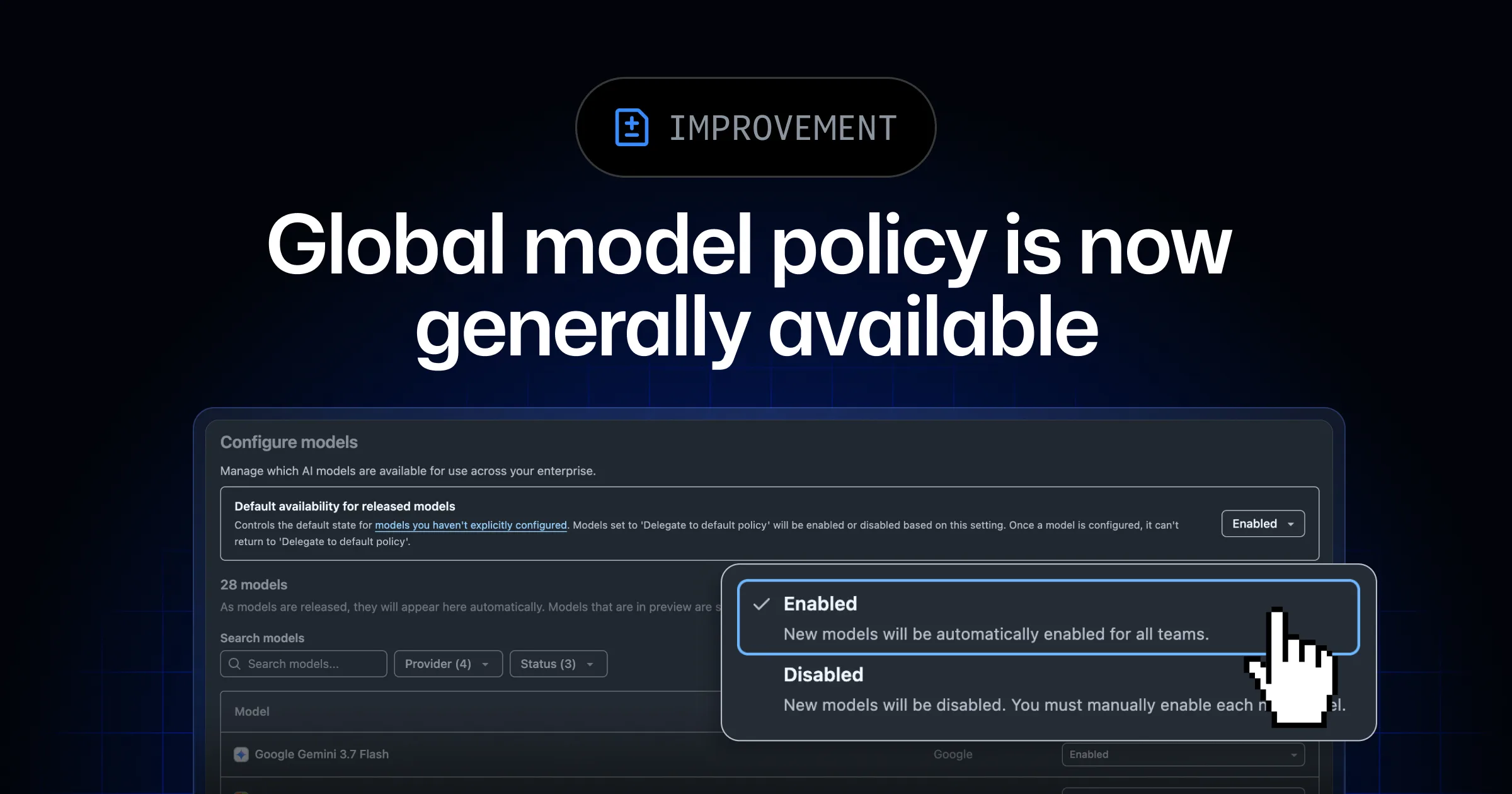
GitHub is rolling out enforcement of the default model policy for Copilot Business and Copilot Enterprise through September 1. Models an administrator never configured stop being unconfigured and start following the policy, and the policy ships enabled. Two categories are held back regardless of what you set: open-weight models, and models GitHub's data retention agreement does not cover. Anthropic's Fable 5 is in the second group.
Source
Global model policy generally availableGitHub Changelog: Copilot · Original published August 26, 2026
GitHub announced the default model policy for Copilot in July. On August 26 it said enforcement is now rolling out, gradually, through September 1, reaching different enterprises at different times. If you administer a Copilot Business or Copilot Enterprise plan, the change worth understanding before that date is what happens to the models you never made a decision about.
Unconfigured stops meaning unavailable
Previously unconfigured models, and new generally available models as they arrive, inherit the global policy state. In your settings they move to a state GitHub calls Delegate to default policy, and from then on they follow whatever the policy says. The policy is enabled by default, so in the ordinary case those models become available to your users.
That state is live rather than a one-time copy. Change the policy later and every model sitting in it follows the change. Explicit decisions are untouched: if an administrator has deliberately turned a specific model on or off, GitHub does not alter that setting.
After the rollout each model shows one of four states: explicitly on, explicitly off, delegating to an enterprise team or organization, or delegating to the default policy.
Two categories the policy cannot switch on
Open-weight models are excluded from default enablement regardless of your policy, and GitHub names DeepSeek and Kimi K2 as examples. So are models not covered by GitHub's data retention agreement, where the named example is Fable 5.
That second exclusion is the one to read carefully. Fable 5 is held back by a contract, not by a capability judgment. The roster your developers see is shaped in part by which agreements GitHub has in place, which is a different axis from which model is best at the work.
The state GitHub may remove
GitHub says it is evaluating making the global policy an explicit decision and removing the Delegate to default policy state entirely, so that every policy reflects an intentional choice rather than an inferred one. It has opened a community discussion for feedback on that.
If that lands, the convenience of a single switch that governs everything unconfigured goes away, and the administrative work moves forward rather than disappearing. Worth knowing now, while the model list is small enough to go through.
Related
OpenClaw 2026.10.2 stops long tool output from slipping credentials past redaction
A bug in OpenClaw's secret masking let a credential through whenever it straddled the boundary between two slices of a long text. The fix ships in 2026.10.2 along with repaired updates from 2026.10.1 and a new compaction default for OpenAI and Anthropic API keys.
OpenClawverified

OpenClaw 2026.10.1 lets agents search installed skills and changes how sessions message each other
OpenClaw released version 2026.10.1 on October 10, 2026, its first stable release since 2026.9.7. Agents can now search the skills installed on a machine and read only the one a task needs, instead of carrying the whole library in the prompt. Opt-in MCP Apps run beside chat, and full backups can go to an external drive or Cloudflare R2. Three changes can break existing setups: session-to-session messaging, the old required argument, and Workboard data stored before July 2026.
OpenClawverified
Claude Code 2.1.294 fixes prompt hooks that let through the actions they were written to block
Anthropic released Claude Code 2.1.294 on October 8, 2026. It fixes prompt and agent hooks phrased as instructions, which could allow exactly the actions they were meant to stop. Version 2.1.295 followed the same day with an onFailure setting that makes a crashed or timed-out command or HTTP hook block the action. Releases 2.1.292 and 2.1.293 from earlier in the week closed several permission and sandbox gaps.
Claude Code Releases (GitHub)verified