Skip to content

OpenAI

ChatGPT

8 items
Brands
GPT-5.6 SOL$4/$20per million tokens, in and out
Modelsstrong signal

GPT-5.6 Sol drops to $4 and $20, and overtakes Claude Opus 5 on cost

OpenAI cut Sol's API price on August 21: input from $5 to $4, output from $30 to $20, cached input from $0.50 to $0.40. On a standard task the model goes from more expensive than Claude Opus 5 to cheaper than it. The cut is promotional and runs at least through November 21.

OpenAIverified
CHATGPT FOR MACiMessagereads and sends, only after you approve
Agentsmedium signal

ChatGPT now reads and sends your Apple Messages, on the Mac only

A plug-in in the ChatGPT desktop app reads and searches your iMessage, SMS and RCS threads and sends messages through Messages on your behalf. By default nothing goes out until you approve both the text and the recipients. There is a switch that removes that step, and OpenAI's own documentation argues against using it.

OpenAIverified

COST PER TASK$1.76the cheapest thousand 4,000-token calls
Modelsstrong signal

Best cheap models for high-volume work, priced per thousand calls

Six models, one task, one number: what a thousand calls cost when each sends 4,000 tokens in and gets 800 back. The cheapest row is $1.76 and the most expensive is $16.00, a nine-fold spread rather than the hundred-fold spread the category implies. Two things move the ranking more than the headline price does, and one of them has a date on it.

Anthropic, Google, OpenAIverified

Modelsstrong signal

Claude Opus 5 vs GPT-5.6 Sol: which is cheaper depends on a threshold OpenAI does not publish

Sol's price cut on August 21 put it below Opus 5 on both short-context columns — $4 against $5 on input, $20 against $25 on output. Its long-context column went the other way and still costs more. Opus 5's price sits between Sol's two columns, so the cheaper model depends on which column your request lands in, and OpenAI does not say where the boundary is.

Anthropic, OpenAIverified

Modelsstrong signal

Cut your model bill by 89% without changing what you ship

Four levers, all published, none of them clever: cache the fixed part of your prompt, batch what can wait, drop a tier where the task allows it, and stop paying multipliers you did not ask for. Worked all the way through on one real workload.

Anthropic, OpenAIverified

Industrystrong signal

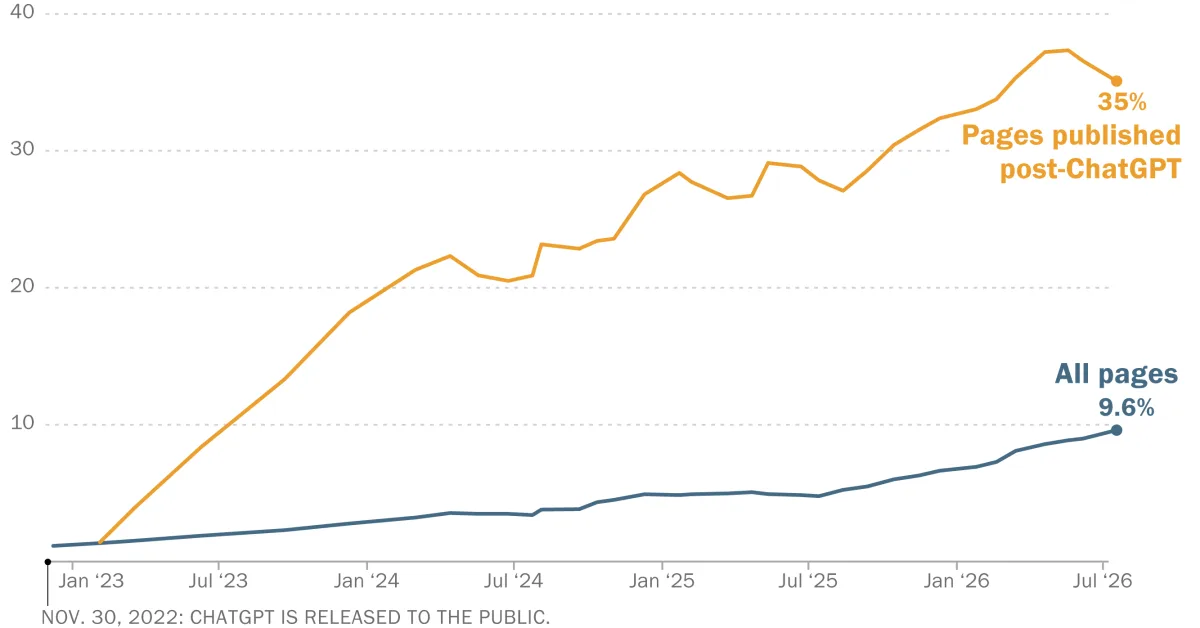
Pew puts a number on it: 35% of pages published after ChatGPT show AI authorship

Pew Research ran nearly half a million pages from Common Crawl through a detector. Among pages published after November 2022, more than a third came back with significant signs of AI writing, and .com domains showed it at ten times the rate of .edu and .gov.

TechCrunchverified

Toolsmedium signal

ChatGPT search switched en masse to the site: operator

On August 20, Simon Willison relayed a measurement from Promptwatch showing that ChatGPT abruptly began narrowing its searches to preselected domains. The share of queries carrying the site: operator held between 0.3% and 0.5% for weeks, then jumped to 16% to 17% on August 8 — two days after OpenAI announced accuracy fixes in GPT-5.6. Willison concludes that the search tool internally has the shape search(query, recency, domains), which means the model picks domains before it even frames the question. If you care about visibility in that search, you are no longer competing only for a place in the result but for your domain to make the list the model assembles on its own.

Simon Willisonverified

Industrymedium signal

OpenAI introduces Private Safety Processing

On August 19, OpenAI released a preview of a system that recognizes abuse patterns across several linked sessions without retaining user content. The idea is that only a narrowly defined safety signal is passed on, without exposing the prompts and responses themselves, which keeps the zero data retention guarantee for paid API customers in force. The target is attackers who split a request across several conversations to avoid detection. The approach is the opposite of Anthropic's policy, which keeps data for 30 days with controlled human review; if you are choosing a vendor for a project with sensitive client data, that difference is worth understanding before you sign. Wider rollout and a technical paper were announced for September.

TechCrunch / OpenAIverified