Google opens the SynthID detector to everyone, and it now reads OpenAI, NVIDIA, and Kakao watermarks too
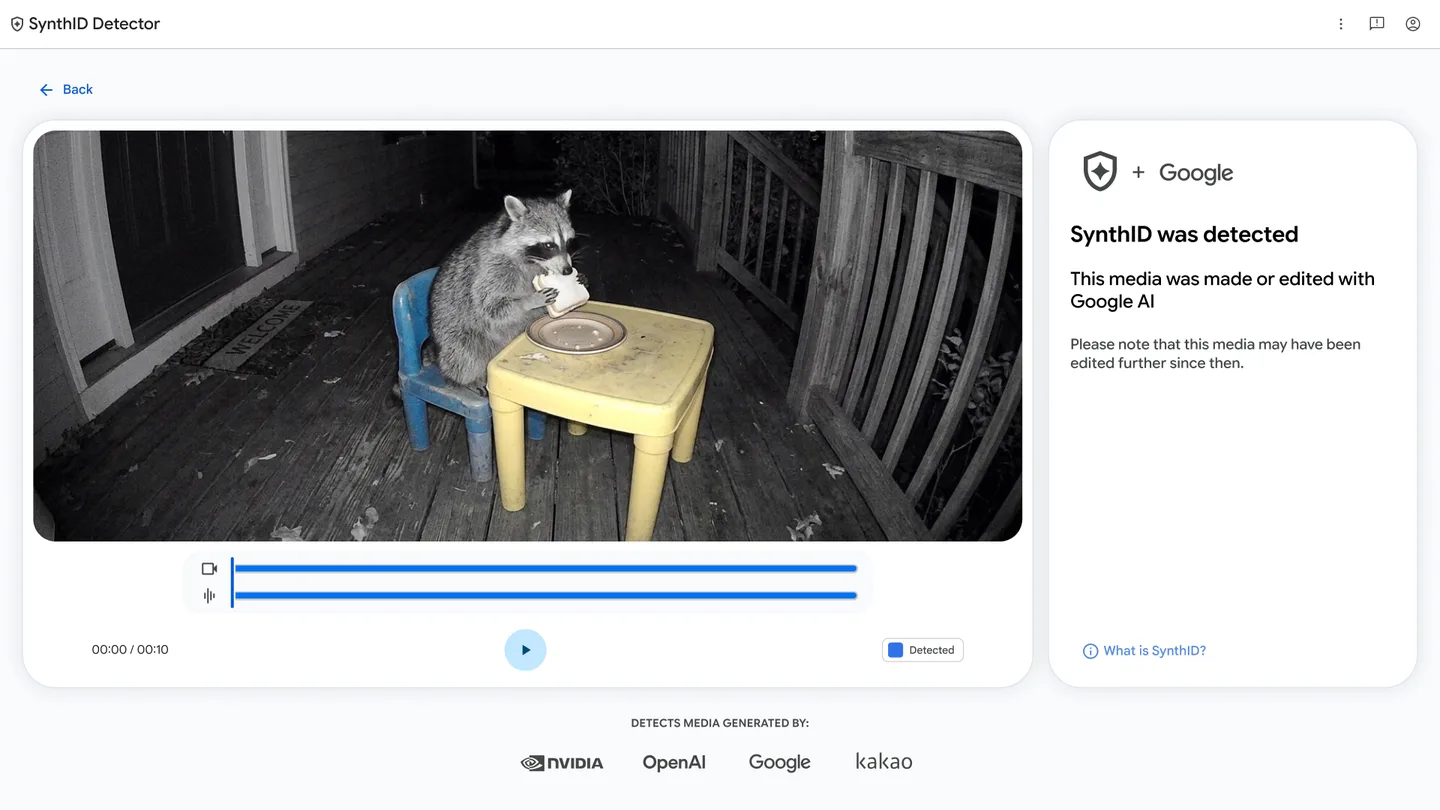
On October 7, 2026, Google DeepMind made its SynthID Detector available to anyone, worldwide and in English, at synthid.com. The tool reports whether an image, video, or audio file carries a SynthID watermark from Google or from its partners OpenAI, NVIDIA, and Kakao, with Apple listed as coming soon. According to Ars Technica, you sign in with a Google, ChatGPT, or Apple account and get roughly 10 checks a day. A negative result does not mean the file is authentic.
Source
We're making it easier to identify AI-generated content globally.Google: The Keyword, AI · Original published October 7, 2026
Until October 7, checking for a SynthID watermark outside Google's trusted tester program meant asking Gemini and reading its answer. The standalone detector replaces that with a file upload and a yes-or-no result. Google says it has watermarked more than 180 billion images and videos and 240,000 years of audio since SynthID launched in 2023, and that its built-in verification in Google Search, the Gemini app, and Chrome now handles more than 1 million requests a day.
What changed on October 7
An early version of the detector reached media professionals in 2025. The version launched on October 7 drops that restriction: anyone can use it, globally, with the interface in English. Pushmeet Kohli of Google DeepMind announced it on Google's blog.
The larger change is partner coverage. The previous tool recognized only Google's own watermark, so, as Ars Technica notes, an image made with ChatGPT carried a SynthID mark that the detector could not see. The new one checks for the distinct watermarks of OpenAI, NVIDIA, and Kakao as well, and Google lists Apple as coming soon.
How the public tool behaves, according to Ars Technica
Ars Technica, which spoke to Google engineers, describes the limits. You have to sign in, and the site accepts Google, ChatGPT, and Apple accounts. Google told the publication that each user gets a daily quota of approximately 10 image, video, and audio checks, and that the cap exists so nobody can use the detector to tune a watermark-removal workflow.
The output is a single message saying whether SynthID was used to produce or edit the file. The internal tool highlighted the regions of an image where the watermark was found; the public site does not.
- Supported inputs are image, video, and audio files.
- The result is binary: the file does or does not carry a watermark the tool knows.
- Ars Technica reports that the site will carry a disclaimer that content from other systems is not identified.
What a negative result does not tell you
The detector only knows the watermarks of Google and its partners. Ars Technica notes that Meta uses different watermarking technology, that some providers use none, and that open-weight models running on private hardware produce media with no watermark and often no metadata. A file that passes may still be AI-generated.
This suggests the tool is most useful as one signal in an intake process, not as a verdict. If you publish user-submitted media or label AI content under European Union rules, the detector lets you check what arrives; it does not do the labeling for you. Ars Technica also points to C2PA, which signs authentic media at capture, as the complementary approach, and notes that Google's Pixel phones already do this.
„a daily usage quota of approximately 10 image, video, and audio checks“
Sources
Related
Python 3.15 makes UTF-8 the default encoding and adds explicit lazy imports
Python 3.15.0 came out on October 9, 2026. Files opened without an explicit encoding are now read and written as UTF-8 on every system, and a new lazy import statement defers loading a module until it is used. The release also adds frozendict and a sampling profiler.
Python Software Foundationverified

Deno's team joins Cloudflare, and the Deno runtime gets one more year of updates
Ryan Dahl announced on October 9, 2026 that the whole Deno team is moving to Cloudflare. The Deno runtime will get monthly fixes for one more year before development ends, and Deno Deploy will shut down after six months. JSR keeps running.
Denoverified

Anthropic's OSS Scanner sends open-source maintainers free vulnerability reports that no human has reviewed
Anthropic launched OSS Scanner on October 8, 2026, an opt-in service that scans eligible open-source projects with its strongest models, including Claude Mythos, at no cost. Each report includes a reproducer, an explanation, and a candidate patch when one exists, but no person checks it before it is sent. Anthropic says it expects more than 90% of findings to be real.
Anthropicverified