ChatGPT moves every tier to GPT-6 and starts answering with interactive charts, forms, and tools
OpenAI began rolling out GPT-6 with a feature called Intelligent UI to ChatGPT Plus, Pro, Business, and Enterprise on October 7, 2026, and extends it to the Free and Go tiers from October 8, 2026. Instead of a block of text, a response can now contain tappable buttons, forms, charts, and small interactive tools that the model composes while it writes. Paid tiers run on GPT-6 Sol and free tiers on GPT-6 Luna; the models behind Work and Codex do not change.
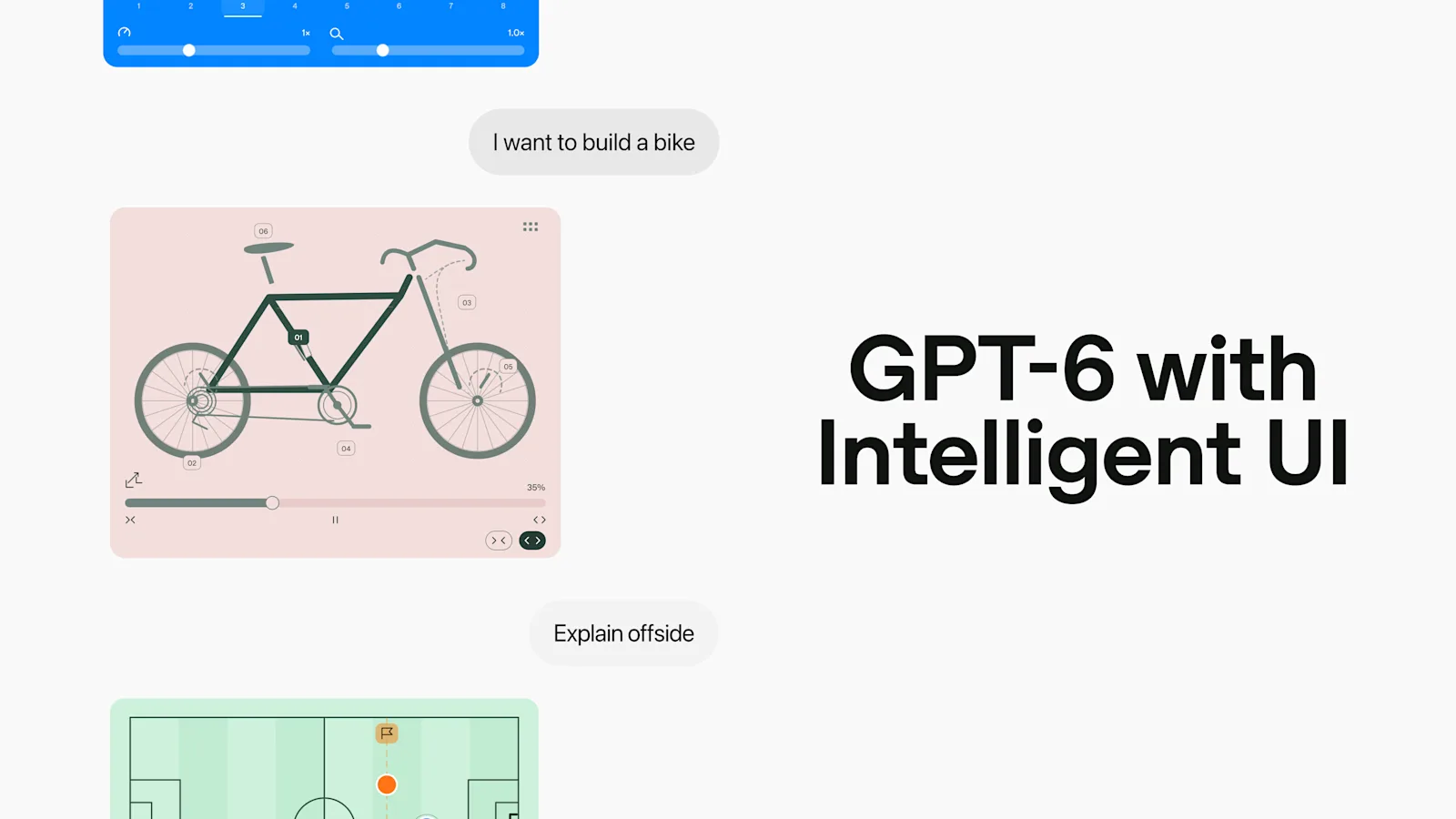
In September 2026 OpenAI released the first GPT-6 models to paying customers. The October 7 update puts a GPT-6 model in front of everyone who uses ChatGPT, which OpenAI says is more than 1.2 billion people a week. The visible change is Intelligent UI: the model has been trained to choose between text, visuals, and interactive elements for each question. A comparison can arrive side by side, an explanation as a diagram you can poke at, and a request for a savings calculator as a working calculator inside the conversation.
How the interface gets built
OpenAI built a library of native, streamable components and a compiler that processes the interface as the model generates it, so the interface appears progressively rather than after the full response is done. GPT-6 was trained to use that library and to judge layout, when interactivity helps, and when a plain text answer is enough; the training included evaluating the interfaces it produced for clarity, usefulness, and completeness.
The examples OpenAI shows are everyday ones: a Sunday roast plan with a guest-count slider that recalculates shopping quantities, a road trip on a map, an interactive diagram of a 7-speed bicycle, a bill splitter, a retirement calculator, a retro game. TechCrunch reports that you can adjust how often visuals appear in responses.
Answering while it is still thinking
GPT-6 in ChatGPT can interleave reasoning with answering. OpenAI says it trained the model to account for the user's waiting time and to build an answer across several partial responses, each adding information, while keeping the whole as cohesive as one written at once.
The numbers are OpenAI's own internal evaluations. For questions that need web search, GPT-6 Instant starts answering 44% sooner on average than GPT-5.6 Instant. On a set of everyday agentic tasks, GPT-6 at Extra High effort begins answering in the same time as GPT-5.6 at Medium while scoring higher overall than GPT-5.6 at Extra High. No independent measurement has been published.
Who gets which model, and when
The rollout reaches Plus, Pro, Business, and Enterprise in the Chat tab on October 7, 2026, and expands to Free and Go from October 8, 2026; Enterprise availability depends on workplace admin settings. Paid tiers are served by GPT-6 Sol and the free tiers by GPT-6 Luna, both tuned for everyday conversation. The update applies only to the Chat experience; Work and Codex keep their current models.
On safety, OpenAI says GPT-6 builds on the Astra line's resistance to attempts to bypass safety training and showed stronger resistance in adversarial testing, particularly to attacks that adapt across multiple turns. The details are in the system card; the announcement itself gives no figures.
„Instead of people adapting to software, software will adapt to people.“
Sources
Related
Python 3.15 makes UTF-8 the default encoding and adds explicit lazy imports
Python 3.15.0 came out on October 9, 2026. Files opened without an explicit encoding are now read and written as UTF-8 on every system, and a new lazy import statement defers loading a module until it is used. The release also adds frozendict and a sampling profiler.
Python Software Foundationverified

Deno's team joins Cloudflare, and the Deno runtime gets one more year of updates
Ryan Dahl announced on October 9, 2026 that the whole Deno team is moving to Cloudflare. The Deno runtime will get monthly fixes for one more year before development ends, and Deno Deploy will shut down after six months. JSR keeps running.
Denoverified

Anthropic's OSS Scanner sends open-source maintainers free vulnerability reports that no human has reviewed
Anthropic launched OSS Scanner on October 8, 2026, an opt-in service that scans eligible open-source projects with its strongest models, including Claude Mythos, at no cost. Each report includes a reproducer, an explanation, and a candidate patch when one exists, but no person checks it before it is sent. Anthropic says it expects more than 90% of findings to be real.
Anthropicverified