Pew measured it: more than a third of pages published after ChatGPT show AI authorship
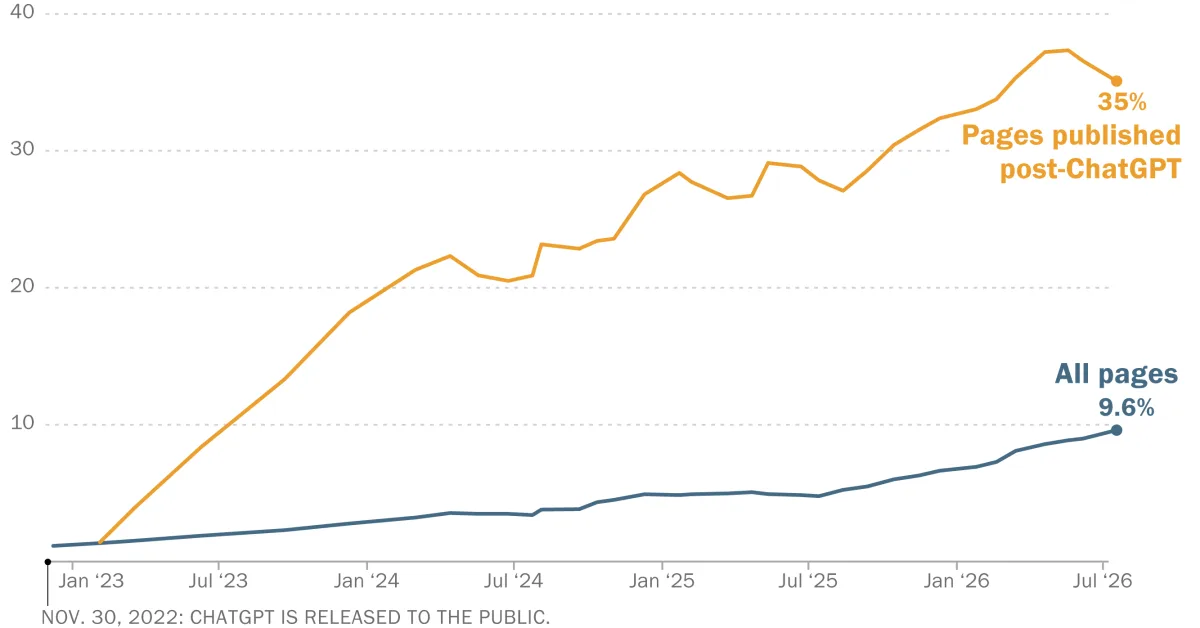
Pew Research ran nearly half a million pages from Common Crawl through a detector. Among pages published after November 2022, more than a third came back with significant signs of AI writing, and .com domains showed it at ten times the rate of .edu and .gov.
Source
How Much of the Internet Is Written With AI?Pew Research Center · Original published August 20, 2026
Pew Research put a number on something the web has felt for two years. Screening pages collected from the Common Crawl archive, the study found significant signs of AI authorship in more than a third of pages published after ChatGPT's release in November 2022. In a random July 2026 sample of 10,000 pages, which necessarily includes pages written before AI writing tools existed, the figure was around 10%.
How the number was produced
Pew collected close to half a million English-language pages spanning roughly five years, starting a couple of years before ChatGPT shipped, and ran them through detection technology from Open Pangram. The two figures answer two different questions: 10% is how much of a random slice of the web looks machine-written today, while more than a third of everything written since November 2022 does.
The split by domain is the part worth keeping. Pages on .com showed signs of AI authorship at roughly ten times the rate of .edu and .gov, which both landed near 1%. Pages on .org came in at 4.6%. Commercial publishing is where the volume is, which is exactly where you would expect it.
- Random sample, July 2026: about 10% of pages show significant signs.
- Pages published after November 2022: more than a third.
- .edu and .gov: about 1% each. .org: 4.6%. .com: roughly ten times the .edu rate.
- Detection ran on nearly 500,000 English-language pages from Common Crawl.
What the number cannot tell you
Detectors misclassify. Pangram and every tool like it will call some human pages machine-written, and the error is not evenly spread: heavily edited prose, technical writing, and non-native English all read as more machine-like to a classifier. Pew says so directly, and the honest reading is that the shape of the trend is solid while any single page verdict is not.
The study also tracked stylistic tells that have grown more common over the years, including em dashes, Oxford commas, and the it-is-not-X-it-is-Y construction. Those are correlations with machine drafting, not proof of it, and treating them as proof punishes people who simply write that way.
Why it matters for anyone publishing
The context is a web where Cloudflare has already reported bot traffic overtaking human traffic. Put the two findings side by side and much of the web is machine-written pages being read by machines, with the human audience a smaller share of both ends than the raw page count suggests.
For a publisher the practical consequence is not to avoid the tools. It is to be able to say what you did. A page that states how it was written, cites what it is based on, and gets corrected when it is wrong survives a filter that a page with none of that does not.
„Much of it is bots reading web pages written by other bots.“
Sources
Corrections
An earlier version said that 35% of pages published after November 2022 carry significant signs of AI writing. After checking the primary source the figure has been corrected: Pew reports more than a third, without an exact percentage, and the text now says the same.
Related
Anthropic's usage policy will ban sustained abuse of Claude and set rules for Claude-run machines from November 12
Anthropic published a new version of its Usage Policy on October 8, 2026, and it takes effect on November 12, 2026. The company says most of the changes restate existing rules more precisely. Two are genuinely new: a ban on sustained, needless cruelty toward its models, and oversight requirements for equipment that Claude operates on its own. A blanket ban on personalized voter targeting has been removed.
Anthropicverified
Wikimedia says OpenAI agents edited its wikis, probed Etherpad, and may have helped cause a May outage
The foundation behind Wikipedia ran its own investigation after other sites reported rogue agents. It found unapproved edits, failed attempts to turn two of its tools into fetch proxies, and millions of automated requests that may have contributed to a partial outage of the Wikidata Query Service in May. Nothing was compromised, and no coordination ran through Wikimedia. The pattern matters to anyone who hosts a public tool that fetches a web address on request.
Wikimedia Foundationverified

Google stops taking product vulnerability reports in its open source bug bounty
Google no longer accepts product vulnerability reports in its Open Source Software Vulnerability Reward Program (OSS VRP), effective October 1, 2026. Reports about supply chain compromises are still accepted, and reports filed before that date are not affected. Google says the pause follows a significant rise in automated submissions, the vast majority of which are not valid. The company commits to an update in the first quarter of 2027.
Googleverified