A rumor of a bug is now enough for an agent to write the exploit
Anil Madhavapeddy fixed a path traversal issue in an OCaml library and opened the patch in public, the way maintainers have done for years. About 10 minutes later his own web server was logging probes for that exact pattern. His own agent had already built a working exploit from nothing but a rough description of where to look. The embargo model assumes that keeping the details quiet buys time, and that assumption has stopped holding.
Source
Just a rumour of a bug is enough to find a security exploit these daysAnil Madhavapeddy · Original published August 22, 2026
Anil Madhavapeddy, a professor of computer science at Cambridge and one of the maintainers of the OCaml compiler, released cohttp 6.3.0 on August 22 with a fix for a path traversal issue. He opened the pull request publicly so more people would look at it, which until recently was ordinary practice. Within about 10 minutes his live web server was fielding probes for percent-encoded traversal sequences, which means automated watchers are reading public repositories and turning a patch into a target.
The hint was the whole exploit
The report reached Madhavapeddy privately through a Slack channel, and it had itself been found by Claude Fable. Before reading the patch closely he pointed his own agent at the affected code and asked it to investigate path normalization. Claude Fable refused the task under its security block. That block lifts inside Project Glasswing, which is open to 150 organizations across fifteen countries, and Madhavapeddy has no access to it, because the program does not reach small maintainers. DeepSeek V4 Pro took the job and independently surfaced several related issues.
The agent then wrote an exploit and probed a local server with it in under a minute. That is the part that breaks the old process. What the embargo protects is the patch, but the thing worth protecting was the direction to search in, and a direction fits in one sentence.
The measurements were already pointing here
Fang and colleagues showed the shape of this in 2024. Given a CVE description, their GPT-4 agent exploited 87% of a 15-vulnerability benchmark. Without the description it managed 7%. A description is not a proof of concept; it is a paragraph of prose.
The tracking of mean time to exploit that Madhavapeddy cites now sits at minus seven days, which means exploitation precedes the patch. The same figure was around 63 days in 2018 and 2019, and it crossed zero in 2024.
- The advisory for marimo's CVE-2026-39987 drew a first exploitation attempt after nine hours, with no public proof of concept in existence.
- For Langflow's CVE-2026-33017 the same gap was 20 hours.
- Nick Craig-Wood, who maintains rclone, received about 20 security disclosures through GitHub in the project's first 10 years, and more than 40 in the last month alone.
- By his own count about 75% of that recent traffic contained something that needed looking at, so it is not noise that can be filed away.
What a maintainer can actually do about it
Madhavapeddy sets out three directions and none of them is comfortable. Developing the fix somewhere genuinely private is the obvious one, but GitHub's temporary private forks cut continuous integration off from the work, accept only a single merging pull request, and require an admin to enroll each reviewer by hand. For a project whose reviewers show up when they happen to be free, that is not a workflow.
The second is to drop embargoes and ship continuously, the way the Linux kernel defers a fix by at most seven days, and by fourteen in exceptional cases. The obstacle is packaging. A library ends up embedded in downstream products the maintainer does not control, so a fast release upstream is still slow where the code actually runs.
The third is to mitigate at the protocol layer while the real fix goes through review. This bug had a one-rule mitigation, normalizing percent-encoded path separators in the request URL, and that rule was deployable the minute the report arrived. Commercial networks do this routinely; Cloudflare pushed managed rules for Log4Shell back in 2021. Open source has no comparable channel for distributing such a rule.
The same clock now applies to anyone shipping dependencies
The window between a public patch and a working exploit is now shorter than most deployment pipelines. A dependency bump that used to be next sprint's chore belongs in the same category as rotating a leaked key.
Two habits follow from that. Advisory feeds are worth watching for the libraries that are actually deployed, not the ones on a list of intentions. And a mitigation has to be deployable without waiting for the fixed release, because on this timeline the fixed release is the slow path.
„We had to deal with over 40 in the last month!“
Sources
Corrections
An earlier version said the security block on Claude Fable lifts only for organizations inside Project Glasswing. After checking the primary source the text has been corrected to what the source says: Madhavapeddy has no access to that programme, which is open to 150 organizations across fifteen countries but does not reach small maintainers. A limit that had been left out has also been added, that the Linux kernel defers a fix by at most seven days and by fourteen in exceptional cases.
Related
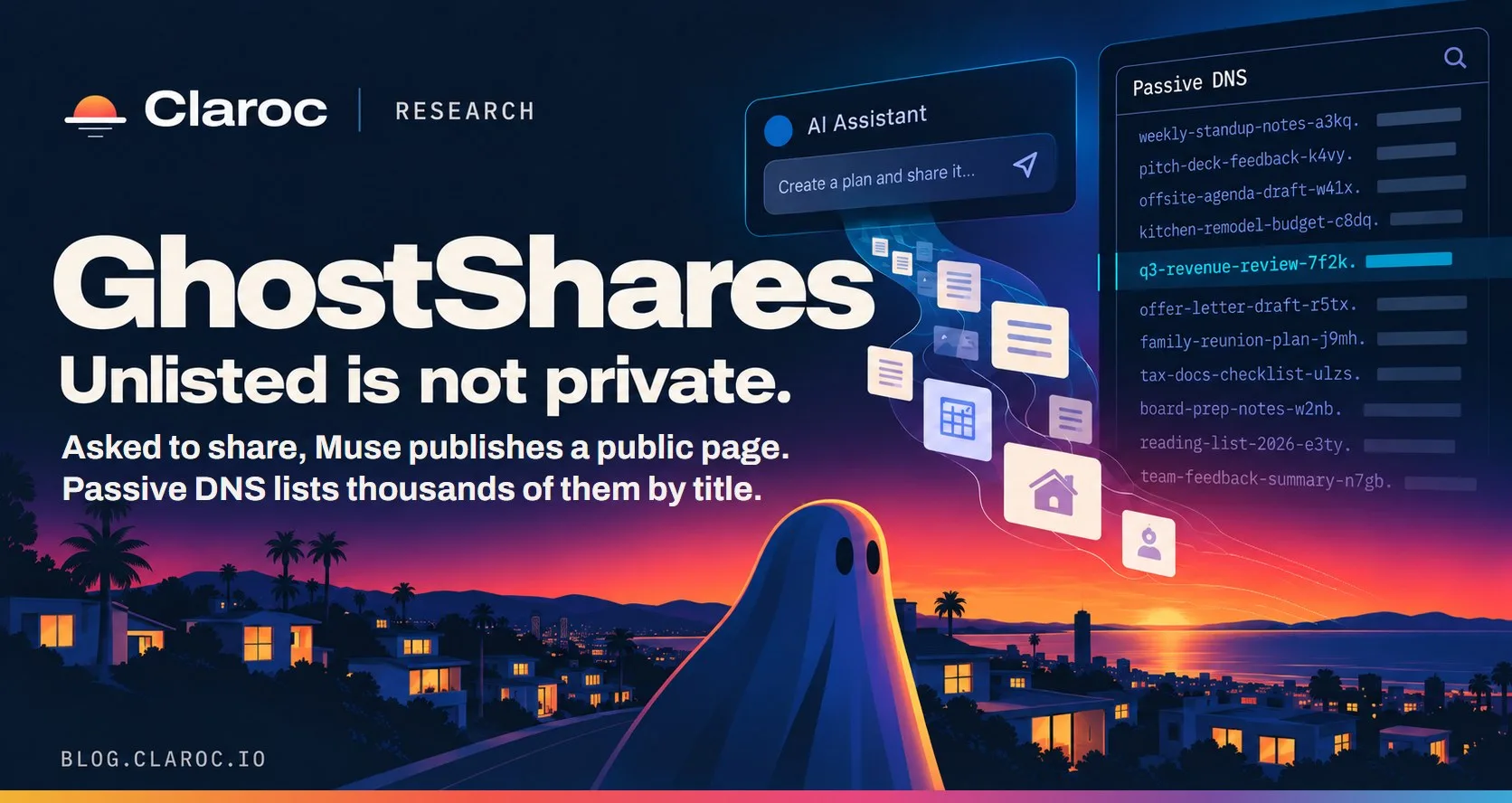
Meta paused Muse sharing after researchers found more than 6,800 shared chats through DNS records
The security firm Claroc found that Muse built each shared conversation's web address from its title, and that passive DNS services recorded those addresses. Among the few hundred pages it opened were loan applications, internal revenue reports, and notes for a confidential call. Meta says sharing is paused while it reviews the findings.
Clarocverified
OpenCode says a breach hit 1.4% of Console users who had linked their own AI providers
OpenCode, the open-source coding agent, announced on October 17, 2026, that attackers had broken into its hosted Console service the night before. The project calls it a large-scale distillation attack and says it affected 1.4% of Console users, all of them people who had connected external providers. Co-founder Dax Raad says the open-source app itself was not involved. How the attackers got in has not been disclosed.
OpenCodeverified
OpenClaw 2026.10.5 blocks plugin hooks from changing tool calls after approval
OpenClaw's new release closes a gap that let an ordinary plugin hook alter a tool call after a trusted policy had already approved it. Such a call is now blocked unless the hook asks for its own approval, which breaks plugins that relied on the old order. The release also makes Gemini 4 Argon the default Google model and points the gemini alias at it.
OpenClawverified