Copilot code review drops its size limit and starts reviewing what bots wrote
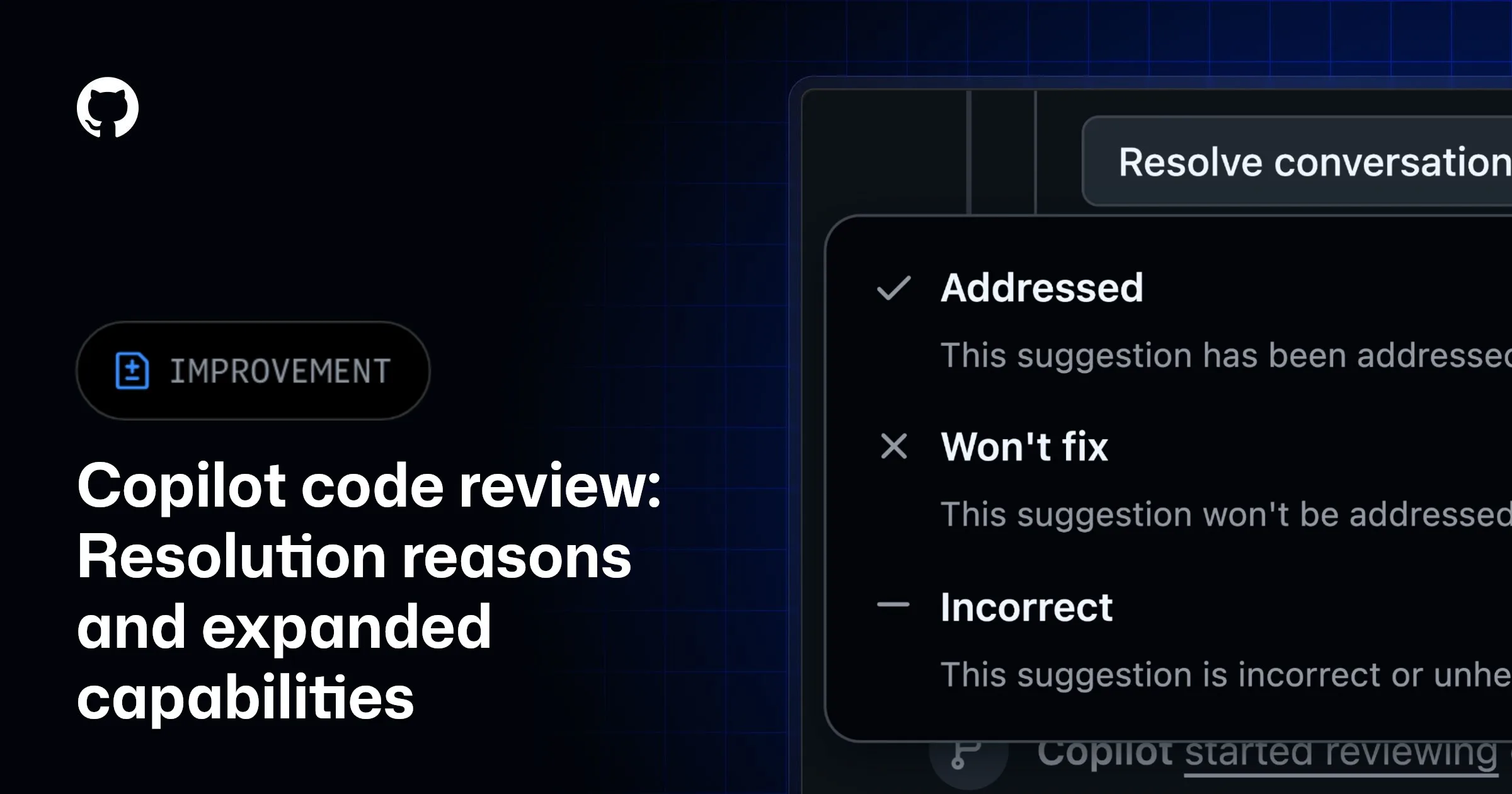
The cap of 300 files or 20.000 lines per pull request is gone, and pull requests opened by bots, the Copilot cloud agent among them, now get a full agentic review instead of a limited one. Resolving a comment now asks why: addressed, won't fix, or incorrect.
Source
Copilot code review: Resolution reasons and expanded capabilitiesGitHub Changelog: Copilot · Original published August 27, 2026
GitHub changed three things in Copilot code review on August 27. Two of them point at the same situation: the pull requests being reviewed are increasingly not written by people.
The size cap is gone
Until now a pull request over 300 files or 20.000 lines of code fell outside what Copilot code review would look at. That limit has been removed, with no replacement figure named.
The cap mattered most exactly where review is hardest to do by hand. A migration, a dependency bump across a monorepo or a generated-code refresh clears 300 files without being complicated, and those are the changes a human reviewer skims.
Bot pull requests get the full review
Pull requests authored by bots, including GitHub's own Copilot cloud agent, are now covered. Ones from the cloud agent previously received a limited review and now get a full agentic one.
This closes a gap that was becoming awkward: the agent that writes the change and the reviewer that checks it are both Copilot, and until now the second one was doing less work precisely when the first one had done all of it. Organizations that allow members without a Copilot license to use code review on GitHub.com can have bot-authored pull requests reviewed too, billed to the organization.
Resolving a review comment now takes a reason from a dropdown next to the resolve button: addressed, won't fix, or incorrect. That third option is the useful one, because it is the only signal in the flow that separates a suggestion a person disagreed with from one that was simply wrong.
Related
OpenClaw 2026.10.2 stops long tool output from slipping credentials past redaction
A bug in OpenClaw's secret masking let a credential through whenever it straddled the boundary between two slices of a long text. The fix ships in 2026.10.2 along with repaired updates from 2026.10.1 and a new compaction default for OpenAI and Anthropic API keys.
OpenClawverified

OpenClaw 2026.10.1 lets agents search installed skills and changes how sessions message each other
OpenClaw released version 2026.10.1 on October 10, 2026, its first stable release since 2026.9.7. Agents can now search the skills installed on a machine and read only the one a task needs, instead of carrying the whole library in the prompt. Opt-in MCP Apps run beside chat, and full backups can go to an external drive or Cloudflare R2. Three changes can break existing setups: session-to-session messaging, the old required argument, and Workboard data stored before July 2026.
OpenClawverified
Claude Code 2.1.294 fixes prompt hooks that let through the actions they were written to block
Anthropic released Claude Code 2.1.294 on October 8, 2026. It fixes prompt and agent hooks phrased as instructions, which could allow exactly the actions they were meant to stop. Version 2.1.295 followed the same day with an onFailure setting that makes a crashed or timed-out command or HTTP hook block the action. Releases 2.1.292 and 2.1.293 from earlier in the week closed several permission and sandbox gaps.
Claude Code Releases (GitHub)verified