GitHub will retire Claude Opus 5, Opus 4.8, and GPT-5.6 Terra from Copilot on November 16
GitHub announced on October 15, 2026, that three models leave every Copilot experience on November 16, 2026, with Claude Opus 5.5 and GPT-6.1 Sol or GPT-6 Luna as suggested replacements. The same day, agentic autofix for code scanning alerts became generally available to Enterprise Cloud customers with Code Security or Advanced Security.
Source
Upcoming deprecation of selected GitHub Copilot models in mid-NovemberGitHub Changelog: Copilot · Original published October 15, 2026
GitHub will stop offering three models in Copilot on November 16, 2026: Claude Opus 4.8, Claude Opus 5, and GPT-5.6 Terra. The change covers every Copilot experience, including Copilot Chat, inline edits, ask and agent modes, and code completions. GitHub says workflows and integrations that name one of these models should move to a supported model before that date.
What replaces each model
GitHub suggests a replacement for each model. For both Claude models it is Claude Opus 5.5, while users of GPT-5.6 Terra are pointed to GPT-6.1 Sol or GPT-6 Luna.
Claude Opus 4.8 stays available to individual Copilot subscribers on annual plans, so the retirement does not apply to them. In Copilot Business and Copilot Enterprise, the replacements are switched on automatically under default model enablement. That does not happen if an administrator turned off the global default or disabled the specific model, and in that case the new models have to be enabled through their policies in Copilot settings. The retired models are removed without any action.
Copilot now fixes code scanning alerts on its own
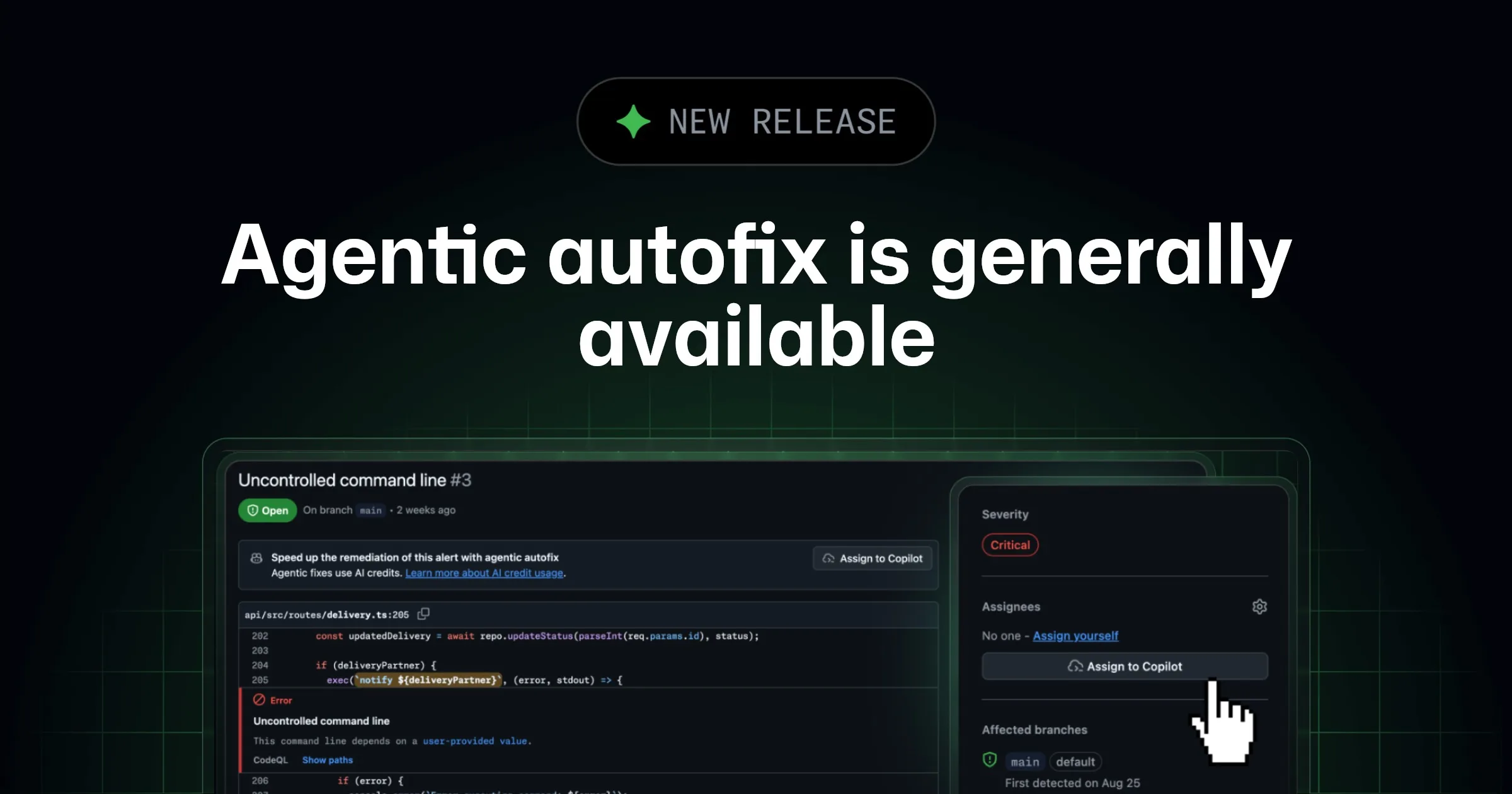
Also on October 15, 2026, GitHub made agentic autofix for code scanning alerts generally available. Code scanning uses CodeQL, GitHub's code analysis engine, to report security problems and bugs as alerts. When an alert is assigned to Copilot, the agent reads the relevant files, writes a fix, and reruns CodeQL to check that the alert is closed. It repeats the cycle if needed, then opens a draft pull request with a summary, the reason the fix works, and the checks it ran.
Alerts can be assigned one at a time, up to 25 at once into a single pull request, or through the REST API. Only alerts on a repository's default branch qualify, so alerts found only in pull requests or on other branches cannot be assigned. Further changes are requested through comments on the pull request or in the repository's Agents tab.
The feature is limited to GitHub Code Security and GitHub Advanced Security customers on GitHub Enterprise Cloud, including Enterprise Cloud with data residency. An enterprise administrator must first enable the new Agentic autofix policy, and a Copilot billing method must be set. Each fix consumes AI Credits from the Code Security budget plus GitHub Actions minutes. Once enabled, the feature replaces the free Generate Fix option on individual alerts with an Assign to Copilot button.
„Please update your workflows and integrations to use the supported models before this date.“
Sources
Related
OpenClaw 2026.10.5 blocks plugin hooks from changing tool calls after approval
OpenClaw's new release closes a gap that let an ordinary plugin hook alter a tool call after a trusted policy had already approved it. Such a call is now blocked unless the hook asks for its own approval, which breaks plugins that relied on the old order. The release also makes Gemini 4 Argon the default Google model and points the gemini alias at it.
OpenClawverified
GitHub Copilot lets enterprise admins tie telemetry to a user's GitHub login and machine name
GitHub added an identity setting to Copilot's enterprise telemetry on October 12, 2026. When an administrator turns it on, OpenTelemetry data carries the developer's GitHub login, local operating-system account, and machine name. Five separate switches decide whether prompts, responses, and tool data are captured, and all of them start off.
GitHubverified
OpenClaw 2026.10.2 stops long tool output from slipping credentials past redaction
A bug in OpenClaw's secret masking let a credential through whenever it straddled the boundary between two slices of a long text. The fix ships in 2026.10.2 along with repaired updates from 2026.10.1 and a new compaction default for OpenAI and Anthropic API keys.
OpenClawverified