Skip to content

Tags

performance

12 items
NEXT.JS 16.4'use cache'recommended for every app, default in new ones
Toolsmedium signal

Next.js 16.4 makes Cache Components the recommended model for every app

Vercel shipped Next.js 16.4 on October 6, 2026. Cache Components, the opt-in caching model built over the 16.x line, is now the recommended choice for every app and the default in new projects. The release adds a way to force a route to stay static, two APIs that keep content out of prefetches, an agent-driven upgrade command, React 19.3, and a smaller Turbopack cache.

Next.js Blogverified
Toolsmedium signal

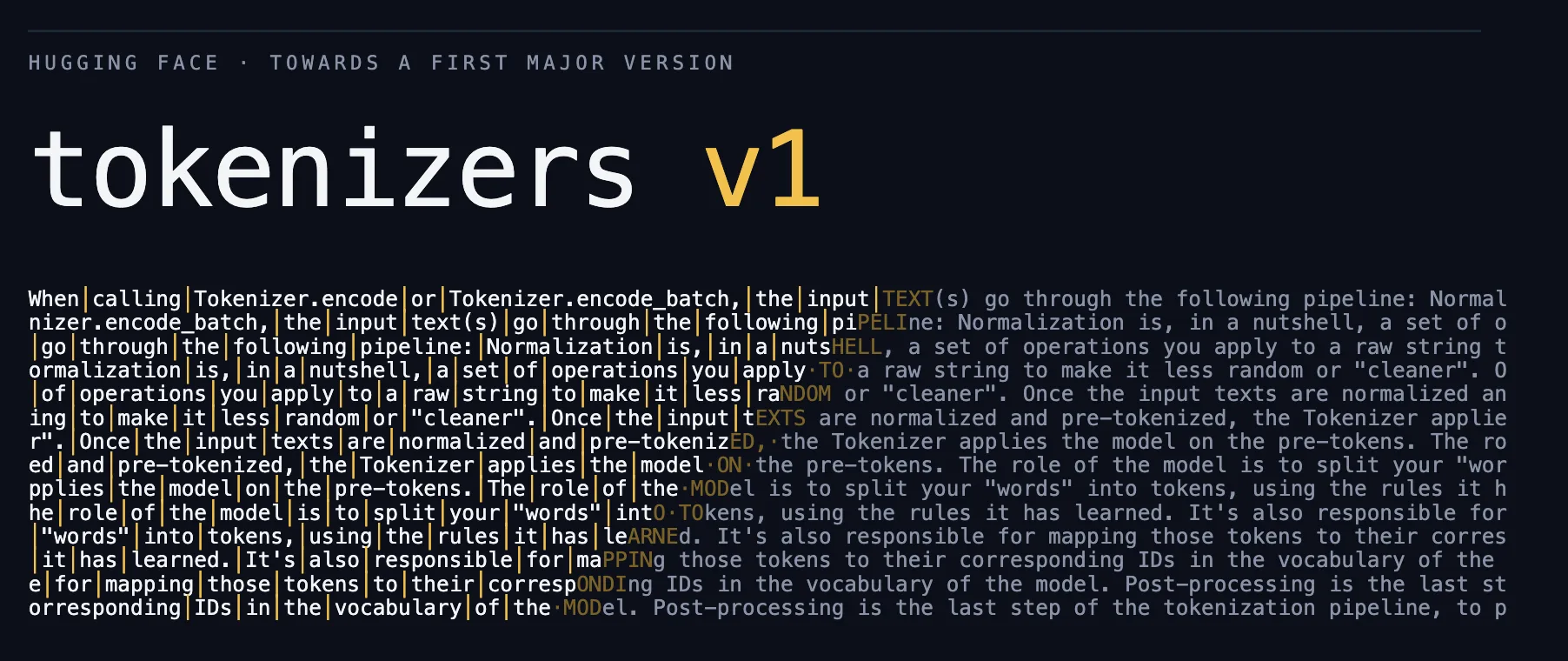
Hugging Face measures tokenizers v1 at 3 to 30 times the encode speed of v0.23

Hugging Face published the release candidate of tokenizers v1 on September 21, 2026, together with the numbers behind it. Across the ten model families the new encode path covers, the library encodes 3 to 30 times faster than v0.23 on a single thread of an Apple M4 Max, and it reaches 76% of linear scaling across eight workers. The output does not change: the same text produces the same token IDs, through the same calls. Every figure was measured against the Rust crate, and the Python bindings most of the ecosystem uses add per-call overhead the numbers exclude.

Hugging Faceverified

Modelsmedium signal

Amazon Bedrock added Kimi K3, and its agent runtime now starts in about two seconds

Two Bedrock announcements landed on September 18, 2026. Kimi K3, which Moonshot AI describes as the first open model with 2.8 trillion parameters, is generally available, and it is the first open-weight model on Bedrock that supports explicit prompt caching. The runtime agents run inside was replaced at the same time: AWS measured a P75 cold start of 1.9 to 2.0 seconds for container images from 200 MB to 2 GB, against 5.4 to 30 seconds on the previous version. Memory is now released during a session instead of being held at the peak.

Amazon Web Servicesverified

Machines & local modelsmedium signal

llama.cpp 0.4.0 adds four model architectures, an Apple RDMA transport, and video flags

The 0.4.0 release landed on September 4, 2026, and it is a numbered version rather than one of the nightly builds. It adds initial support for Qwen3.8-Flash-Next, NVIDIA Nemotron-3-Puzzle-75B-A9B, DSpark on Nemotron 3.5, and nanbeige4.2-3B. Apple RDMA becomes an RPC transport, video arrives as command-line options, and the quantizer gains a memory ceiling. Two server defaults changed, and saved session state carries a new version number.

llama.cppverified

Modelsmedium signal

NeoMME's 260M encoder lands within 0.002 of a 3.75B model on ViDoRe v3

H company published NeoMME on September 3, 2026: a pair of multimodal encoders, at 260M and 800M parameters, released under Apache 2.0 and loadable through Hugging Face Transformers. On the ViDoRe v3 document retrieval benchmark the small one scores 0.523 nDCG@10, which is 0.002 behind ColQwen2.5 at roughly 14 times its parameter count. It also encodes about 51 pages per second on a single NVIDIA L40S, and the index it produces can be compressed from about 1.5 MB per page to 6 kB while keeping more than 95% of retrieval quality.

Hugging Faceverified

Modelsmedium signal

ChatGPT, Claude, Grok, and Gemini all had trouble inside the same two hours on September 3

On September 3, 2026, Anthropic logged elevated errors across Claude Mythos 5.1, Claude Fable 5.1, and Claude Opus 5, OpenAI logged elevated errors across ChatGPT and Codex, Grok showed users an error message, and third-party monitors recorded a likely Gemini API interruption. Four independent providers, one morning. No status page names a shared cause, and Amazon Web Services, Microsoft Azure, and Cloudflare reported nothing major. For anyone whose product calls more than one of these, this is the failure mode that a second provider does not fix.

Ars Technicaverified

Machines & local modelsstrong signal

Hugging Face published 207 WebGPU kernels and a loader that pulls them from the Hub

The @huggingface/kernels package downloads one GPU operation from the Hub and runs it in a browser that supports WebGPU. All 207 kernels are Apache-2.0, and each one is published with its interface contract, correctness cases, and benchmark cases in the same repository. Hugging Face compared them with ONNX Runtime Web 1.30.0 on an Apple M4 GPU and reports a 2.57x geometric mean speedup across 809 comparable cases. The timings cover work on the GPU alone, for single operations rather than whole models.

Hugging Faceverified

Machines & local modelsmedium signal

llama.cpp spent two days on long context, and the gains landed on three different backends

Between August 29 and 31, 2026, llama.cpp shipped a run of changes that all point at the same place: the part of inference that gets slower as the context grows. Vulkan, CUDA and the Metal and OpenCL paths each got their own fix, with numbers the authors published. Three crashes were closed alongside them. None of it needs a flag; it arrives with the next build.

llama.cppverified

Webmedium signal

How Baseline helps you ship less JavaScript

Jad Joubran gives a practical method for auditing package.json: which libraries can be dropped today because the browser does the same job natively. The piece explains Baseline's three states — limited availability, newly available, and widely available — and shows how to use them as a measure instead of a feeling. The gap between the claim that something needs a library and the fact that the browser already does it closes faster than most projects track.

Smashing Magazineverified

Webmedium signal

NoLoJS: a catalog of patterns HTML and CSS now handle

Aaron T. Grogg assembled a survey of common JavaScript patterns that today are solved with plain HTML and CSS, with no script at all, or the smallest one possible. The collection pairs well with the Baseline piece: first check what the platform already does, then drop the dependency. The result is a lighter page and better Core Web Vitals numbers.

GitHubverified