Amazon now confirms whether a message really came from Amazon, and not only in the United States
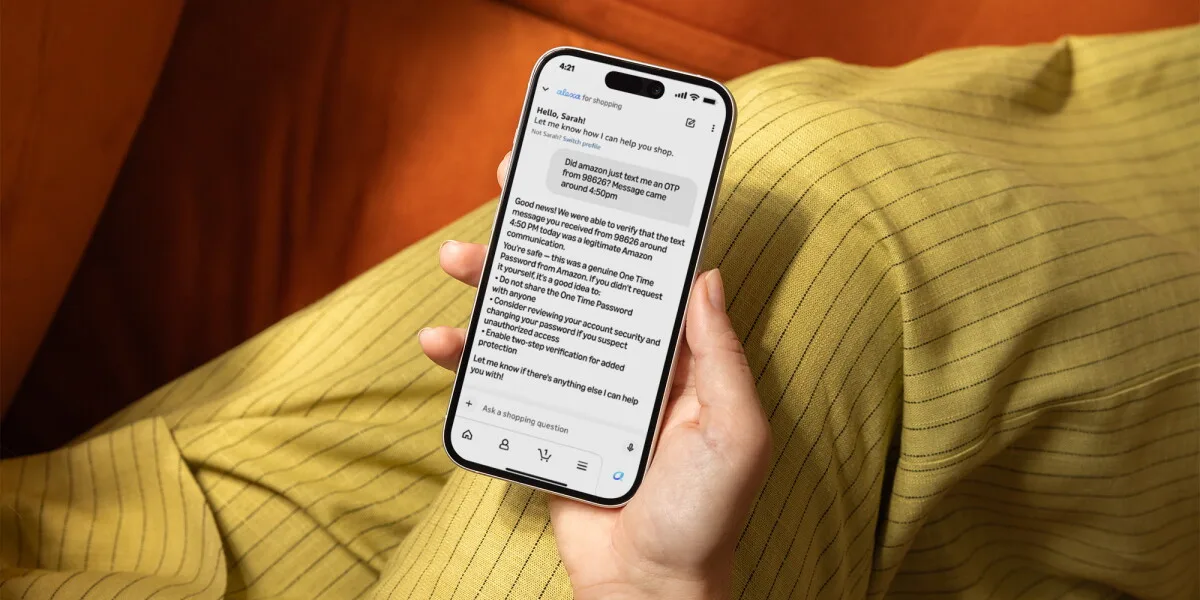
Amazon added message verification to Alexa for Shopping, so a customer in the United States can ask whether an email, a text or a phone call really came from the company. The tool compares the message against a record of everything Amazon has sent, weighing who sent it, what it says, when it was sent and how it is formatted. It gives one of three answers, and it confirms only when it is certain. Anyone outside the United States can run the same check by forwarding the message to a verification address Amazon has opened to the whole world.
Source
Is that message really from Amazon? Just ask Alexa for ShoppingAmazon News · Original published September 2, 2026
Amazon says 360,000 people a year contact its customer service with the same question: is this message from Amazon real. The company has now automated the answer. In the United States the question goes to Alexa for Shopping and comes back in seconds, and anywhere else the message can be forwarded to a verification address instead. Amazon's own page prints no date; reports place the announcement on September 2, 2026.
How the check works
The tool does not judge whether a message looks suspicious. It compares the message against a record of every message Amazon has sent, and it weighs who sent it, what it says, when it was sent and how it is formatted. That is a different method from a spam filter, which guesses from the shape of the text alone.
The answer comes in one of three forms, and the third one matters as much as the first two, because it is where a tool of this kind usually pretends to be sure.
- The message is an official Amazon communication.
- The message does not match any official Amazon communication, based on what was submitted.
- The tool cannot confirm with certainty, and the question goes to the other routes.
Who can use it, and where
The assistant route is a United States launch through Alexa for Shopping, and Amazon says it will reach more regions over time. That is the part most readers of this site cannot try yet.
The second route has no such limit. Amazon opened an email address for verification that is available to anyone in the world, customer or not: a suspicious message is forwarded there and an answer comes back. A verification form on the customer service pages does the same job, and scams can be reported in 28 languages from a phone or a computer.
What the check does not settle
The service answers one question, whether a message came from Amazon. It says nothing about a message that impersonates a bank, a courier or a marketplace seller, and it does not act on the message it examines.
This suggests the harder problem is reach rather than detection. The check helps a person who already doubts the message enough to ask about it, and Amazon's own figure describes exactly that group: the 360,000 a year who were suspicious enough to write in. The ones who were not suspicious never ask anybody.
„an email address available to anyone in the world, Amazon customer or not“
Sources
Related
Python 3.15 makes UTF-8 the default encoding and adds explicit lazy imports
Python 3.15.0 came out on October 9, 2026. Files opened without an explicit encoding are now read and written as UTF-8 on every system, and a new lazy import statement defers loading a module until it is used. The release also adds frozendict and a sampling profiler.
Python Software Foundationverified

Deno's team joins Cloudflare, and the Deno runtime gets one more year of updates
Ryan Dahl announced on October 9, 2026 that the whole Deno team is moving to Cloudflare. The Deno runtime will get monthly fixes for one more year before development ends, and Deno Deploy will shut down after six months. JSR keeps running.
Denoverified

Anthropic's OSS Scanner sends open-source maintainers free vulnerability reports that no human has reviewed
Anthropic launched OSS Scanner on October 8, 2026, an opt-in service that scans eligible open-source projects with its strongest models, including Claude Mythos, at no cost. Each report includes a reproducer, an explanation, and a candidate patch when one exists, but no person checks it before it is sent. Anthropic says it expects more than 90% of findings to be real.
Anthropicverified