Apple opens a health AI study app to up to 200,000 iPhone users in the US
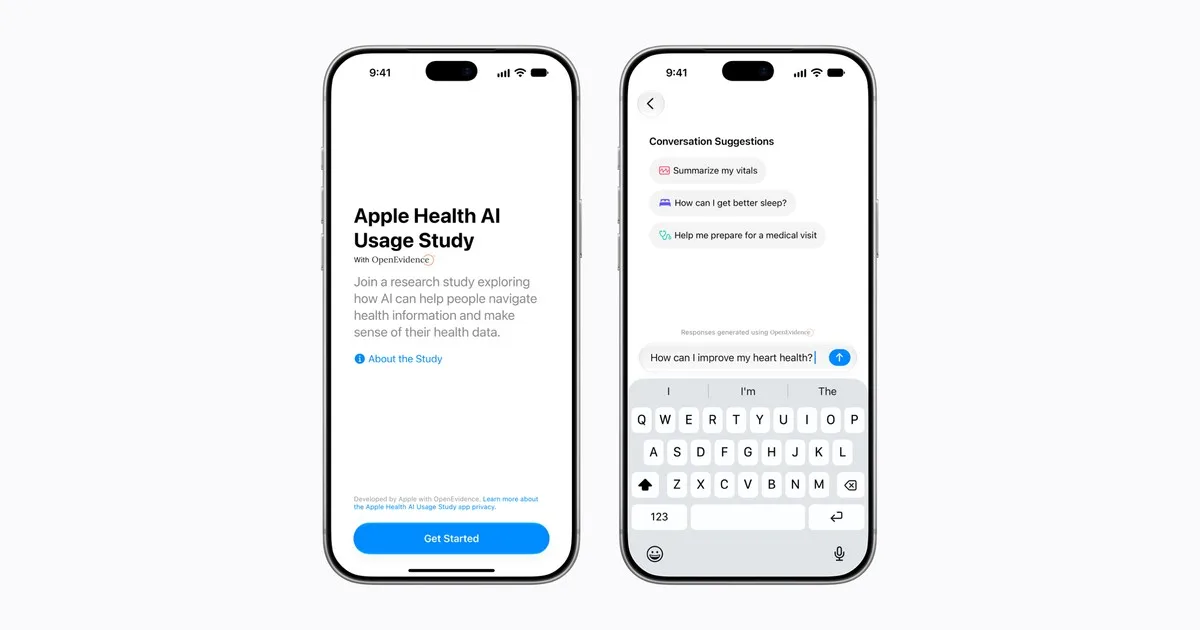
Apple launched the Apple Health AI Usage Study on November 15, 2026. Participants ask a chatbot everyday health questions in a dedicated app and get answers from OpenEvidence with links to clinical literature. The study is open only in the United States, to people 21 and older with an iPhone 15 Pro or later. Apple says the study data will not be used to train AI models.
Source
Apple launches research study to explore the use of AI for healthApple Newsroom · Original published November 15, 2026
Apple has started a research study in which people ask an AI assistant about their health. The Apple Health AI Usage Study launched in the United States on November 15, 2026, as a virtual study with its own app, and up to 200,000 people can join. Apple says the data collected in the study will not be used to train AI models.
How the study app works
The answers come from OpenEvidence, a clinical AI platform built for healthcare professionals, and Apple designed the app around it. OpenEvidence draws on medical sources such as The New England Journal of Medicine, the Journal of the American Medical Association and Nature, and each response links to peer-reviewed clinical citations. Participants can choose to share HealthKit data, such as resting heart rate, activity, sleep or lab results. The study then measures whether personal data makes the answers more relevant and easier to understand.
Apple presents the work as research rather than a product. According to the company, the study examines what drives trust in a health chatbot, the quality of its answers, how well people understand them and what they do next. Apple also acknowledges that consumer health tools built on large language models (LLMs), the systems that generate chatbot text, can give incomplete or unclear answers. The app includes guardrails meant to detect certain concerning questions and point the participant to a doctor or other resources.
Who can join
Enrollment is limited to the United States and to people 21 and older. It also requires an iPhone that supports Apple Intelligence, which means an iPhone 15 Pro or later running iOS 26 or later. Sharing HealthKit data and survey answers is optional. The announcement does not say whether the study will lead to a health feature in Apple's own apps, or when results will be published.
„Health is deeply personal“
Once a week, in your inbox
The whole week's news, gathered into one email. No ads, no passing your address on, one-click unsubscribe.
The address is used only for this roundup. It is not sold and not passed to anyone.
Related

Meta brings its Muse agent to the UK, with AI training on interactions switched on by default
Meta's personal AI agent is now open to UK adults on phones, the web, and WhatsApp. It is free, with paid plans whose prices the announcement does not give. A setting that lets Meta use interactions with Muse to develop its AI is on from the start, and users can turn it off.
Metaverified
Claude can now install artifacts as Mac and Windows apps, and some can ask for full access
Anthropic has begun rolling out a beta that turns a Claude artifact into an app with its own window and icon. It covers macOS and Windows on plans from Free to Enterprise. With the user's permission, an app can show notifications, sit in the menu bar, or get full access to the computer. Anthropic says it does not review the apps before installation.
Anthropicverified
GPT-6.2 arrives in ChatGPT's Chat tab for Plus, Pro, Business, and Enterprise plans
Paid ChatGPT plans are getting a version of GPT-6.2 tuned for everyday conversation. OpenAI reports large gains in understanding images and following instructions, all from its own tests. The system card published the same day also shows a step back: the model sticks to its default behavior more often when a user asks for something else.
OpenAIverified