Meta brings its Muse agent to the UK, with AI training on interactions switched on by default
Meta's personal AI agent is now open to UK adults on phones, the web, and WhatsApp. It is free, with paid plans whose prices the announcement does not give. A setting that lets Meta use interactions with Muse to develop its AI is on from the start, and users can turn it off.

Source
Introducing Muse in the UK: A Personal AI Agent You ControlMeta Newsroom · Original published November 24, 2026
Meta has launched its personal AI agent Muse in the UK, the company announced on November 24, 2026. Muse goes beyond answering questions: with the user's permission, it sends email, fills out forms, and makes purchases. One setting matters before the first task. Meta says the use of people's interactions with Muse to develop the company's AI is on when they start, so anyone who does not want that has to turn it off.
Muse is available to people aged 18 and over on iOS, Android, muse.ai, and WhatsApp. Meta says it is free for most of what people need, with subscription plans for those who want to do more. The announcement gives neither the plan prices nor the limit on free use. Support for Meta's AI glasses is planned for the months ahead.
Each Muse has its own virtual computer in the cloud, and it keeps working on longer tasks after the app is closed. The company says a user's information and logins are kept on that computer rather than in Meta's other services, and that no one else's Muse can reach them.
What happens to the data
Meta says conversations with Muse and the information it keeps are not shared with the company's advertising systems. Training is a separate question, and Meta's two posts treat it differently. The launch announcement says that users decide and can switch it off at any time. The companion post on user controls adds that the setting is on at the start. It is in Settings, under Data controls.
When the setting stays on, Meta says, it removes certain details, such as names, email addresses, and phone numbers. The company also says it does not use interactions that contain private messages, such as emails or Instagram direct messages, to develop and improve its models.
Facebook, Instagram, and Threads are connected automatically when a user's accounts are in the same Accounts Centre, Meta's shared account settings. Muse can then use what the user can already see in those apps. For other services, the user chooses what to connect and how far the access goes, for example letting Muse read email without sending any.
Approvals and payments
According to Meta, Muse asks before important actions such as sending an email, and every purchase needs approval. For other tasks, the user can let it take steps without asking each time and choose how long that permission lasts. A separate security agent checks Muse's actions, and the information it sends out, against the permissions granted.
Meta says passwords sit in a secure credentials store, where Muse can use them without the AI model seeing them. If email is connected, Muse ignores one-time codes and password-reset links. Checkout runs through Onelink, built by Stripe, which generates a digital version of the user's card, and through Shop Pay in stores that support it.
Muse keeps a record of what it has done and what it plans to do. Users can edit what it remembers, or reset it to delete all their Muse data.
UK services
Connectors, which link Muse to other services, cover global brands such as Spotify and OpenTable at launch. Meta is also working with UK partners that include Marks & Spencer, Sainsbury's, Argos, Trainline, and easyJet. With some of them, a user can connect a personal account so that Muse can repeat a usual order or pull up a booking. With others, Muse finds its way around the website. The announcement does not say which partner offers which option, and PayPal is still listed as coming soon.
„Purchases need your approval every time.“
Sources
Once a week, in your inbox
The whole week's news, gathered into one email. No ads, no passing your address on, one-click unsubscribe.
The address is used only for this roundup. It is not sold and not passed to anyone.
Related
Claude can now install artifacts as Mac and Windows apps, and some can ask for full access
Anthropic has begun rolling out a beta that turns a Claude artifact into an app with its own window and icon. It covers macOS and Windows on plans from Free to Enterprise. With the user's permission, an app can show notifications, sit in the menu bar, or get full access to the computer. Anthropic says it does not review the apps before installation.
Anthropicverified
GPT-6.2 arrives in ChatGPT's Chat tab for Plus, Pro, Business, and Enterprise plans
Paid ChatGPT plans are getting a version of GPT-6.2 tuned for everyday conversation. OpenAI reports large gains in understanding images and following instructions, all from its own tests. The system card published the same day also shows a step back: the model sticks to its default behavior more often when a user asks for something else.
OpenAIverified
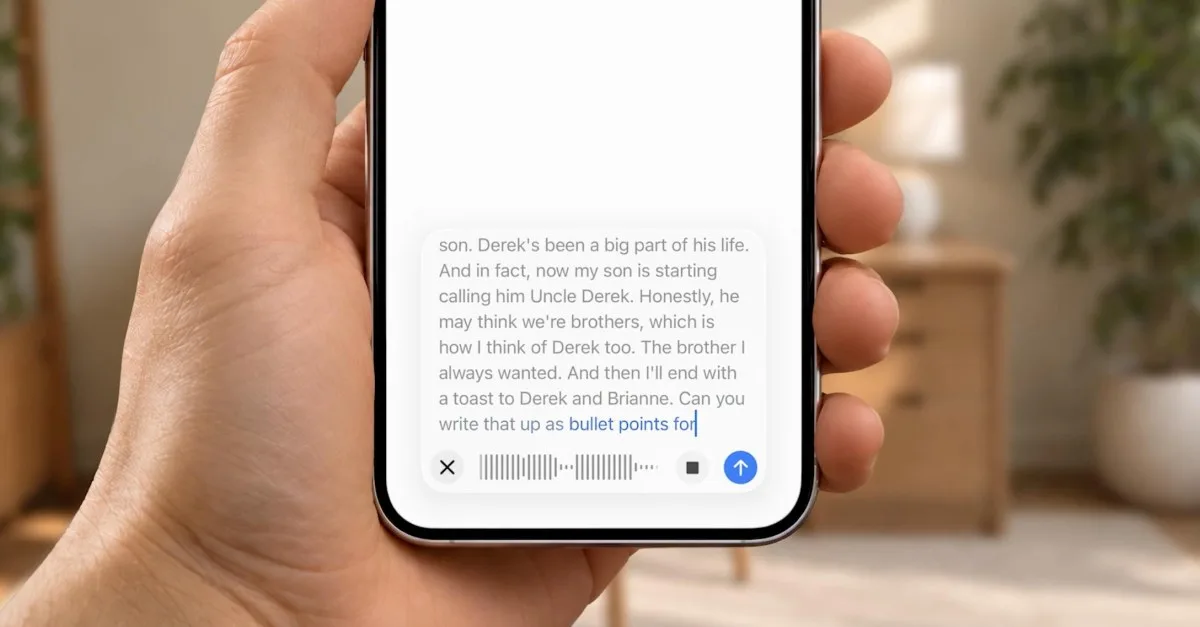
ChatGPT now transcribes dictation as you speak and drops the 10-minute limit
OpenAI has rolled out Live Dictation in ChatGPT on every plan. Speech becomes text while the user is still talking, and recordings are no longer capped at 10 minutes.
OpenAIverified