Copilot can now approve a pull request, if an administrator lets it
GitHub added an approval assessment to every Copilot code review, and a separate setting that lets Copilot submit a real approval. That approval counts toward a repository's required-approvals rule, which means a machine can satisfy a gate that used to need a person. It is off by default and configurable at three levels, down to which file paths Copilot may sign off on. A second changelog entry the same day gives individual user budgets an expiry date.
Source
Copilot code review can now approve pull requestsGitHub Changelog: Copilot · Original published September 1, 2026
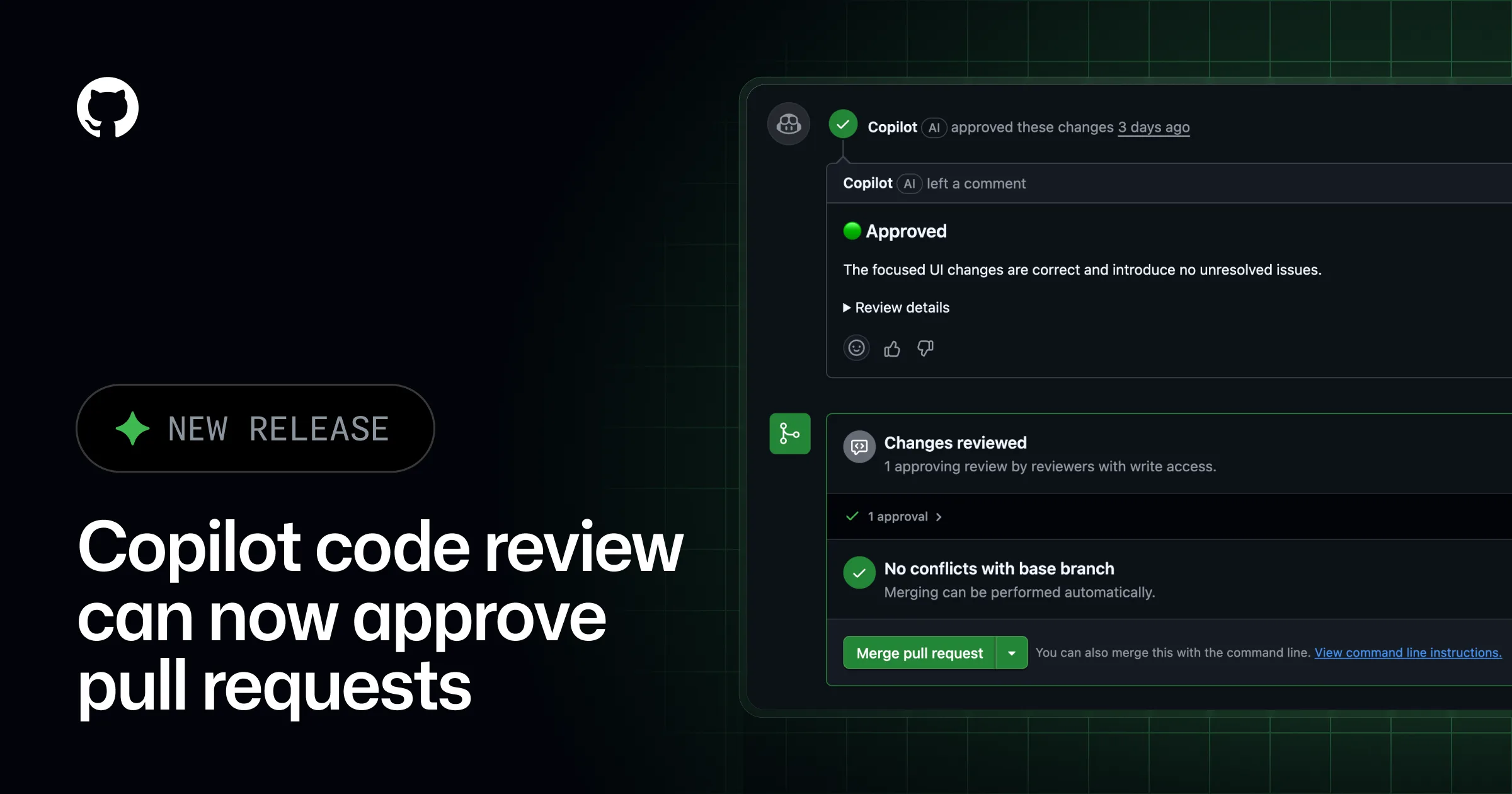
GitHub shipped two Copilot changes on September 1, 2026, and one of them moves a decision that used to belong to a person. Copilot code review can now submit an approval on a pull request, and that approval counts toward the repository's required-approvals rule. The feature is off unless an administrator turns it on, which is the part worth reading twice before anyone does.
What the approval actually does
There are two separate things here, and the changelog keeps them apart. The first is the approval assessment: every Copilot code review now carries, in its overview comment, a signal for whether Copilot considers the pull request ready to approve. GitHub is explicit that this assessment on its own does not count toward merge requirements. It is a read on the model's judgment, surfaced next to the detailed comments.
The second is the approval itself. When an administrator enables it, Copilot submits a review approval that behaves like anyone else's. It counts toward the required-approvals rule, and it is dismissed as soon as new commits are pushed, exactly as a human reviewer's approval would be. A fresh review can then be requested to get a new one. The feature is in public preview on the Copilot Pro, Pro+, Max, Business and Enterprise plans.
Who decides, and at which level
Control sits with administrators at three levels, and the repository level is the one with real granularity.
- Enterprise administrators can leave approvals off across the whole enterprise, or let each organization decide.
- Organization administrators can turn approvals on for the whole organization, delegate the decision to repository administrators, enable it for named repositories, or switch it off.
- Repository administrators turn approvals on or off, and choose which file paths Copilot is allowed to approve.
- The path restriction is the useful lever: generated files, lock files and documentation can be opened to Copilot while application code stays with people.
Budgets can now expire on their own
The second change is smaller and lands on billing. An individual user budget can now carry an optional expiration date, and GitHub removes the budget on that date. The user then falls back to the next budget that applies to them, which is their cost center per-user budget or otherwise the universal budget. GitHub says the point is to stop the manual cleanup that temporary overrides used to require at scale.
The choices when creating or editing a budget are no expiration, which stays the default, expiration at the start of the next billing cycle, or expiration on a specific date in UTC. An expiration can be changed or cleared at any time, and it can be set in the billing settings or through the expires_at field in the Budgets REST API. This one is generally available, on the Copilot Business and Copilot Enterprise plans.
What to weigh before enabling it
The required-approvals rule exists to guarantee that at least one person other than the author looked at a change. Once Copilot can satisfy that rule, the guarantee changes shape: on a repository that requires a single approval, a change can now merge without any person having read it. This suggests the path restriction is not an optional refinement but the main safety control in the feature.
The dismissal behavior helps more than it first appears. Because an approval evaporates when new commits arrive, an author cannot collect a Copilot approval early and then push whatever they like. Anyone enabling this on a shared repository should decide in advance which paths are eligible, and treat the approval assessment, which changes nothing on its own, as the default setting for everything else.
„By default, Copilot will not approve pull requests.“
Sources
Related
OpenClaw 2026.10.2 stops long tool output from slipping credentials past redaction
A bug in OpenClaw's secret masking let a credential through whenever it straddled the boundary between two slices of a long text. The fix ships in 2026.10.2 along with repaired updates from 2026.10.1 and a new compaction default for OpenAI and Anthropic API keys.
OpenClawverified

OpenClaw 2026.10.1 lets agents search installed skills and changes how sessions message each other
OpenClaw released version 2026.10.1 on October 10, 2026, its first stable release since 2026.9.7. Agents can now search the skills installed on a machine and read only the one a task needs, instead of carrying the whole library in the prompt. Opt-in MCP Apps run beside chat, and full backups can go to an external drive or Cloudflare R2. Three changes can break existing setups: session-to-session messaging, the old required argument, and Workboard data stored before July 2026.
OpenClawverified
Claude Code 2.1.294 fixes prompt hooks that let through the actions they were written to block
Anthropic released Claude Code 2.1.294 on October 8, 2026. It fixes prompt and agent hooks phrased as instructions, which could allow exactly the actions they were meant to stop. Version 2.1.295 followed the same day with an onFailure setting that makes a crashed or timed-out command or HTTP hook block the action. Releases 2.1.292 and 2.1.293 from earlier in the week closed several permission and sandbox gaps.
Claude Code Releases (GitHub)verified