Copilot code review resolves its own comments, and Lite reviews now run an ensemble
GitHub shipped the change on September 11, 2026. When a later commit addresses a review comment, Copilot now resolves that comment during its rereview, and feedback that still needs work stays open. The review agent also picked up the full set of shell tools from the Copilot SDK, so it can run builds, tests and targeted scripts against the code it is reading. The Lite effort level now runs an ensemble of agents instead of one, which GitHub measured at 47% more addressed high severity comments per review for about 8% less cost.
Source
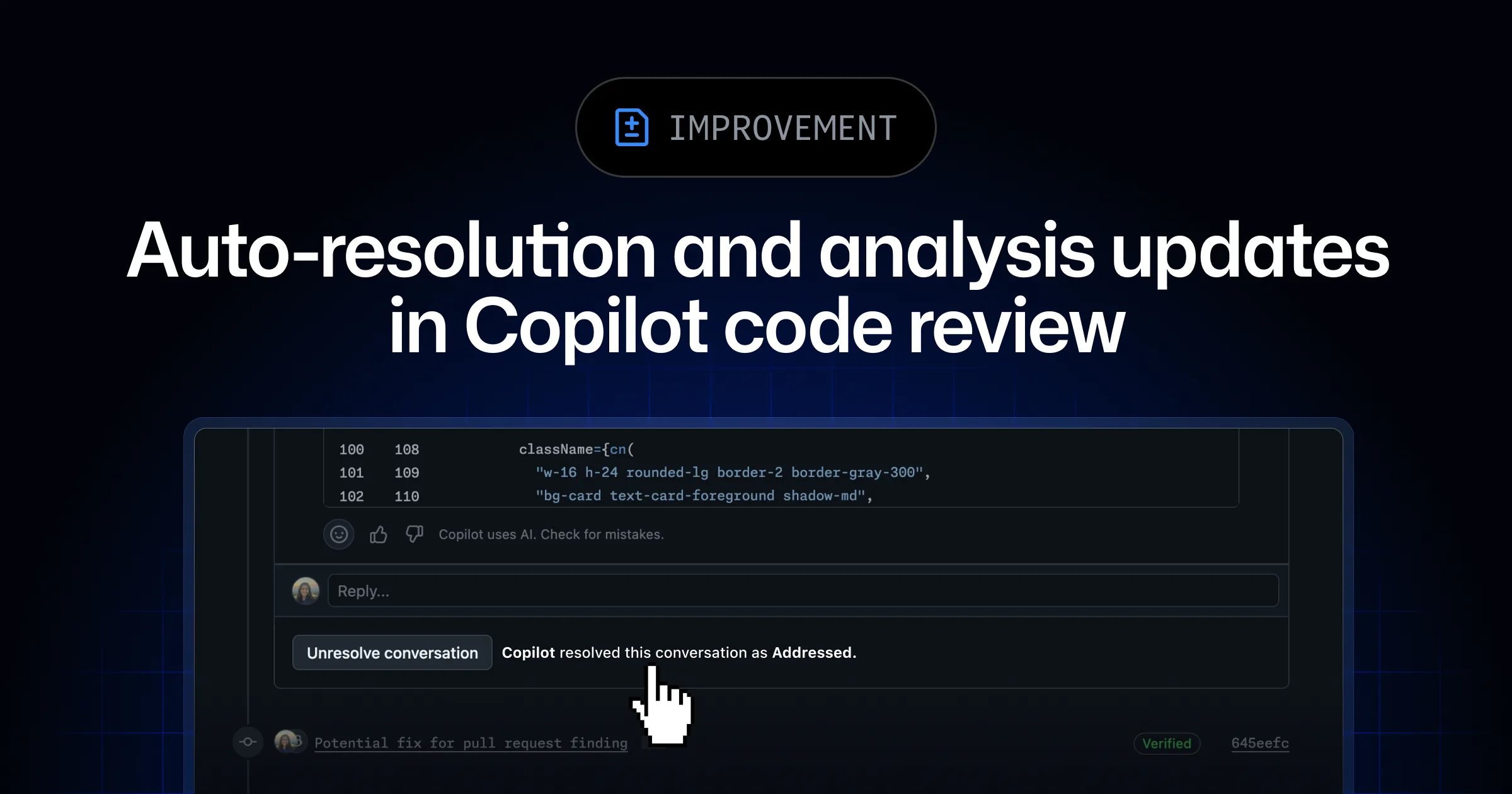
Auto-resolution and analysis updates in Copilot code reviewGitHub Changelog: Copilot · Original published September 11, 2026
A review comment that no longer applies is noise, and until this change someone had to clear it by hand. GitHub changed that on September 11, 2026. When you push a commit that addresses a comment from Copilot code review, Copilot resolves that comment itself during the rereview. Feedback that is still outstanding stays open, so the open threads on a pull request describe what is left rather than everything that was ever said. Applying one of Copilot's suggestions now also fills in a commit message written from the change, instead of the standard one.
What the review agent is now allowed to run
Copilot code review already read the files in a pull request. It now uses the full set of shell tools from the Copilot SDK, running behind the Copilot agent firewall. The review agent can run build commands, execute tests, run a targeted script, and pull information from the tools and APIs available to it. The practical difference is that a review no longer stops at reading the code; it can also run it.
GitHub says that in its own experiments developers left more positive feedback on Copilot's comments, and that Copilot surfaced more high severity findings and fewer nits. No figure was published with that claim, which sets it apart from the measurement in the next section.
The Lite level now works as a committee
Until now a review at the Lite effort level was the work of a single agent. It is now an ensemble: each agent contributes its own reading of the code, and Copilot merges their findings into one review. GitHub reports that the ensemble raised the average number of addressed comments per review by 47% for high severity findings, 31% for medium and 11% for low, while cutting the cost of a review by about 8%.
The figure counts addressed comments, not findings produced, and the difference matters. One reading is that it measures how much of the feedback a developer accepted and acted on, which is a better signal than raw volume but says nothing about what the review missed. The measurement is the vendor's own, published without a description of the sample, and nobody has repeated it independently.
Usage metrics now count the VS Code Agents window
On the same day, GitHub added generally available metrics for the dedicated VS Code Agents window to Copilot usage metrics reports. Aggregate enterprise and organization reports, over both 1-day and 28-day periods, gain a daily count of unique users active in that window and an aggregate of session counts and total user messages. Per-user reports gain an indicator of whether that person used the window, plus the same totals for them.
- The metrics cover only the dedicated VS Code Agents window, and stay separate from editor-window Agent Mode and from generic usage rollups.
- The fields are optional: where the data is unavailable they stay absent or null, so existing reports keep parsing.
- Access goes to enterprise owners and billing managers, organization owners, and anyone with a custom role that grants View Copilot Metrics, and the Copilot usage metrics policy has to be enabled.
„Each agent contributes its own perspective on the code.“
Sources
Related
OpenClaw 2026.10.2 stops long tool output from slipping credentials past redaction
A bug in OpenClaw's secret masking let a credential through whenever it straddled the boundary between two slices of a long text. The fix ships in 2026.10.2 along with repaired updates from 2026.10.1 and a new compaction default for OpenAI and Anthropic API keys.
OpenClawverified

OpenClaw 2026.10.1 lets agents search installed skills and changes how sessions message each other
OpenClaw released version 2026.10.1 on October 10, 2026, its first stable release since 2026.9.7. Agents can now search the skills installed on a machine and read only the one a task needs, instead of carrying the whole library in the prompt. Opt-in MCP Apps run beside chat, and full backups can go to an external drive or Cloudflare R2. Three changes can break existing setups: session-to-session messaging, the old required argument, and Workboard data stored before July 2026.
OpenClawverified
Claude Code 2.1.294 fixes prompt hooks that let through the actions they were written to block
Anthropic released Claude Code 2.1.294 on October 8, 2026. It fixes prompt and agent hooks phrased as instructions, which could allow exactly the actions they were meant to stop. Version 2.1.295 followed the same day with an onFailure setting that makes a crashed or timed-out command or HTTP hook block the action. Releases 2.1.292 and 2.1.293 from earlier in the week closed several permission and sandbox gaps.
Claude Code Releases (GitHub)verified