GitHub Copilot's HydraFusion, which can run two models on one request, reaches VS Code and the Copilot app
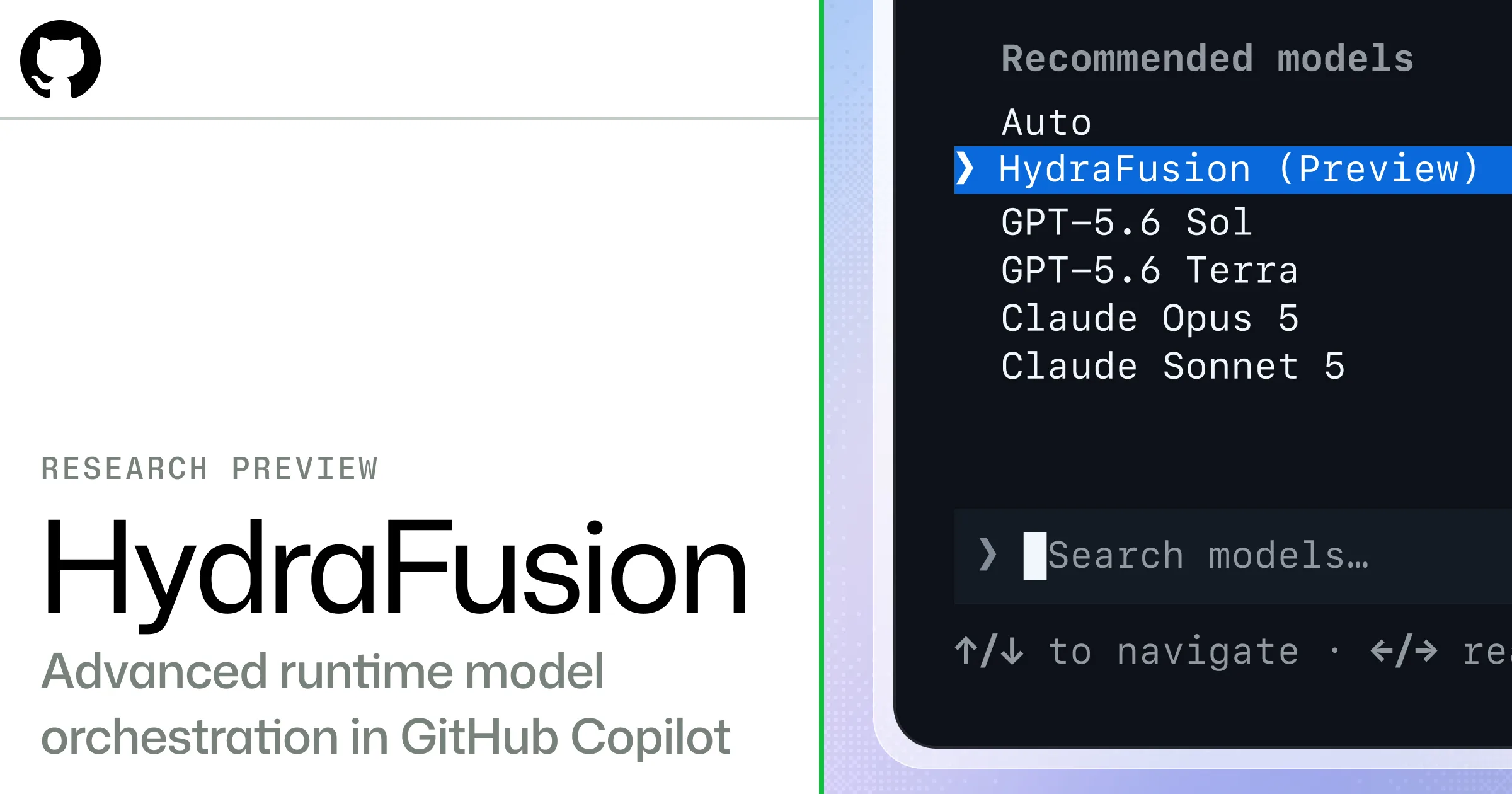
HydraFusion sits in the model picker but is not a model. It chooses one of three workflows per request and can hand a task to two models in a row, one drafting and one checking. GitHub moved the research preview from Copilot CLI to Visual Studio Code and the Copilot app on September 30, 2026, for Pro, Pro+, Business, and Enterprise plans. Billing follows the tokens each model consumes, so a request can cost more or less than a single-model one.
Source
HydraFusion in VS Code and the GitHub Copilot appGitHub Changelog: Copilot · Original published September 30, 2026
Since September 4, HydraFusion existed only inside Copilot CLI, behind the /experimental command. On September 30, 2026, GitHub made the same research preview available in VS Code 1.140 or later and in the GitHub Copilot app. You pick it where you would pick a model, and from there Copilot decides whether one model solves the task or two take turns.
Three workflows, chosen per request
GitHub describes HydraFusion as treating workflow selection as an optimization problem. It reads capability signals for reasoning, code generation, debugging, and tool use, then picks the cheapest execution pattern that it expects to meet the quality bar. The pattern is one of three.
- Single: one selected model solves the task directly.
- Cascade: an efficient model drafts a solution, and a quality gate either accepts it or escalates to a stronger model.
- Critique: one model drafts, an independent read-only critic from a different model family reviews it, following the same review pattern as Rubber Duck, and the drafting model revises once.
How it differs from Auto
Auto, the existing default, selects a model for each request and stops there. HydraFusion selects a workflow and coordinates more than one model within a single turn. GitHub's September 4 research post says it chooses from models across multiple providers, without naming them; Claude Opus 5 and GPT-5.6 Sol served as the comparison baselines.
GitHub's own controlled evaluations from that post put HydraFusion 4.9 percentage points above the Opus 5 baseline on TerminalBench 2.1, at 67% lower estimated cost. On DeepSWE it was 1.5 points below at 36% lower cost, and on CheckpointBench 0.1 points below at 65% lower cost. These are the vendor's offline numbers, with no independent replication.
Who gets it and how to turn it on
The preview is available on Copilot Pro, Pro+, Business, and Enterprise. On Business and Enterprise an administrator has to allow preview features first. In VS Code you select HydraFusion from the Copilot Chat model picker; if it is missing, you enable chat.copilot.hydraFusion.enabled. In the Copilot app you update, search Settings for HydraFusion, turn it on, and pick it from the model picker.
GitHub says the expansion to more surfaces was the top request from early feedback. The same release, GitHub adds, shows each workflow step more clearly, sends progress updates more often, and keeps the status readable during long tasks. It remains a research preview and is subject to change.
What it costs
The September 30 post says nothing about billing. The September 4 post does: usage is based on the tokens consumed by the models HydraFusion runs, priced at each model's standard rate. When the workflow is Cascade or Critique, one request pays for two models. This suggests the bill per request is harder to predict than with a model you chose yourself, and GitHub's cost reductions are averages across benchmark runs, not a guarantee per task.
The same post states the current limit: HydraFusion is optimized for first-turn, single-prompt coding tasks, with multi-turn improvements planned next. A long back-and-forth in chat is not what it was tuned for yet.
„HydraFusion treats workflow selection as an optimization problem.“
Sources
Related
OpenClaw 2026.10.2 stops long tool output from slipping credentials past redaction
A bug in OpenClaw's secret masking let a credential through whenever it straddled the boundary between two slices of a long text. The fix ships in 2026.10.2 along with repaired updates from 2026.10.1 and a new compaction default for OpenAI and Anthropic API keys.
OpenClawverified

OpenClaw 2026.10.1 lets agents search installed skills and changes how sessions message each other
OpenClaw released version 2026.10.1 on October 10, 2026, its first stable release since 2026.9.7. Agents can now search the skills installed on a machine and read only the one a task needs, instead of carrying the whole library in the prompt. Opt-in MCP Apps run beside chat, and full backups can go to an external drive or Cloudflare R2. Three changes can break existing setups: session-to-session messaging, the old required argument, and Workboard data stored before July 2026.
OpenClawverified
Claude Code 2.1.294 fixes prompt hooks that let through the actions they were written to block
Anthropic released Claude Code 2.1.294 on October 8, 2026. It fixes prompt and agent hooks phrased as instructions, which could allow exactly the actions they were meant to stop. Version 2.1.295 followed the same day with an onFailure setting that makes a crashed or timed-out command or HTTP hook block the action. Releases 2.1.292 and 2.1.293 from earlier in the week closed several permission and sandbox gaps.
Claude Code Releases (GitHub)verified