OpenClaw 2026.9.1 rolls back a failed update and adds a host blocklist to its SSRF policy
The September release of the open personal assistant reworks the part that breaks machines. The update command now restores the previous npm candidate when the Doctor run that follows the upgrade fails, and it keeps configuration and secret references through that failure. The same release gives the SSRF policy an explicit list of hostnames to refuse, stops systemd unit backups from carrying Gateway tokens, and draws Mermaid blocks as diagrams inside the chat. One group has to act: anyone on 2026.8.2 without a service manager should run the update once with restarts disabled.
OpenClaw published 2026.9.1 on September 3, 2026. The release notes are long, but three items in them change what an operator actually does. An update that fails no longer leaves the machine half-migrated. The SSRF policy can be given a list of hosts to refuse. Diagrams written as Mermaid blocks are drawn in the chat window instead of being shown as code.
The update path is the headline
A failed upgrade used to be able to leave a machine between two versions. In 2026.9.1 the update rolls back the npm candidate when the Doctor run that follows it fails, and the configuration and the secret references survive that failure. Failures are handed to a built-in triage agent, and the restart waits for plugins to report ready instead of racing them.
Two behaviors changed for people running without a service manager. The update now proceeds without a Gateway service rather than refusing, and an update launched by an agent is allowed to finish outside the Gateway process tree. Local npm archives from npm 12 are accepted.
- Anyone still on 2026.8.2 without a service manager should run the update once with restarts disabled.
- Interrupted credential migrations recover, and credentials replaced during cleanup are preserved.
- Gateway startup survives large agent rosters, and malformed legacy cron rows are quarantined instead of blocking boot.
What the security fixes cover
The SSRF policy gains a blocked-hostnames setting, and it applies to the browser, to web fetches, and to webhooks. Those are the three places where the assistant reaches out on someone else's behalf, and the list is something an operator writes rather than something the tool guesses.
Several fixes close paths by which a secret could leave in plain text. Reading the configuration no longer returns unredacted pre-migration snapshots, systemd unit backups no longer carry Gateway tokens, and the iOS app keeps deep-link URLs out of its logs.
- Commands stop reaching a Watch node once its device has been revoked.
- The Copilot Azure BYOK proxy now requires the per-process nonce.
- Webhook rate limits are isolated per client, and oversized A2A JSON-RPC batches and responses are rejected.
Diagrams, a shorter first run, and personal skills
Mermaid blocks now render as diagrams in the Control UI and in the native macOS, iOS, and Android apps, with an enlarged preview and a retry when a diagram fails to draw on mobile. The use is obvious enough: an agent that explains a system can now show it rather than print it.
A fresh install, npx openclaw@latest included, gets a quick-start lane that detects an existing Claude Code or Codex login and any API keys, verifies them live, and opens the web dashboard from a foreground Gateway; the full wizard stays available as Custom setup. On a shared Gateway, personal skill libraries now sit beside the workspace set, can be imported from ZIP archives, and can be shared or published per identity.
Models and configuration
The release adds Anthropic Fable 5.1 through shared model metadata, shows SuperGrok usage in the model list and the usage panel, keeps GPT-5.6 Ultra selected across runtime boundaries, and keeps Sonnet 5 pricing current on Vertex. Local providers were tidied up as well: llama.cpp models behind web-app endpoints are discovered, and model catalogues refresh after an auth or config change without a restart.
On the configuration side, missed recurring jobs can be skipped at startup with cron.skipMissedJobs, a channel switched off with enabled: false no longer loads its plugin at all, and config set accepts guards that fail the write when the current value is not what the caller expected. Agents can be given a default working directory, a global worktree root, and up to 100 managed checkouts.
„Updates that leave you working“
Related
OpenClaw 2026.9.2 turns Swarm on by default and makes sessions visible to other agents
The open personal assistant shipped 2026.9.2 on September 5, 2026, and two of its lines describe defaults rather than features. Swarm, which runs several sub-agents at once, is now on unless it is switched off, and session tools now show every session instead of only the calling agent's. The same release makes GPT-6 Astra selectable, applies most settings changes without restarting the Gateway, and moves plugin icons into the package. Plugin authors get a date: the deprecated prompt-context aliases become eligible for removal on or after September 8, 2026.
OpenClawverified
Claude Code 2.1.261 changes what Ctrl+W does and stops auto-approving diagram-renderer links
The release that landed on September 4, 2026 is mostly fixes, but four entries change behavior that was already there. The prompt's word-editing keys now match Bash, and the setting that used to select a keybinding style has no effect at all. Auto mode now treats a link that packs your content into a public diagram renderer's URL as an upload to that site, so it is no longer approved without you. Two new settings raise how much command output reaches the model inline, up to 128,000 characters.
Anthropicverified
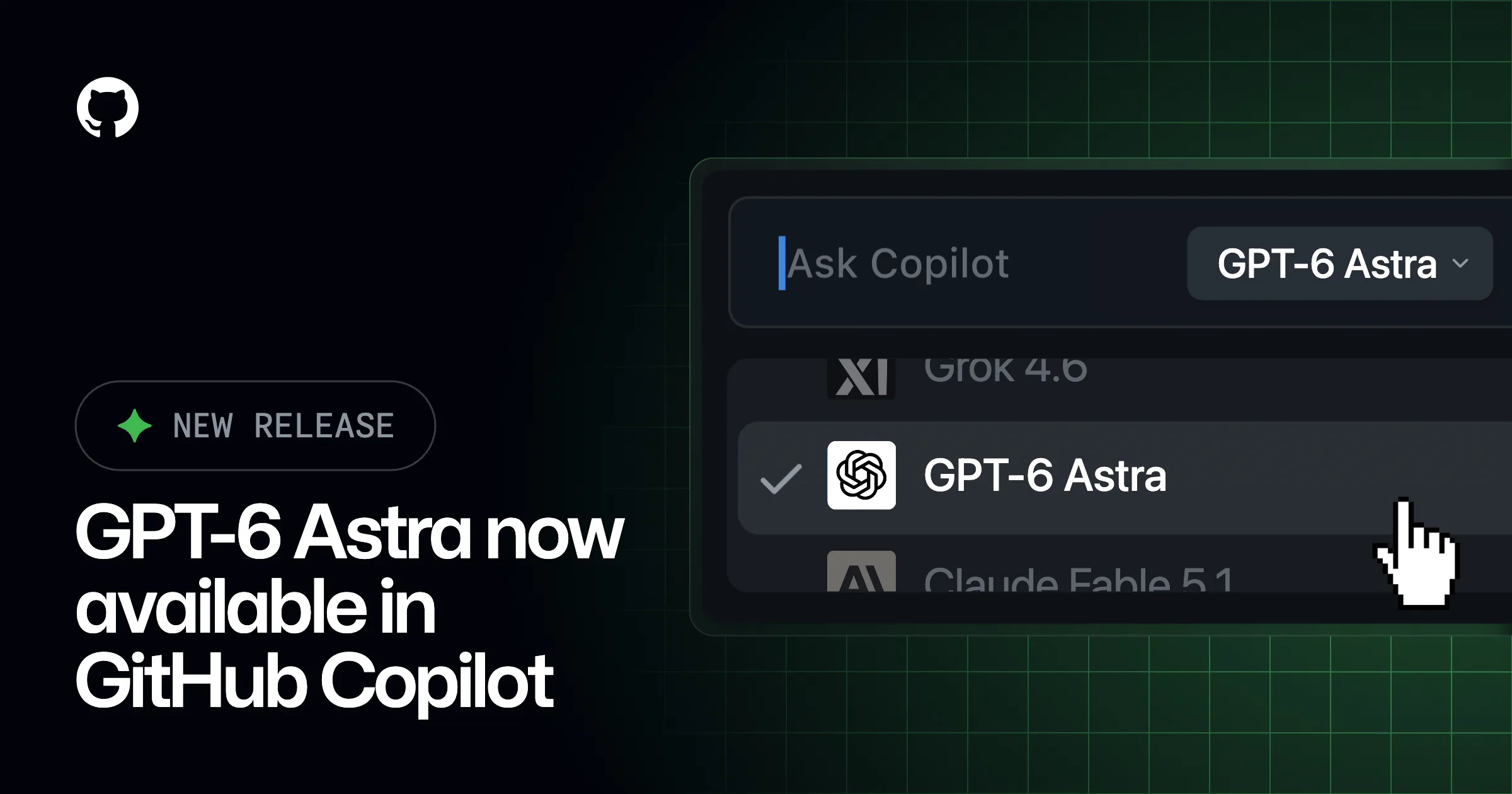
GitHub Copilot switches GPT-6 Astra on by itself and leaves Claude Fable 5.1 off
GPT-6 Astra became generally available in GitHub Copilot on September 4, 2026, for the Pro+, Max, Business, and Enterprise plans. Claude Fable 5.1 reached the same four plans three days earlier. The two arrived with opposite administrator defaults: Astra is enabled automatically under default model enablement, while the Fable 5.1 policy is off until someone turns it on. Fable 5.1 is also the one that retains prompts and outputs, and the zero-retention exemption runs only to the end of the calendar year.
GitHubverified