Skip to content

Tags

local models

17 items
LLAMA.CPP B115567.63 GBBonsai 2 27B without the fork
Machines & local modelsmedium signal

llama.cpp now runs PrismML's ternary Bonsai 2 27B without the company's fork

Build b11556 adds the weight rotation step that Bonsai 2 27B was missing in stock llama.cpp. The 7.63 GB Q2_0 file now gives correct output there, while PrismML's smaller PQ2_0 and PTQ1_0 packs still require the company's own build.

llama.cppverified
Agentsmedium signal

GitHub Copilot ships a local sandbox for agent commands and lets its CLI pick models from Ollama

On October 7, 2026, GitHub made local sandboxing for Copilot generally available in the Copilot CLI, the GitHub Copilot app, and VS Code sessions that use Agent Host, at no extra cost. The sandbox limits what a command Copilot runs can read, write, and reach on the network, and it is off until you or your organization turn it on. The same day the CLI gained a picker for models served by a local Ollama instance, and Claude Haiku 5.5 joined the model list for paid plans.

GitHub Changelogverified

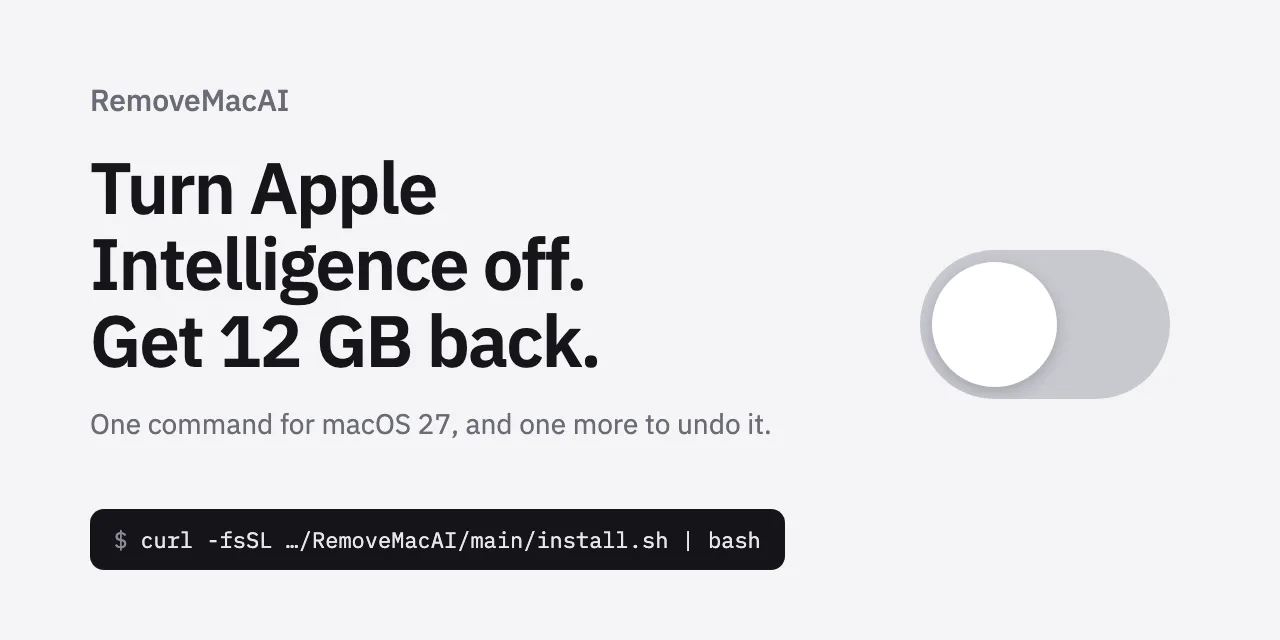
RemoveMacAI's project card: the heading Turn Apple Intelligence off. Get 12 GB back., a line about one command for macOS 27 and one more to undo it, a toggle switch in the off position, and the install command in a terminal box.
Toolsmedium signal

An open source tool turns off Apple Intelligence on macOS 27 and deletes its models

RemoveMacAI is an open source command line tool that turns off Apple Intelligence on macOS 27, removes the downloaded models, and blocks macOS from downloading them again. Its author says macOS 27 no longer has a single switch for these features and keeps the models on disk after they are turned off. MacRumors puts the space freed at roughly 12 GB, depending on which models are installed. The first release came out on September 29, 2026, and four more followed by October 5, 2026.

RemoveMacAIverified

Machines & local modelsmedium signal

llama.cpp 0.6.0 adds GLM-5.3-Flash support and a server API for decision models

The llama.cpp project released version 0.6.0 on October 5, 2026. It adds support for GLM-5.3-Flash, a model for text and images with 320 billion parameters, and a new server endpoint for decision models. Two changes to speculative decoding come with measurements from their authors, one on Nvidia's DGX Spark and one on Apple GPUs. The release also changes the C API and raises the version of the saved session format, so programs built on the library need a check before you upgrade.

llama.cppverified

Modelsweak signal

Ai2 releases AstaBrief, an open-weights model that writes cited research reports

Ai2 released the weights and training data for AstaBrief on October 2, 2026. The model takes a research question plus retrieved excerpts from the literature and writes a report with citations. Ai2 measures it at 51.1 seconds per report in its Asta platform, against 178.5 seconds for the Claude-powered mode beside it. The license is Apache 2.0, and Ai2 says its evaluation predates the current frontier models.

Ai2verified

Agentsmedium signal

Google's Antigravity SDK can now run agents offline on a local Gemma 4 model

Google added local model support to the Antigravity SDK on September 23, 2026. The first supported setup is Gemma 4 26B A4B running through LiteRT, and Google recommends more than 24 GB of video or unified memory. The SDK can also talk to local servers such as Ollama, LM Studio, and vLLM.

Google Developers Blogverified

Machines & local modelsmedium signal

llama.cpp 0.5.0 adds the HRM-Text architecture and lets its server listen on several addresses

The llama.cpp project released version 0.5.0 on September 23, 2026. It adds support for HRM-Text, the architecture behind DFM Mimir 1B, and conversion for MiMo-V2.6. The server can now listen on several addresses at once, and router mode no longer passes the API key file to the model processes it starts.

llama.cppverified

Machines & local modelsmedium signal

Transformers now loads llama.cpp GGUF quants on Apple Silicon

A GGUF checkpoint can be passed straight to from_pretrained and run with its weights still packed, using ggml's Metal kernels through the kernels library. The target is a single interactive conversation on an Apple Silicon Mac, and the packed path covers the Qwen3.5 dense and mixture-of-experts architectures plus compatible Qwen3.8 checkpoints. Hugging Face says the result comes close to llama.cpp on the three checkpoints it measured, while noting the two measurements were not taken under identical conditions. It still recommends llama.cpp when efficient local inference is the priority.

Hugging Faceverified

Machines & local modelsmedium signal

llama.cpp stops handing the API key file to child servers in router mode

Build b11077, published on September 21, 2026, fixes an authentication bug in llama.cpp's router mode. When a server was started with both a key on the command line and a file of keys, the child instances it spawned validated against the file only, so a client using the command-line key could list models but got 401 on every chat request. The same change stops the key file path from reaching a child process at all. It is one line in one file, and it is the difference between a working deployment and one that looks healthy while refusing work.

llama.cppverified

Machines & local modelsstrong signal

Apple claims 4.3x faster AI on Mac Studio, and the 512GB configuration arrives in late October

Mac Studio with M5 Max and the all-new M5 Ultra reaches stores on September 22, 2026, and Apple puts its AI performance at up to 4.3x the previous generation, measured in July 2026 against a machine with M3 Ultra. The configuration that decides how large a local model can be, 512GB of unified memory at up to 1.2TB/s, sits in a footnote: it comes in late October. On the software side the new Siri AI ships in beta, in English to start, and will not be available in the EU on iOS, iPadOS or watchOS at launch. Apple Intelligence features that run on server-side models also have daily usage limits, and Apple says wider access to them will be sold for a fee later.

Appleverified

Machines & local modelsmedium signal

llama.cpp 0.4.0 adds four model architectures, an Apple RDMA transport, and video flags

The 0.4.0 release landed on September 4, 2026, and it is a numbered version rather than one of the nightly builds. It adds initial support for Qwen3.8-Flash-Next, NVIDIA Nemotron-3-Puzzle-75B-A9B, DSpark on Nemotron 3.5, and nanbeige4.2-3B. Apple RDMA becomes an RPC transport, video arrives as command-line options, and the quantizer gains a memory ceiling. Two server defaults changed, and saved session state carries a new version number.

llama.cppverified

Agentsmedium signal

OpenClaw 2026.9.1 rolls back a failed update and adds a host blocklist to its SSRF policy

The September release of the open personal assistant reworks the part that breaks machines. The update command now restores the previous npm candidate when the Doctor run that follows the upgrade fails, and it keeps configuration and secret references through that failure. The same release gives the SSRF policy an explicit list of hostnames to refuse, stops systemd unit backups from carrying Gateway tokens, and draws Mermaid blocks as diagrams inside the chat. One group has to act: anyone on 2026.8.2 without a service manager should run the update once with restarts disabled.

OpenClawverified

Machines & local modelsstrong signal

NVIDIA's free PAIR beta sends local inference to whichever machine on your network is free

NVIDIA published the Personal AI Router at IFA 2026 on September 3, 2026. It is a free, open source tool for Windows, macOS, and Linux that finds compatible machines on your local network and routes each independent inference request to one that has capacity, so parallel agent subtasks stop queueing behind a single GPU. It works with Ollama and LM Studio, and supports GeForce RTX 20 Series and newer, RTX PRO workstation cards, DGX Spark, and Apple M4 silicon. What it does not do is pool memory, so a model that does not fit on one machine still does not fit.

NVIDIAverified

Machines & local modelsmedium signal

llama.cpp spent two days on long context, and the gains landed on three different backends

Between August 29 and 31, 2026, llama.cpp shipped a run of changes that all point at the same place: the part of inference that gets slower as the context grows. Vulkan, CUDA and the Metal and OpenCL paths each got their own fix, with numbers the authors published. Three crashes were closed alongside them. None of it needs a flag; it arrives with the next build.

llama.cppverified

Industrymedium signal

Gemma passes a billion downloads and 100,000 derived models

On August 20, Google announced that the Gemma family of open models has passed a billion downloads. In two years the community has published more than 100,000 derived models, and the most recent Kaggle competition drew more than 1,600 entries. An Awesome Gemma repository launched with the announcement, meant as an index of vetted projects, fine-tuned models, tutorials, and tools. The figure matters to someone building sites too, because a model you run on your own server stops being exotic, which makes text processing without sending data to a third party workable.

Googleverified