Anthropic previews a standard that lets agents drive laboratory hardware
The Model Hardware Standard gives an agent one driver format for microscopes, liquid handlers and robotic arms, cutting integration work that used to take weeks down to hours or minutes. It is model-agnostic and reachable over the Model Context Protocol, but for now it is open only to selected labs and manufacturers, by application.
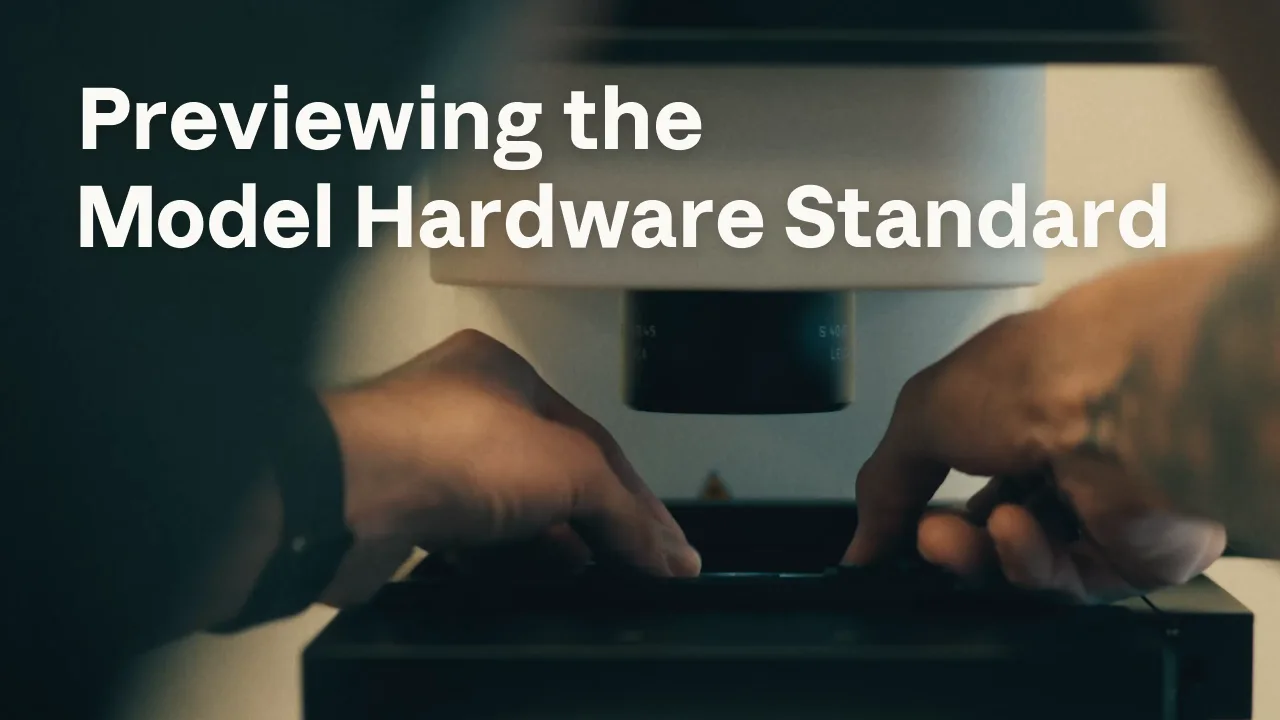
Anthropic opened a research preview of the Model Hardware Standard on August 27, a shared specification that lets AI agents operate physical laboratory and manufacturing equipment. The work began as a collaboration with HHMI Janelia Research Campus, and it is going first to a selected group of research labs and advanced manufacturers rather than to everyone.
What the standard actually does
Most laboratory instruments do not talk to each other. Each carries its own programming interface, and connecting them has meant paying specialists to build bespoke integrations, work that Anthropic says typically takes weeks or months. MHS replaces that with a single standardised driver built on primitives as plain as read and write, such as get temperature and set temperature, which any programmable device can act on.
The driver also carries what code alone never states. Tags let an operator describe a machine in plain language, or have an agent interview them about the setup, and the driver turns that into a reference file listing what the device measures, what can be adjusted and which safety limits apply. Anthropic's own example is the weight of a robot arm: absent from any API, and decisive for handling it safely.
Control runs over three routes, MCP, the command line and code files, and the standard is model-agnostic, so any agent harness that speaks those protocols can reach it. When a task runs too long or too fast for step-by-step reasoning, the agent chains driver commands into a code file and lets the instruments execute on their own.
What the partners measured
Anthropic published five early projects. The figures below are the partners' own.
- QuEra Computing gave an agent control over part of the laser system inside its neutral-atom quantum computers. The agent built a controller that recovers the laser's lock, the precise frequency the lasers must hold to interact with the atoms, 99.3 percent of the time without a person stepping in.
- Carnegie Mellon researchers ran serial dilution dose-response experiments about three times faster than before, with one agent orchestrating a liquid handler, a plate reader, a robotic arm and monitoring cameras spread across three computers with fundamentally incompatible interfaces.
- At HHMI Janelia, a microscopy rig that had previously required seven separate vendor programs with no shared interface was brought under one.
- Genentech tested the standard on the BCA protein assay, a routine measurement of total protein concentration that needs a liquid handler, a robotic arm and a plate reader working together.
What is not settled
The preview is an application, not a download. Anthropic says the standard will be open-sourced later and does not name a date, and the stated reason for holding it back is that safety evaluations and best practices for AI systems driving physical equipment do not exist yet. The partners are being asked to help write them.
Hardware vendors are moving regardless. Amazon Web Services will support MHS through Strands Robots, its library for connecting agents to physical devices, and is giving preview participants a private pre-release of that package. Automata is adding MHS support to LINQ, its lab automation platform.
„MHS works with any device that has a programmable interface.“
Related
OpenClaw 2026.10.2 stops long tool output from slipping credentials past redaction
A bug in OpenClaw's secret masking let a credential through whenever it straddled the boundary between two slices of a long text. The fix ships in 2026.10.2 along with repaired updates from 2026.10.1 and a new compaction default for OpenAI and Anthropic API keys.
OpenClawverified

OpenClaw 2026.10.1 lets agents search installed skills and changes how sessions message each other
OpenClaw released version 2026.10.1 on October 10, 2026, its first stable release since 2026.9.7. Agents can now search the skills installed on a machine and read only the one a task needs, instead of carrying the whole library in the prompt. Opt-in MCP Apps run beside chat, and full backups can go to an external drive or Cloudflare R2. Three changes can break existing setups: session-to-session messaging, the old required argument, and Workboard data stored before July 2026.
OpenClawverified
Claude Code 2.1.294 fixes prompt hooks that let through the actions they were written to block
Anthropic released Claude Code 2.1.294 on October 8, 2026. It fixes prompt and agent hooks phrased as instructions, which could allow exactly the actions they were meant to stop. Version 2.1.295 followed the same day with an onFailure setting that makes a crashed or timed-out command or HTTP hook block the action. Releases 2.1.292 and 2.1.293 from earlier in the week closed several permission and sandbox gaps.
Claude Code Releases (GitHub)verified