GitHub puts Grok 4.7 in Copilot at the same rate it charges for 4.6
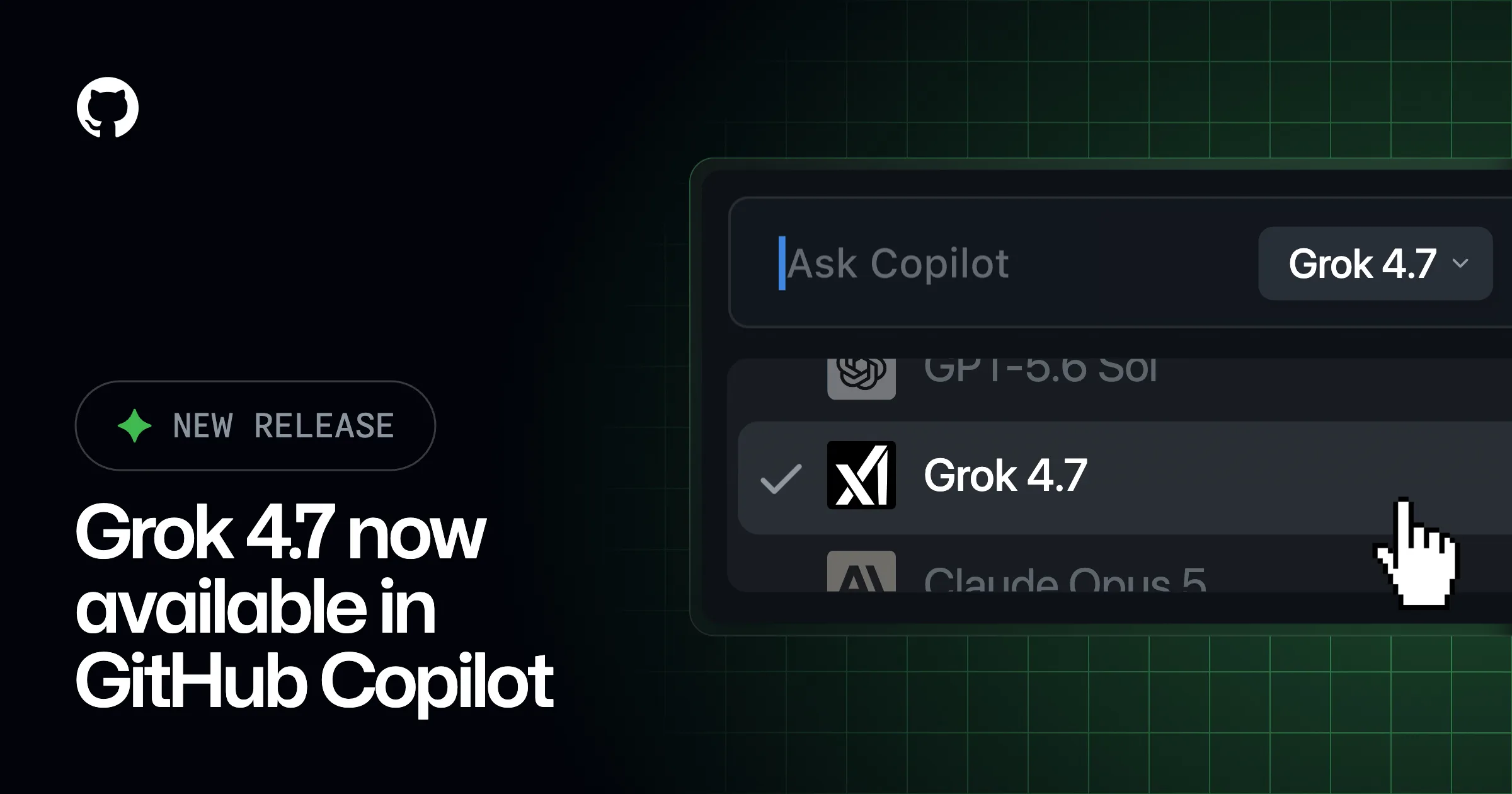
GitHub started rolling out Grok 4.7 in Copilot on September 21, 2026. The model is billed at provider list pricing under usage-based billing, and the documentation puts it at $2.00 per million input tokens and $6.00 per million output tokens below 200K of context, exactly what Grok 4.5 and 4.6 cost in the same table. It reaches Copilot Pro, Pro+, Max, Business and Enterprise, and the model picker in eight places, from Visual Studio Code to Eclipse. For a company on Business or Enterprise, a new model switches itself on unless an administrator has already turned the default off.
Source
Grok 4.7 is now available in GitHub CopilotGitHub Changelog: Copilot · Original published September 21, 2026
A new model in the picker is a billing event before it is a capability. On September 21, 2026, GitHub said Grok 4.7 is rolling out in Copilot, billed at provider list pricing under usage-based billing rather than at a flat request multiplier. The rate is written down: $2.00 per million input tokens, $0.50 per million cached input tokens and $6.00 per million output tokens for requests below 200K of context. That is the same rate the pricing table carries for Grok 4.5 and Grok 4.6.
What is available, and where
GitHub describes Grok 4.7 as xAI's latest reasoning model, built on Grok 4.6 and "designed for agentic coding and complex, multistep workflows". No benchmark result is published with the announcement, so the comparison with the model you already use is something you make in your own work rather than something the changelog settles.
The rollout is gradual, which means the entry can be absent from your picker for a while after the announcement. The plans named are Copilot Pro, Pro+, Max, Business and Enterprise; Copilot Free is not on the list.
- Visual Studio Code, Visual Studio, JetBrains, Xcode and Eclipse show the model in the picker.
- So do the Copilot CLI, the Copilot cloud agent and the GitHub Copilot app.
- Rollout is gradual, so absence from the picker is not a fault to report.
- Copilot Free is not among the plans that receive the model.
What it costs
Under usage-based billing, tokens are converted into GitHub AI credits, where one credit is worth $0.01. Usage inside a plan's allowance is covered; anything beyond it is billed in credits at the per-token rate of the model that produced it. For Grok 4.7 the documentation lists two context tiers. Below 200K tokens the rate is $2.00 per million input tokens, $0.50 per million cached input tokens and $6.00 per million output tokens; above 200K it doubles to $4.00, $1.00 and $12.00.
The same table lists Grok 4.5 and Grok 4.6 at identical numbers in both tiers, so the newer model does not cost more than the ones it follows. That is the useful part of this release for anyone watching a Copilot bill: the decision to switch does not have to be priced, only tested. The long-context tier is worth noting anyway, because it doubles every column at once, and a large repository fed into an agent crosses 200K without anybody choosing to.
Who decides in a company
On Business and Enterprise plans, access to models runs through the model policy in Copilot settings. Default model enablement is the part that matters: a new model is enabled automatically unless an administrator has turned the global default off or disabled that specific model. Nothing has to be approved for Grok 4.7 to appear.
This suggests the default lands the decision with individual developers and the bill with the organization. An administrator who wants the opposite has to act before the rollout reaches their seats, not after, because the spending happens at the moment somebody picks the model from a list.
„designed for agentic coding and complex, multistep workflows“
Sources
Related
OpenClaw 2026.10.2 stops long tool output from slipping credentials past redaction
A bug in OpenClaw's secret masking let a credential through whenever it straddled the boundary between two slices of a long text. The fix ships in 2026.10.2 along with repaired updates from 2026.10.1 and a new compaction default for OpenAI and Anthropic API keys.
OpenClawverified

OpenClaw 2026.10.1 lets agents search installed skills and changes how sessions message each other
OpenClaw released version 2026.10.1 on October 10, 2026, its first stable release since 2026.9.7. Agents can now search the skills installed on a machine and read only the one a task needs, instead of carrying the whole library in the prompt. Opt-in MCP Apps run beside chat, and full backups can go to an external drive or Cloudflare R2. Three changes can break existing setups: session-to-session messaging, the old required argument, and Workboard data stored before July 2026.
OpenClawverified
Claude Code 2.1.294 fixes prompt hooks that let through the actions they were written to block
Anthropic released Claude Code 2.1.294 on October 8, 2026. It fixes prompt and agent hooks phrased as instructions, which could allow exactly the actions they were meant to stop. Version 2.1.295 followed the same day with an onFailure setting that makes a crashed or timed-out command or HTTP hook block the action. Releases 2.1.292 and 2.1.293 from earlier in the week closed several permission and sandbox gaps.
Claude Code Releases (GitHub)verified