GitHub will turn on unconfigured Copilot features on October 22 unless administrators choose otherwise
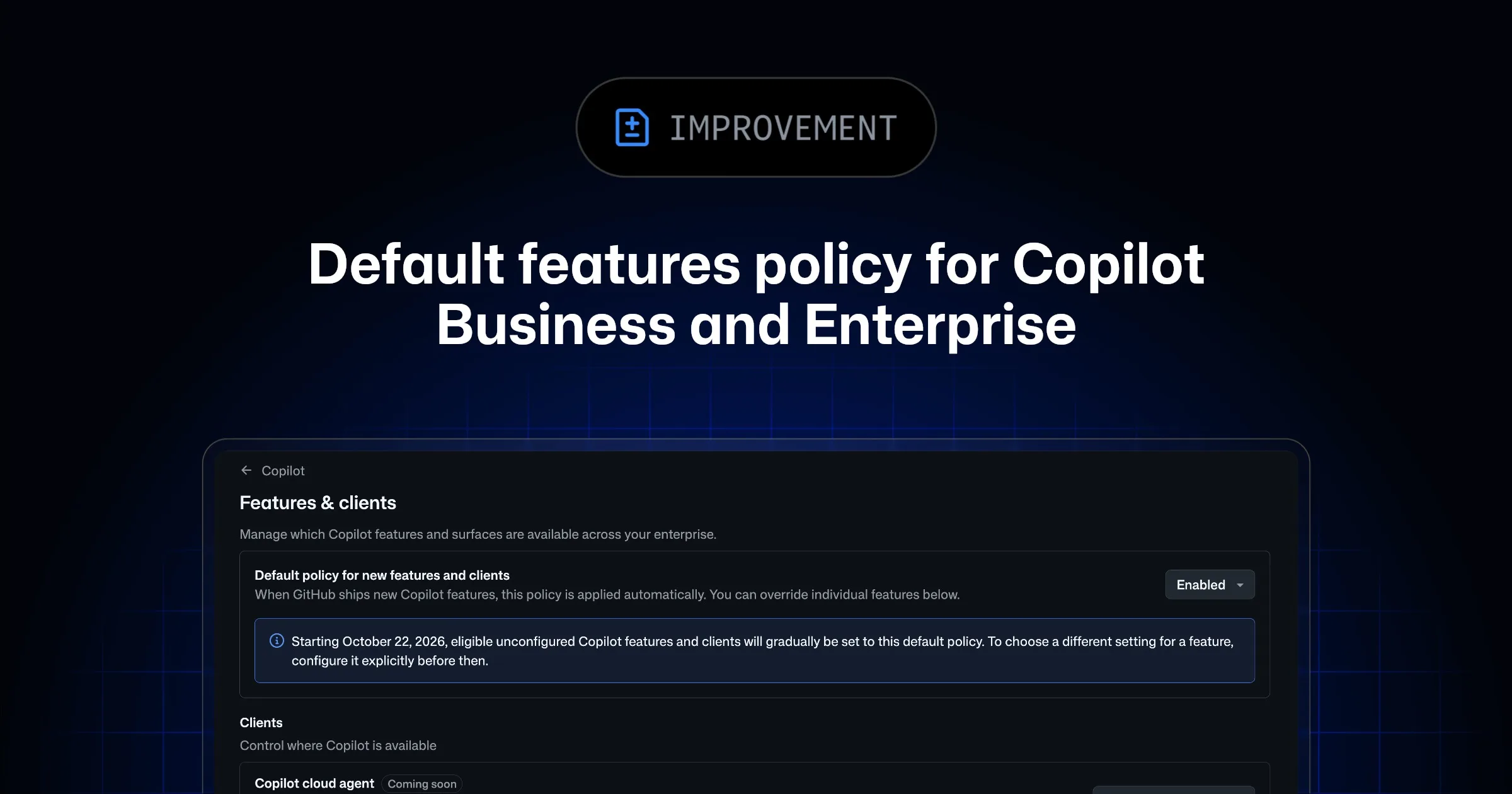
GitHub added a global default policy for Copilot Business and Copilot Enterprise on September 24, 2026. From October 22, generally available features that an administrator never configured will follow that default, and the default is Enabled. The policy also covers Copilot code review and MCP servers in Copilot.
Source
Default Enablement of Copilot Features for Copilot Business and EnterpriseGitHub Changelog: Copilot · Original published September 24, 2026
GitHub announced a new setting, Default policy for new features, in the AI Controls section of enterprise and organization settings. You can configure it now, and for 28 days it does not change what your users can reach. On October 22, 2026, it starts deciding the status of every eligible feature left as Unconfigured.
What the policy decides
The policy has three values. Enabled makes current and future eligible features available to users by default. Disabled keeps current eligible features off and requires administrator approval for future ones. Let organizations decide passes the choice to organization owners.
According to GitHub's documentation, the policy itself is enabled by default. An enterprise that does nothing before October 22 will therefore see its unconfigured, generally available features switched on.
What counts as a feature
The policy covers every policy on the enterprise's Features & clients page, plus two more that matter in a security review:
- the Copilot code review policy on the Agents page;
- the MCP servers in Copilot policy on the MCP page, which governs whether Copilot can use Model Context Protocol (MCP) servers.
What stays as it is
Explicit decisions are preserved, so a feature an administrator enabled or disabled keeps that setting. Preview features remain opt-in, and a preview someone opted into keeps that choice when it becomes generally available.
Two groups of policies are excluded. One restricts Copilot to data residency or FedRAMP models on GHE.com. The other stores local Copilot CLI and VS Code sessions in the cloud.
Models already follow a similar rule
A separate policy for models, Default availability for released models, is already active. Some models stay disabled whatever it says: pre-release models, open-weight models such as DeepSeek and Kimi K3, and Claude Fable 5 and Claude Fable 5.1. GitHub says those two are not covered by its data retention agreement.
„If you don't take action, unconfigured features will be enabled on October 22.“
Sources
Once a week, in your inbox
The whole week's news, gathered into one email. No ads, no passing your address on, one-click unsubscribe.
The address is used only for this roundup. It is not sold and not passed to anyone.
Related
GitHub will bill organizations for Copilot code review by default starting December 30
GitHub said on November 25, 2026, that Copilot code review for licensed members will be billed to the organization that owns the repository whenever no billing choice has been saved. The change applies to Copilot Business and Copilot Enterprise. Administrators who want to keep the current arrangement have to select Member before December 30, 2026.
GitHub Changelogverified
OpenClaw 2026.11.10 turns on Deep Research by default and lets users take over the agent's browser
OpenClaw's new release includes Deep Research, which looks through several sources and returns a report with quotes and gaps marked. It is on by default and uses the models the user has already set up. A second addition lets a user take over a browser tab during a sign-in, although the agent can still capture the page. The optional Knowledge plugin stores memory in local Markdown files.
OpenClawverified

AWS WAF will bill each protected resource from February 2027 and drop its fees for rules
Amazon is changing how it charges for AWS WAF, the firewall that filters traffic to web applications. Rules and rule sets become free, while every protected resource gets an hourly fee. Sites with many rules on a few resources stand to pay less, and companies that cover many resources with one rule set can pay several times more.
AWSverified