Google's CC agent gets an account of its own and admits six household members
Google Labs has turned CC, its experimental personal agent, into one that a household shares. The agent now holds its own verified Google account, admits up to six members, and reads only the mail and files each of them hands over. It writes a shared morning brief, keeps the group calendar and task list, and fills in registration PDFs. The experiment is open on web and mobile to people 18 and older in the United States.
Source
The new CC, an AI agent built for familiesGoogle: The Keyword, AI · Original published September 17, 2026
Every CC now runs under a verified Google account of its own. Google Labs described the change on September 17, 2026: the experimental agent that used to work out of one person's inbox has become a shared one, with up to six members who each decide separately what it may read. The work it takes over is the coordination a household does by hand — who has to be where, which form is due, what goes on the shopping list.
An account is what makes the agent a participant
Giving the agent its own Google account is more than bookkeeping. It shows up in a thread or on a calendar entry as itself, under a permissions model every member can inspect, rather than acting through the account of whoever set it up. Google says it answers only to members of the group and takes no action outside it without permission.
Each member joins separately and shares separately. A person can hand CC the mail from a school, a swim center or a vet and keep everything else private, and can change that at any time. An Auto "cc" CC setting marks senders whose mail always goes to the agent, and once a week each member receives a private list of new senders to accept or ignore.
What it does with what it is given
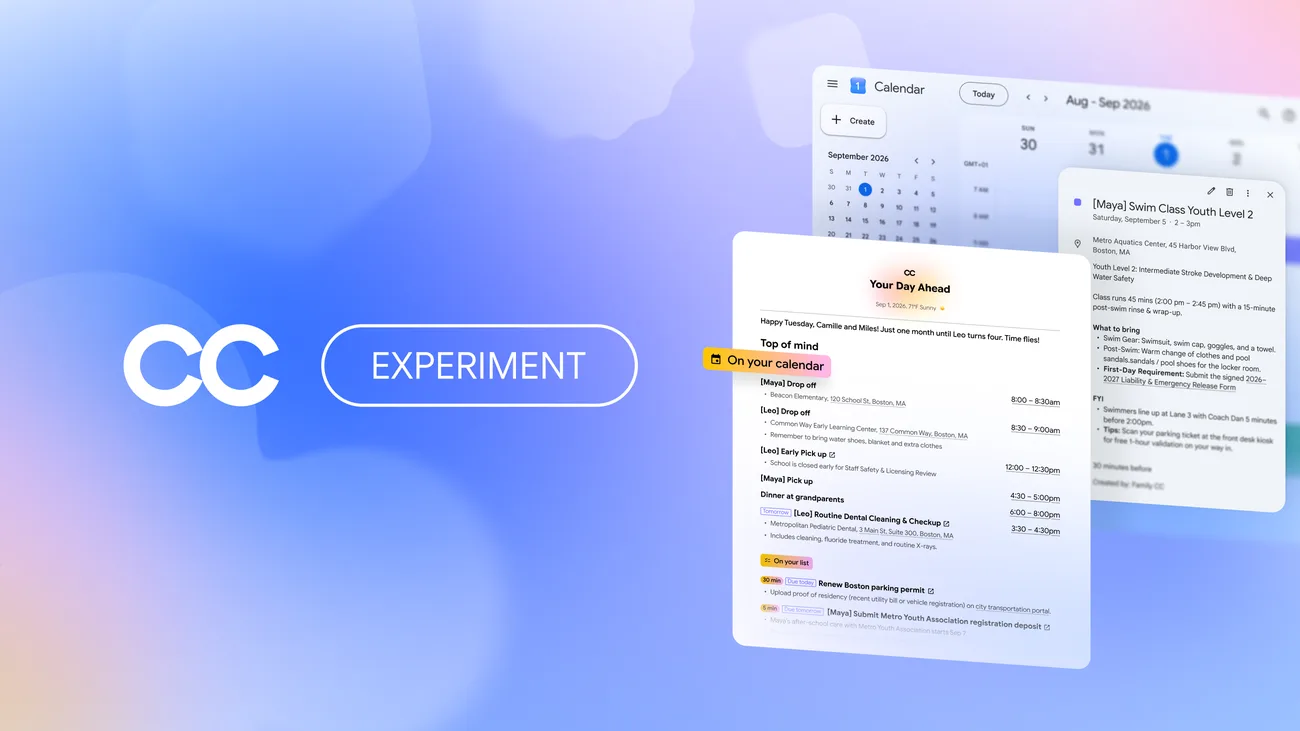
Each morning the agent sends the group a brief called Your Day Ahead. It states who has to be where, what is still open, and what the agent finished the previous day, so the information does not sit in one person's inbox or in one person's head.
It also acts. It tracks dates and to-dos, writes them into a shared calendar and task list, and keeps them current as plans change. It fills in permission slips and activity registration PDFs, builds school supply lists, and drafts weekly meal plans, asking for whatever detail it is missing and storing the answer in a group memory.
- A member can forward a single message — a photographed party invitation, a practice schedule — by mail or Google Chat and have the calendar updated from it.
- Drive folders, individual files and calendars can be shared with the agent directly.
- The shared memory separates what applies to the whole household from what belongs to one person, such as a dietary preference or a time zone.
- Google says the agent asks before it acts on a form.
Where it runs, and who can have it
Each CC runs on an isolated cloud computer of its own, on Google's agentic harness Antigravity and the latest Gemini models. That is what lets it pre-fill class registration PDFs, read live drive times from the Google Maps API between back-to-back activities, and write shared Docs and Sheets rather than only summarize.
It remains an early Google Labs experiment, available on web and mobile to people 18 and older in the United States with a personal Google account. Existing users are told to expect an upgrade email in the coming days; everyone else joins a waitlist. What it will cost once the experiment ends is not stated.
„CC only sees what each member chooses to share“
Related
OpenClaw 2026.10.2 stops long tool output from slipping credentials past redaction
A bug in OpenClaw's secret masking let a credential through whenever it straddled the boundary between two slices of a long text. The fix ships in 2026.10.2 along with repaired updates from 2026.10.1 and a new compaction default for OpenAI and Anthropic API keys.
OpenClawverified

OpenClaw 2026.10.1 lets agents search installed skills and changes how sessions message each other
OpenClaw released version 2026.10.1 on October 10, 2026, its first stable release since 2026.9.7. Agents can now search the skills installed on a machine and read only the one a task needs, instead of carrying the whole library in the prompt. Opt-in MCP Apps run beside chat, and full backups can go to an external drive or Cloudflare R2. Three changes can break existing setups: session-to-session messaging, the old required argument, and Workboard data stored before July 2026.
OpenClawverified
Claude Code 2.1.294 fixes prompt hooks that let through the actions they were written to block
Anthropic released Claude Code 2.1.294 on October 8, 2026. It fixes prompt and agent hooks phrased as instructions, which could allow exactly the actions they were meant to stop. Version 2.1.295 followed the same day with an onFailure setting that makes a crashed or timed-out command or HTTP hook block the action. Releases 2.1.292 and 2.1.293 from earlier in the week closed several permission and sandbox gaps.
Claude Code Releases (GitHub)verified