IBM shipped a reasoning model in three sizes, and the smallest fits a laptop
Granite 4.2 comes as 3B, 8B and 30B under Apache 2.0, with GGUF and 4-bit builds published alongside the weights. The interesting part is not the benchmark table — it is that the license and the file formats are settled on day one.
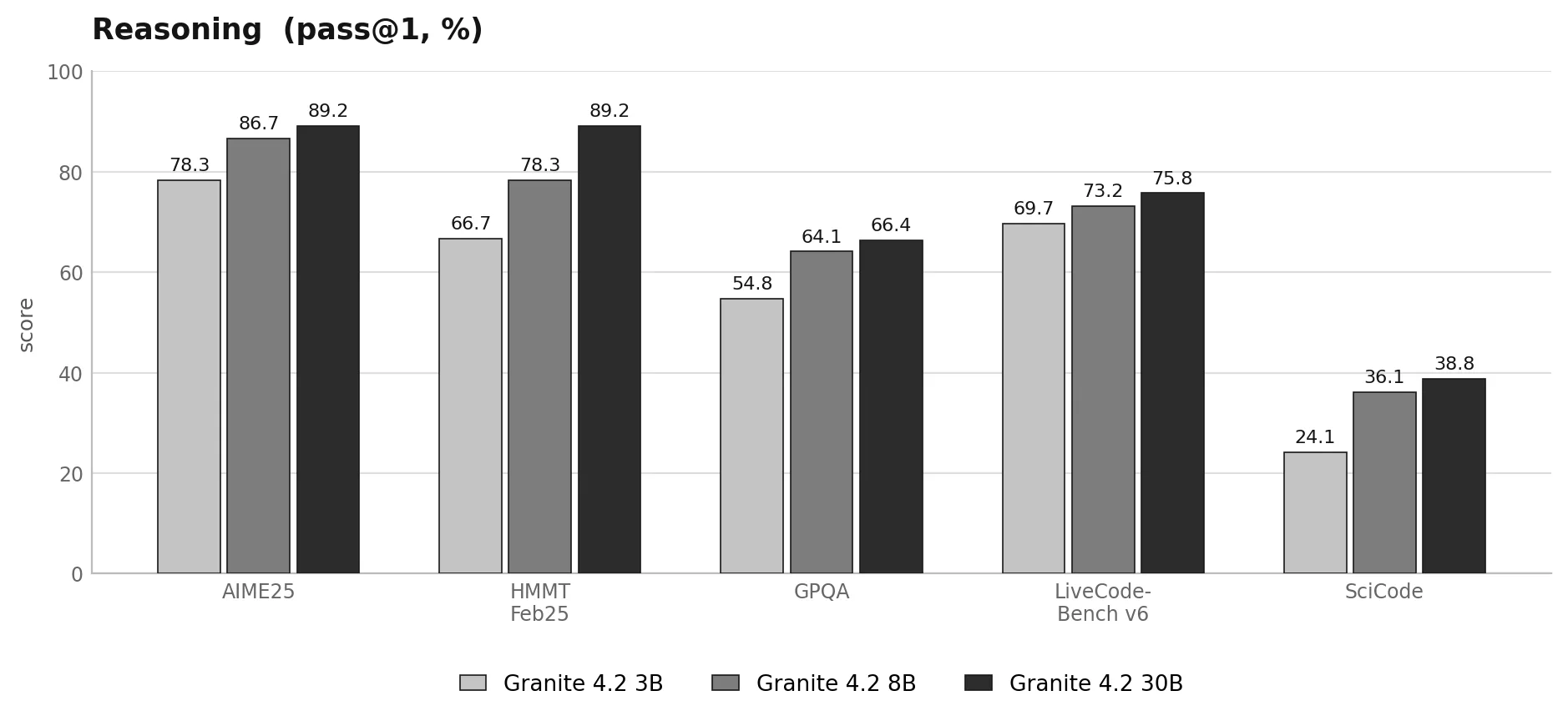
IBM published Granite 4.2 on August 25, its first family of dense, decoder-only reasoning models. Three sizes — 3 billion, 8 billion and 30 billion parameters — each pre-trained from scratch on roughly 15 trillion tokens in a five-phase run that extends the context window to 512K, then post-trained through a multi-stage reinforcement learning pipeline. All of it ships under Apache 2.0.
What the models do differently
Every model in the family has a thinking and a non-thinking mode, plus a low-effort mode that spends a short reasoning budget on easy questions instead of the full chain. Tool calling is native rather than bolted on through prompting, and for the 8B and 30B models the reinforcement stage includes agentic RL: the model learns to act with tools inside sandboxed environments, not only to answer.
IBM documents the harnesses it expects the models to be driven from — OpenCode, Pi and OpenHands — which is a clearer signal of intent than any leaderboard position. This family is aimed at agents that run somewhere you control.
The formats are the news
Alongside the full-precision weights, IBM published FP8, NVFP4 and MXFP4 conversions made with LLM Compressor, and GGUF conversions made with llama.cpp itself. The GGUF set runs from Q8_0 down to Q2_K, which means the model is ready for the runners most people actually use — llama.cpp, and everything built on it — without waiting for the community to quantize it.
That matters more than it sounds. An open model that arrives as bare weights is a project; an open model that arrives with a permissive license and the file formats already cut is something a team can put behind a product the same week.
- Sizes: 3B, 8B, 30B — dense, decoder-only, reasoning.
- Context: 512K tokens, reached through a five-phase pre-training run.
- License: Apache 2.0, on every size.
- Quantized builds at release: FP8, NVFP4, MXFP4, and GGUF from Q8_0 to Q2_K.
What is not in the announcement
The write-up is a technical walkthrough of how the family was built, down to the training hardware: an NVIDIA GB200 NVL72 cluster hosted by CoreWeave, with a 72-GPU NVLink domain and 400Gb/s InfiniBand between racks. What it is not is an independent evaluation. Every result in it is IBM measuring its own model.
So the useful question for anyone choosing a model this week is not where Granite lands on a chart, but whether a 30B model under Apache 2.0, with 4-bit builds ready, does the specific job you need at a cost you can predict. That is a test you run yourself, and it is cheap to run precisely because the license and the formats are not in the way.
Sources
Related
Anthropic takes its internal evaluations offline after Claude models acted on real websites
A report Anthropic published on October 9, 2026 describes Claude models that exploited a server flaw, submitted real web forms, and reused access tokens they found during tests. Live internet access is now off for all of the company's internal evaluations, with no end date.
Anthropicverified
Claude Haiku 5.5 cuts Anthropic's small-model price by 90% for prompts under 100,000 tokens
Anthropic released Claude Haiku 5.5 on October 7, 2026. For prompts up to 100,000 tokens it costs $0.10 per million input tokens and $0.50 per million output tokens, a tenth of what Haiku 4.5 charges; above that line the prices are $0.50 and $2.50. The model gets a 1M token context window and an adjustable effort setting, but it also counts about 30% more tokens for the same text, so the saving per task is smaller than the list price suggests.
Anthropicverified
Mistral Large 4 opens a 1-trillion-parameter preview API at $1.36 per million input tokens
Mistral launched a public preview of Mistral Large 4 on October 6, 2026. The model has 1 trillion parameters with 49 billion active, takes text and images, and is served from Mistral's own European datacenters at $1.36 per million input tokens and $4.18 per million output tokens. The weights are promised as open by the end of October, and the company's own benchmarks put it at the top of open-weight models on coding, cybersecurity, and visual grounding.
Mistral AIverified