llama.cpp can now run Hibiki, a model that translates spoken French into spoken English in real time
llama.cpp build b12619 adds Kyutai's Hibiki, a speech translation model that listens and speaks at the same time. It runs only through the realtime WebSocket endpoint of llama-server, which gains a full-duplex mode for it. The model translates only from French to English, and its original checkpoint has to be converted first.
Source
llama.cpp b12619: mtmd: support kyutai/hibiki realtime full-duplexllama.cpp · Original published November 21, 2026
The llama.cpp project released build b12619 on November 21, 2026, with support for Hibiki, a speech translation model from Kyutai. Hibiki turns French speech into English speech while the speaker is still talking, and llama.cpp can now run it on your own hardware through llama-server. For that, the server gained a full-duplex mode, in which the model receives audio and returns the translation over the same connection at the same time.
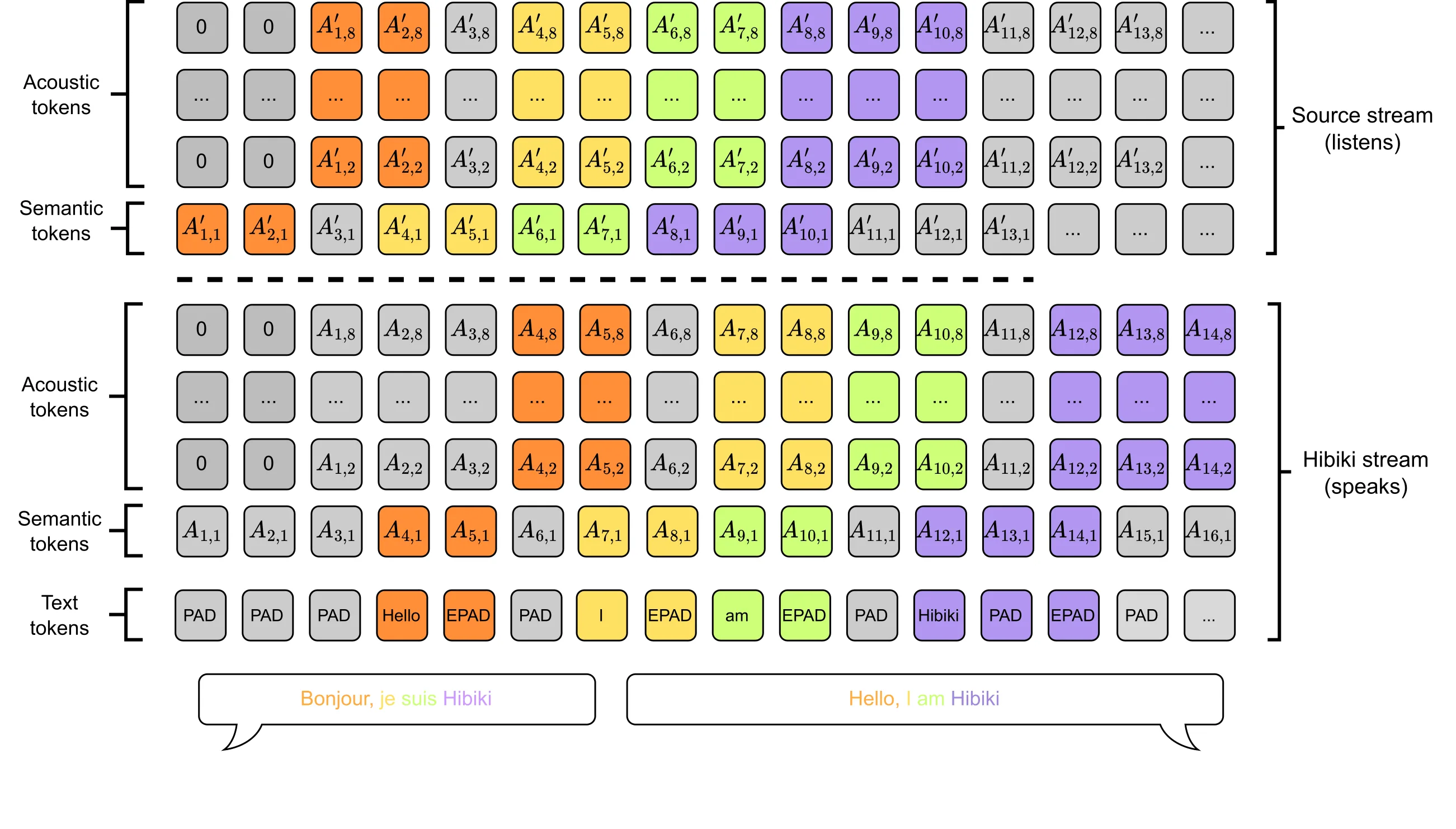
Conventional translation waits for the end of a sentence. Hibiki is built for simultaneous translation instead: according to Kyutai's model card, it gathers just enough context to translate correctly and delivers the English output chunk by chunk as the person speaks. The output is synthesized English speech, along with a text translation.
In llama.cpp the model runs only through the /v1/realtime WebSocket endpoint of llama-server. There are no turns: the first chunk of audio a client sends opens a response, and every 80 ms of incoming audio yields 80 ms of translated audio plus the matching text. Input and output are 16-bit mono PCM audio.
Two sizes and their limits
Two checkpoints are supported. Kyutai's model cards describe Hibiki-1B, which the paper calls Hibiki-M, as a 1.7 billion parameter model, and Hibiki-2B as a 2.7 billion parameter model. Both are published under the CC-BY 4.0 license. The original checkpoints are not in the usual Hugging Face layout, so the llama.cpp conversion script turns each one into two GGUF files, the model and its mmproj companion.
The model attends to the last 120 seconds of the stream. Once that window fills, llama.cpp keeps the first frames of the stream and drops the oldest frames after them, 20 seconds at a time. The documentation says this keeps Hibiki-1B working on long streams, while Hibiki-2B still degrades after about two minutes, as the reference implementation does. For the larger model, it recommends ending the response between long segments of speech.
Kyutai controls how closely the English voice resembles the original speaker through classifier-free guidance, where a higher coefficient gives a closer voice but too high a value hurts the translation. llama.cpp does not support that setting yet and conditions the output voice the way the reference implementation does, with the very_good setting. The model card also says Hibiki translates only from French to English, and other language pairs would require fine-tuning.
„Hibiki currently only supports French-to-English translation.“
Sources
Once a week, in your inbox
The whole week's news, gathered into one email. No ads, no passing your address on, one-click unsubscribe.
The address is used only for this roundup. It is not sold and not passed to anyone.
Related
OpenAI opens healthcare model configurations to API organizations at base-model token prices
OpenAI has added four healthcare configurations of its models to the API. They combine healthcare-specific instructions with search over a dedicated index of medical sources. Token prices match the base models, but OpenAI calls the pricing promotional and search is billed separately. Access alone does not permit processing protected health information.
OpenAIverified
llama.cpp can now quantize a model to a file size you set and choose the bit mix itself
Build b12669 adds an option to llama-quantize that takes a target file size and decides how many bits each part of the model gets. The author reports matching or beating the standard presets in 93% of tests. A second contributor found an improvement on several models and a clear loss on one.
llama.cppverified
Anthropic will retire Claude Opus 4.5 on January 22, 2027, and points developers to Opus 5.5
Requests to Claude Opus 4.5 will fail from January 22, 2027, on the platforms Anthropic runs, including when the model is set in Claude Code. Opus 5.5 is cheaper per token but needs code changes. On the same day Anthropic opened a beta that lets eligible organizations use its most capable models without Anthropic keeping their prompts.
Anthropicverified