Microsoft's new Copilot app puts Cowork, Code, and Autopilot on usage-based billing
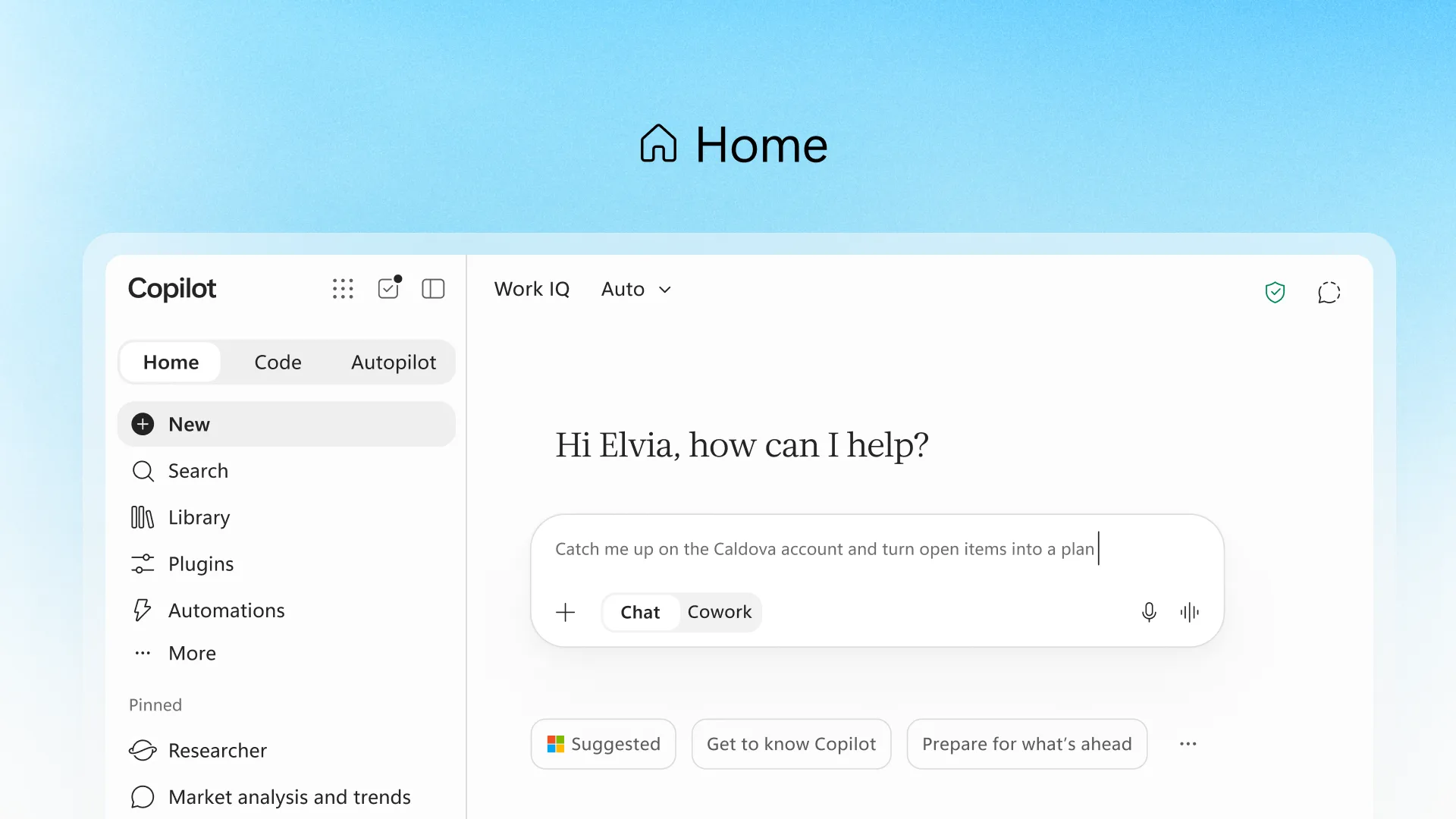
Microsoft introduced a redesigned Copilot app on September 25, 2026, with three tabs: Home, Code, and Autopilot. The per-user license still covers everyday chat and Office work. Cowork, Code, Autopilot, and frontier models such as Fable and Astra are billed by usage in Copilot Credits.
Source
Introducing the new Copilot with Home, Code and AutopilotMicrosoft Official Blog and Copilot Blog · Original published September 25, 2026
Microsoft is splitting what Copilot costs into two parts. Quick questions and drafting stay on the per-user subscription, while agents that run for hours are billed by how much they use. For enterprise customers, nothing on the metered side runs until an administrator sets a spending policy.
What the new app contains
Home combines Chat and Cowork in one place. Chat handles quick questions and drafts, and Cowork takes a delegated task and runs it until it returns a finished result. Office in Copilot brings Word, Excel, and PowerPoint into the same view.
Code builds apps, trackers, dashboards, and automations from a plain-language description. Microsoft says it runs on the same underlying technology as GitHub Copilot. The code runs in a sandboxed environment inside your organization's Microsoft 365 tenant.
Autopilot, previously called Scout, is an agent hosted in the cloud with its own identity, memory, and computer. It can watch channels, follow up on threads, and run recurring work without waiting for a prompt.
When each part arrives
- Home rolls out through the Frontier early-access program in the coming weeks.
- Code reaches the Frontier program at the end of September and comes to Microsoft 365 Premium and Pro subscribers as a preview later in 2026.
- Autopilot expands to a private preview at the end of September.
- Copilot Managed Runtime, which hosts apps built in Cowork, Code, and Copilot Studio, has been in preview since September 25, 2026.
How the two billing models split
The user subscription license (USL) is priced per user per month. It covers Copilot in Chat and in Word, Excel, PowerPoint, Outlook, and Teams, along with model selection and Auto, which picks a model for each request.
GPT-5.6 and Sonnet 5 are included in the USL, and Microsoft says new models such as Opus 5 will be included with limits. If you reach a limit, you get a warning first. Then you choose between switching to Auto at no extra cost and moving to credits.
Usage-based billing (UBB) is counted in Copilot Credits. It covers Cowork, Code, Autopilot, and frontier models such as Fable and Astra, and it requires a USL. Both billing models currently run on models from OpenAI and Anthropic.
What administrators control
For enterprise customers, UBB features are visible in the product but stay off until an administrator creates a spending policy in the Microsoft 365 admin center. Nothing is billed before that.
A policy sets budgets for the whole tenant and for groups, caps for individual users, and alerts at spending thresholds. Policies can also be managed through the Microsoft Graph API. A setting that limits which model families each group can use is rolling out in Cowork first.
Cost management now covers Code and Managed Runtime as well as Cowork. Microsoft says Copilot Studio agents follow in October.
„Some vendors put everyday AI work on a meter.“
Sources
Related
Python 3.15 makes UTF-8 the default encoding and adds explicit lazy imports
Python 3.15.0 came out on October 9, 2026. Files opened without an explicit encoding are now read and written as UTF-8 on every system, and a new lazy import statement defers loading a module until it is used. The release also adds frozendict and a sampling profiler.
Python Software Foundationverified

Deno's team joins Cloudflare, and the Deno runtime gets one more year of updates
Ryan Dahl announced on October 9, 2026 that the whole Deno team is moving to Cloudflare. The Deno runtime will get monthly fixes for one more year before development ends, and Deno Deploy will shut down after six months. JSR keeps running.
Denoverified

Anthropic's OSS Scanner sends open-source maintainers free vulnerability reports that no human has reviewed
Anthropic launched OSS Scanner on October 8, 2026, an opt-in service that scans eligible open-source projects with its strongest models, including Claude Mythos, at no cost. Each report includes a reproducer, an explanation, and a candidate patch when one exists, but no person checks it before it is sent. Anthropic says it expects more than 90% of findings to be real.
Anthropicverified