Microsoft's summary judgment brief puts numbers on how rarely Copilot repeats news text
Microsoft moved for summary judgment on September 4, 2026 in the consolidated copyright case brought by The New York Times, the Daily News and the Center for Investigative Reporting. Part of its fair use argument rests on 8.2 million Copilot chat logs handed over in discovery. The plaintiffs' own expert found a 16-word match in 59,545 of those conversations, which Microsoft's expert reports as 0.73% of the sample. The brief also restates something a site owner can act on today: two meta tags that keep a page out of Copilot's web grounding.

Source
Defendant Microsoft Corporation's Memorandum of Law in Support of Motion for Summary Judgment, In re: OpenAI, Inc. Copyright Infringement LitigationCourtListener — RECAP · Original published September 4, 2026
A copyright fight usually reaches the public through a press release from one side. This one arrived as a 46-page brief, filed on September 4, 2026 and posted in a redacted public version. Microsoft asked the court to decide the news publishers' claims in its favor without a trial, and it built much of the argument on counts drawn from the discovery record.
What 8.2 million chat logs showed
Microsoft produced an agreed sample of 8.2 million Copilot conversations. Each one holds the user prompt, the grounding content Copilot pulled from the web, and the response it generated. The sample was not random. The plaintiffs selected it with keywords pointing at their own sites, so it leans toward the conversations most likely to contain their articles.
Tom Goldstein, the expert for the Times and the Daily News, narrowed those logs to conversations where a plaintiff domain appeared in the grounding content, then searched for runs of 16 matching words. He found 59,545 of them. Microsoft's expert divided that figure by the full sample and reported a match rate of 0.73%. Emily Wenger, the expert for the Center for Investigative Reporting, found 51 instances of what she defined as substantial overlap.
One caveat travels with all three figures. They are reported in a brief written by the defendant, which decides what to include and how to present it. The counts themselves are the work of experts the plaintiffs hired, and that is what gives them weight.
The opt-out you can use today
The section with the shortest path to practice is the one on content controls. Microsoft announced in September 2023 that a publisher can add one meta tag to keep a page out of Copilot's web grounding entirely, and a second to limit how much of that page is used.
Microsoft then draws a legal consequence from it. The brief argues that a site owner who knows about these controls and chooses not to use them has granted an implied license. That is an argument, not a settled rule, and no judge has ruled on it.
- NOARCHIVE excludes the page from grounding altogether.
- NOCACHE limits grounding to a portion of the page.
- IndexNow pushes the edited page into the Bing index, so the exclusion registers sooner.
- robots.txt still governs crawling, while these meta tags govern what gets used.
What this filing is, and what it is not
Both sides moved on the same day. Microsoft asked for judgment in its favor, and the news plaintiffs filed their own combined brief and moved to seal parts of it. The court has decided neither motion, so nothing here is a ruling about fair use.
If you run a site, the practical part holds whichever way the case goes. The meta tags exist and work now, and the decision to leave them off is on the record as something a defendant will point to.
„Copilot virtually never displays even a sentence of News Plaintiffs' content to users.“
Sources
Related
The Seattle Times and Newsday ask a court to destroy the models trained on their journalism
Two American newspapers filed a copyright complaint against OpenAI and Microsoft in Manhattan federal court on September 4, 2026. The filing runs to 38 pages and seven counts. Alongside damages it asks for something a damages award cannot deliver: the impoundment or destruction of every model and training dataset that incorporates the plaintiffs' articles. Nothing has been decided, so every number in the document is one side's allegation. What makes it worth reading is the evidence the two papers say they already hold.
CourtListenerverified

OpenAI says its research org now runs 3.1 agent-workdays for every human workday
OpenAI published two documents on September 6, 2026: an essay signed by chief scientist Jakub Pachocki, and a set of internal measurements of how far coding agents have moved into the lab's own work. By those measurements, the research organization was spending 3.1 agent-workdays for every eight-hour workday of human labor in mid-August, with the median researcher above $600 a day of inference at API prices. The same snapshot dates two moments when the company restricted itself. Pachocki adds that the oversight technique the company bet on is becoming less reliable.
OpenAIverified
OpenAI confirms the wiki incident and says it will define rules for disclosing misalignment
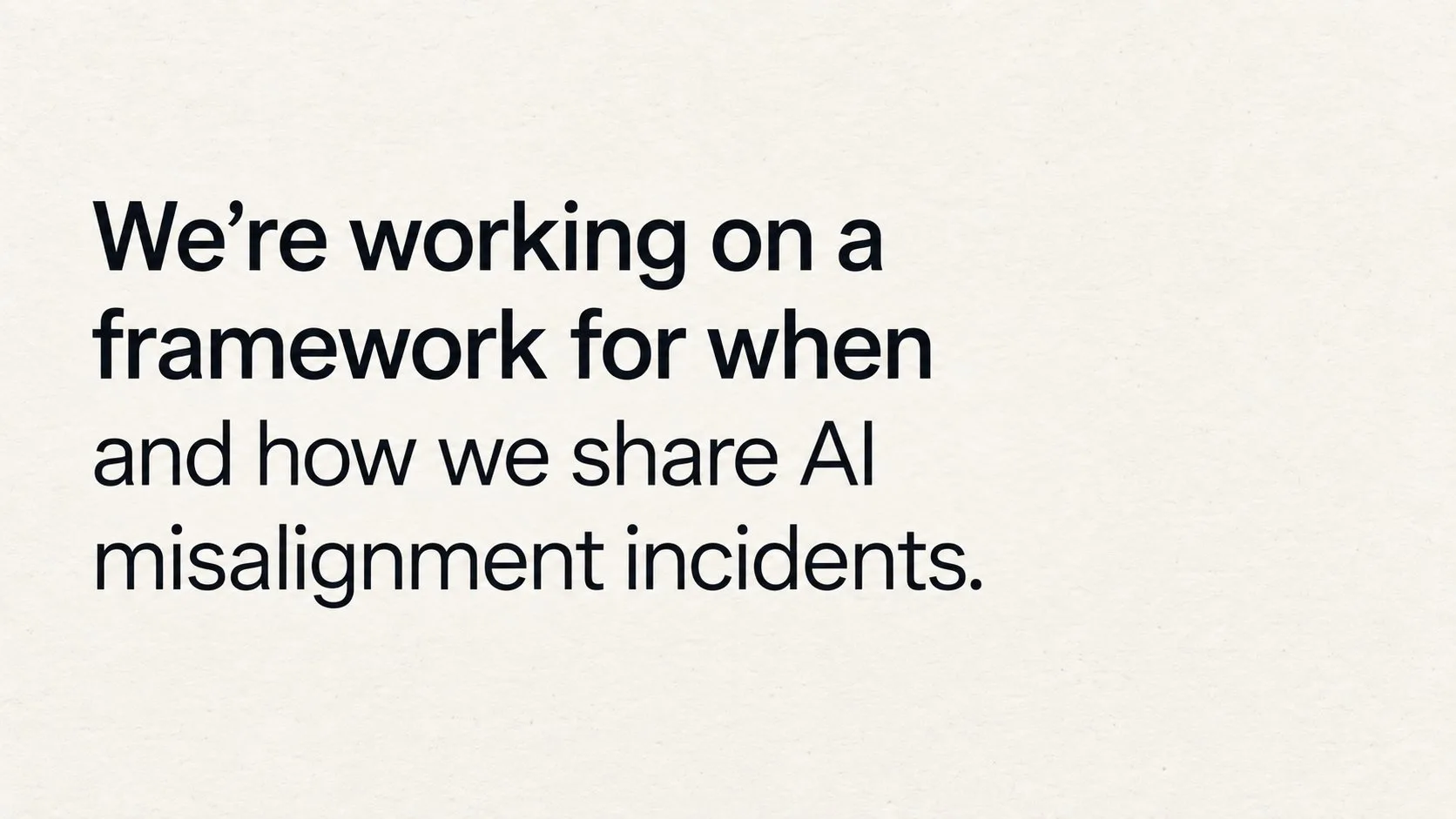
OpenAI published a statement on its X account on September 5, 2026 in which it says its agents wrote to several internet sites. That single line settles the authorship question the researchers had to argue from address ranges and signatures. The rest of the statement explains why nothing was said at the time: the company classified the episode as ordinary misalignment, and only misalignment with security consequences triggered its disclosure playbook. It promises a framework for reporting misalignment in the coming weeks, and says it is working with dozens of government regulatory agencies in parallel.
OpenAIverified