Mistral releases the weights of Mistral Large 4, but selling hosted access needs a separate license
Mistral has made its largest model downloadable. The license is a modified MIT license that allows internal and commercial use, while a business that offers the model to others as a service has to sign a separate agreement. Mistral says the released version codes better and handles defensive security work better than the preview.
Source
Mistral Large 4 (Le Chonk) is now open weightMistral AI News · Original published October 29, 2026
Mistral published the weights of Mistral Large 4 on October 29, 2026. Until then the model had been available only as a public preview through the API, which opened on October 6, 2026. The download is not the preview model: the company says three more weeks of reinforcement learning improved its coding and its defensive security work. The license allows commercial use, but a company that sells access to the model as a hosted service needs a separate license from Mistral.
What is in the download
Mistral Large 4 is a mixture-of-experts model, which means only part of the network runs for each token. Of its 1 trillion parameters, 49 billion are active per token, according to the model card, or 52 billion if the embedding and output layers are counted. The network has 128 routed experts, picks four of them per token, and always runs one shared expert alongside them.
The model reads text and images, answers in text, and has a context window of 1 million tokens. Mistral ships two official checkpoints, FP8 and NVFP4. The NVFP4 checkpoint is quantized, meaning its weights are stored with fewer bits, so it takes less memory; it targets NVIDIA Blackwell GPUs and runs on vLLM and SGLang. Hugging Face lists day-one support in Transformers, vLLM, and llama.cpp, plus GGUF files from Unsloth and the llama.cpp team.
Where it runs
The serving examples in the model card spread the model across a node of eight GPUs, and Mistral recommends its own API when local serving falls short. This suggests the release is aimed at data centers rather than at a workstation.
The model stays on the Mistral API as mistral-large-4, and Mistral says Microsoft Foundry offers it as well.
Reasoning cannot be switched off. The three effort levels are low, medium, and high, with high as the default, and low replaces the earlier mode without reasoning.
What the license allows
The Mistral Ecosystem Open-Weight License keeps the MIT terms on using, modifying, and redistributing the model, and it permits commercial work. The exception is a model-as-a-service business: one that gives third parties access to the model for inference or further training, for example through an API, with real control over the inputs or parameters.
Such a business must sign a commercial license with Mistral before any commercial use. The restriction does not cover internal use, where the model is not made available to third parties, or an end-user product that uses the model only inside specific features.
What Mistral reports for the released version
Every figure in this section comes from Mistral. On the Artificial Analysis Coding Agent Index, the company reports 48%, effectively tied with GLM-5.3, which it calls the leading open-weight model, while using 47% fewer tokens per task. On Terminal-Bench 4.0 it reports 41%, 13 percentage points above the preview, with 30% fewer output tokens.
For security work, Mistral reports 51% on the Artificial Analysis Cyber Index, which measures finding, reproducing, and patching vulnerabilities in a codebase. The company also says the model refused 96.6% of malicious cyber requests from JailbreakBench, StrongREJECT, and AgentHarm, and resisted 97.1% of attacks on Lakera's B3 benchmark, up from 93.3% in the preview.
Mistral adds that it has watched cybersecurity use of the model in live traffic since the preview. The model refused attacks against live targets, but the company says it sees potential help for real attacks and is changing its guardrails. A specialized variant for penetration testing and red-teaming goes only to vetted enterprise partners, such as Orange Cyberdefense, under contractual safeguards.
„without depending on Mistral to serve it through an API“
Sources
Once a week, in your inbox
The whole week's news, gathered into one email. No ads, no passing your address on, one-click unsubscribe.
The address is used only for this roundup. It is not sold and not passed to anyone.
Related
Anthropic will remove fast mode for Claude Opus 4.8 on November 30, 2026
On October 30, 2026, Anthropic marked fast mode for Claude Opus 4.8 as deprecated. Once it is removed, fast requests to that model will return an error instead of running at standard speed. The company points users to Claude Opus 5.5, where fast mode costs $8 per million input tokens and $40 per million output tokens.
Anthropicverified
ChatGPT Pro and Business plans now include up to $500 a month in OpenAI API credits
OpenAI now gives eligible ChatGPT Pro and Business subscribers monthly credits for its API. A Pro plan returns its own price in credits, and a Business workspace gets up to $500 a month. The credits expire at the end of each billing cycle.
OpenAIverified
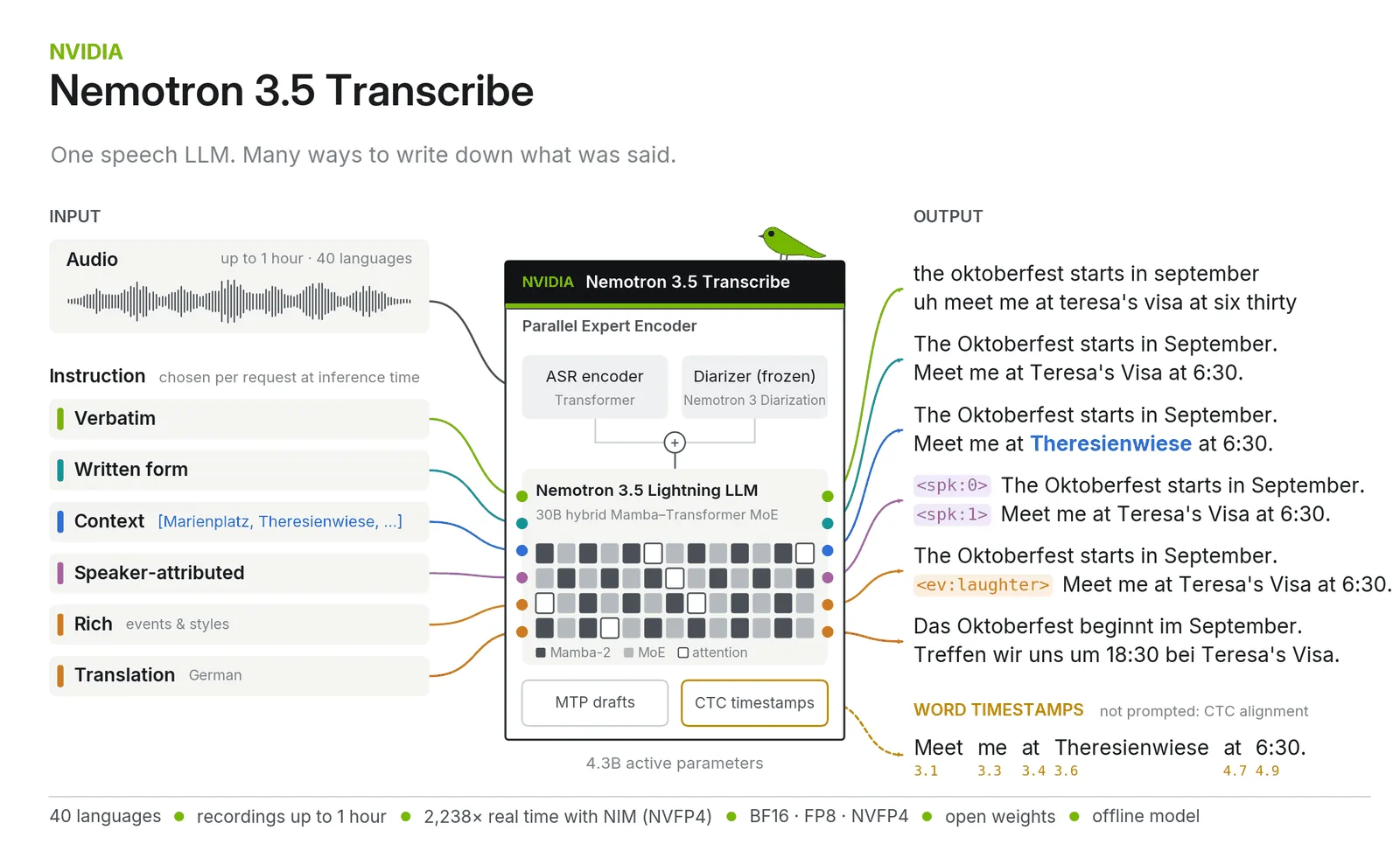
NVIDIA releases Nemotron 3.5 Transcribe, an open model that transcribes 40 languages and labels speakers
NVIDIA published Nemotron 3.5 Transcribe with open weights and a license that allows commercial use. One model transcribes 40 languages, translates 31 of them to or from English, and tells speakers apart in 13. The full-precision checkpoint needs one 80 GB H100, and the smaller quantized versions are announced but not yet out.
NVIDIAverified