NVIDIA releases Nemotron 3.5 Transcribe, an open model that transcribes 40 languages and labels speakers
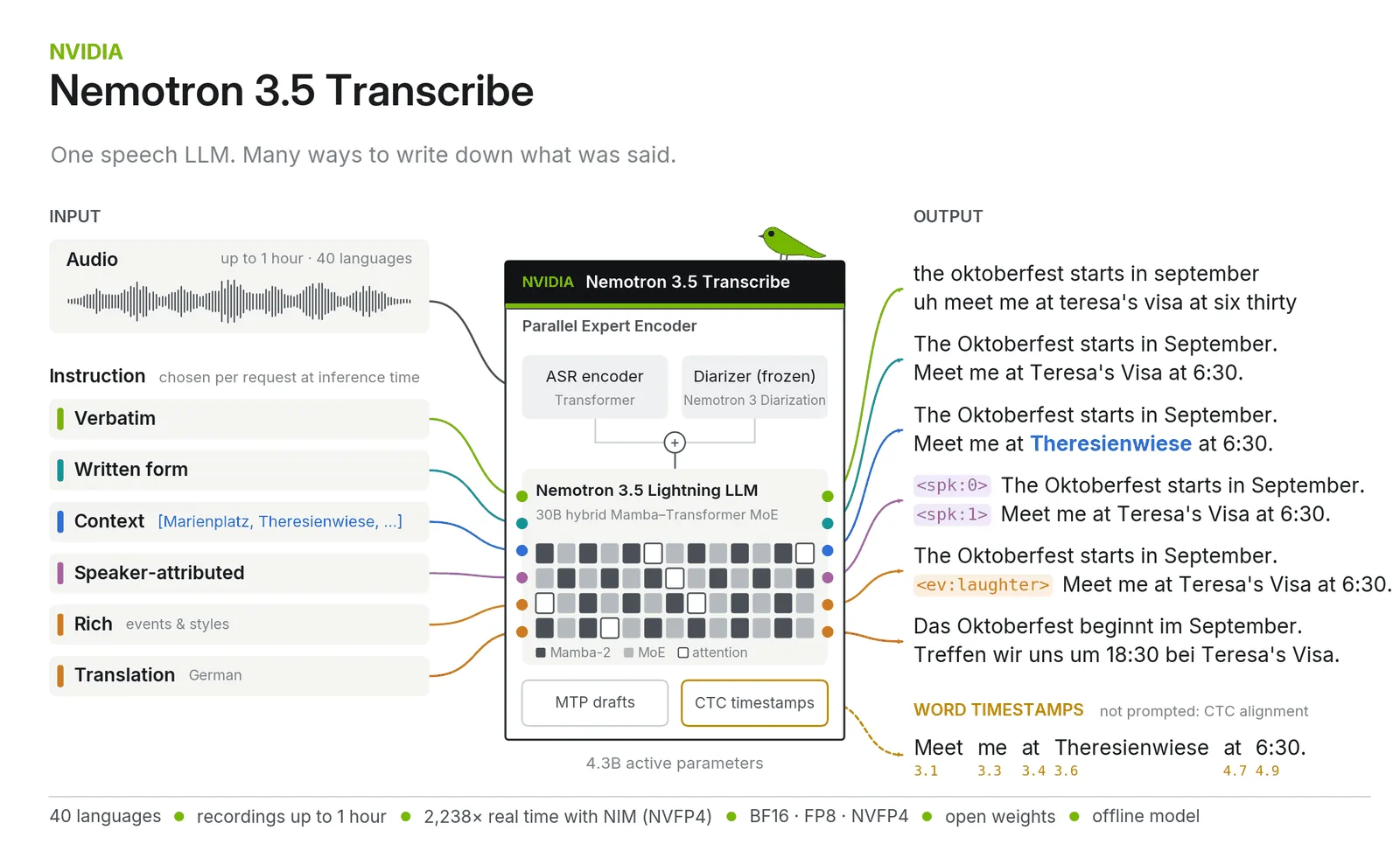
NVIDIA published Nemotron 3.5 Transcribe with open weights and a license that allows commercial use. One model transcribes 40 languages, translates 31 of them to or from English, and tells speakers apart in 13. The full-precision checkpoint needs one 80 GB H100, and the smaller quantized versions are announced but not yet out.
Source
NVIDIA Nemotron 3.5 Transcribe and Granary v2: Intelligent Multilingual Transcription You Can Prompt and AdaptHugging Face Blog · Original published October 28, 2026
NVIDIA has released Nemotron 3.5 Transcribe, an open-weight speech model that turns recorded audio into text. The same checkpoint transcribes, translates, marks who is speaking, and answers questions about a recording. This suggests that an app chaining separate models for those jobs could try a single one instead. The model went up on Hugging Face on October 28, 2026, under the OpenMDW-1.1 license, which permits commercial use.
What one model does
The model card lists transcription in 40 languages and translation between English and 31 of them, in both directions. In 13 languages the model also performs speaker attribution, known as diarization: it marks which person said which words. NVIDIA says it handles recordings up to an hour long and labels up to eight speakers.
Output is steered with a plain-language instruction rather than with settings. One recording can come back as a transcript with speaker labels, as an English translation, or as an answer to a question such as which decisions a meeting reached. A prompt can also carry a list of expected terms, such as drug names, which the model is told to use only when the audio supports them. Question answering was trained and evaluated only in English, and the card warns it may not work reliably in other languages.
This is an offline model. NVIDIA built it for recorded audio, not for live streaming, so real-time captioning is not what it is meant for.
What it takes to run
The model has 34 billion parameters in total, and about 4.3 billion of them, including the audio encoder, are active for each token. That is the mixture-of-experts design: each step runs only part of the network, which cuts the amount of computation, but all of the weights still have to fit in memory.
The reference weights are in BF16, and NVIDIA's quick start serves them on one H100 with 80 GB of memory. The card also names FP8 and NVFP4 builds, quantized versions that store the weights at lower precision so they need less memory, and its hardware table pairs them with the RTX 5090 and DGX Spark. NVIDIA's announcement says those versions are coming soon, and on October 28 their repositories were not public. Until they ship, running the model yourself is a job for a data-center GPU, not a desktop.
What the measurements show
NVIDIA reports the lowest average word error rate among open-weight models on the multilingual Open ASR Leaderboard, 4.62% across seven languages. Word error rate is the share of words a transcript gets wrong, so lower is better. On the speech-to-text ranking from Artificial Analysis, an independent benchmarking firm, NVIDIA says the model ties for first among open-weight models at 2.8%, with roughly a sixth of the active parameters of the model it ties.
NVIDIA also published a fine-tuning case study on medical speech from Indian doctors and medical students. On speakers held out from tuning, the error rate fell from 22.44% with the best prompt to 12.17% after fine-tuning, a 45.8% relative reduction, and the whole adaptation took about 14 GPU-hours. The same tuning raised the error rate on general English slightly, from 1.54% to 1.69%.
Where Serbian stands
Serbian is not among the 40 languages. Croatian is, rated production-ready by NVIDIA, with a word error rate of 8.31% on the FLEURS test set, and Slovenian and Bulgarian are listed as well. NVIDIA has published no results for Serbian, so how much the Croatian support helps with Serbian speech is unknown.
„Transcribe is built for recorded audio, not live streaming.“
Sources
Once a week, in your inbox
The whole week's news, gathered into one email. No ads, no passing your address on, one-click unsubscribe.
The address is used only for this roundup. It is not sold and not passed to anyone.
Related
Anthropic will remove fast mode for Claude Opus 4.8 on November 30, 2026
On October 30, 2026, Anthropic marked fast mode for Claude Opus 4.8 as deprecated. Once it is removed, fast requests to that model will return an error instead of running at standard speed. The company points users to Claude Opus 5.5, where fast mode costs $8 per million input tokens and $40 per million output tokens.
Anthropicverified
ChatGPT Pro and Business plans now include up to $500 a month in OpenAI API credits
OpenAI now gives eligible ChatGPT Pro and Business subscribers monthly credits for its API. A Pro plan returns its own price in credits, and a Business workspace gets up to $500 a month. The credits expire at the end of each billing cycle.
OpenAIverified
Mistral releases the weights of Mistral Large 4, but selling hosted access needs a separate license
Mistral has made its largest model downloadable. The license is a modified MIT license that allows internal and commercial use, while a business that offers the model to others as a service has to sign a separate agreement. Mistral says the released version codes better and handles defensive security work better than the preview.
Mistral AIverified