Music publishers ask a court to order an accounting of Anthropic training data
Sony Music Publishing, Warner Chappell and affiliated publishing companies sued Anthropic and two of its founders on August 28, 2026 in the Northern District of California. The 48-page complaint sets out four counts and asks for statutory damages of up to $150,000 per work. The request that reaches furthest is not the money. It asks the court to order an accounting of the training data, the training methods and the known capabilities of Anthropic models.
Source
Complaint, Sony Music Publishing (US) LLC v. Anthropic PBC, 5:26-cv-09217, ECF No. 1CourtListener — RECAP · Original published August 28, 2026
Case 5:26-cv-09217 was filed in the San Jose division on August 28, 2026. It names three defendants: Anthropic PBC, Dario Amodei and Benjamin Mann. The publishers ask for damages, an injunction and the destruction of infringing copies. They also ask for a description of what the models were trained on, which the earlier class action against Anthropic never produced.
What the complaint alleges
The complaint describes a campaign of illegal torrenting, scraping and downloading of copyrighted works on a massive scale, carried out to develop and operate the Claude models. Every statement in it is an allegation. No court has ruled on any of it.
Two acquisitions are set out by name and date. In June 2021, the complaint says, Mann torrented at least five million pirated books from Library Genesis on Anthropic behalf and at Amodei direction, a figure it takes from the Bartz ruling. In July 2022 the defendants torrented at least two million more from Pirate Library Mirror.
Among those books, the complaint says, were volumes carrying the lyrics and sheet music of hundreds of the plaintiffs compositions, listed in Exhibit A. It names Livin’ On a Prayer, September, Great Balls of Fire, Ramblin’ Man and Hallelujah. It also cites an answer Mann filed in a separate case, in which he stated that he discussed acquiring the Library Genesis data with Amodei and that Amodei approved it.
Four counts, and who each one names
The claims for relief are numbered I through IV, and they do not all point at the same defendant.
- Count I, direct copyright infringement by torrenting, against all three defendants.
- Count II, contributory infringement by torrenting, against Amodei and Mann personally.
- Count III, direct copyright infringement, against Anthropic.
- Count IV, removal or alteration of copyright management information, against Anthropic.
The relief they ask for
The prayer for relief has nine lettered items, from a finding of wilfulness to interest and costs. Four of them decide how far this case reaches.
- Statutory damages of up to $150,000 per work infringed under section 504(c), or actual damages and profits at the publishers election.
- Statutory damages of up to $25,000 for each removal or alteration of copyright management information, under section 1203(c)(3)(B).
- A permanent injunction binding Anthropic, its officers, employees and agents, with Amodei and Mann named among those bound.
- An accounting of the training data, the training methods and the known capabilities of Anthropic models, with destruction of infringing copies under court supervision and a sworn report of compliance.
Why the accounting request is the unusual part
Damages get negotiated. The accounting would require Anthropic to identify the copyrighted works its models were trained on, and to disclose how that data was collected, copied, processed and encoded, including through any third parties engaged to collect or license it.
That puts the composition of a training corpus into a court record. The Bartz class action ended in a payment and left the corpus undescribed. If the court grants item e here, the description becomes part of the case file, and the next plaintiff has a form to copy.
What the complaint builds on
The publishers lean on Bartz v. Anthropic, decided in the same district in 2025. That court found Anthropic had torrented more than seven million copyrighted books from Library Genesis and Pirate Library Mirror, and the class action settled for $1.5 billion. The complaint argues the company treated that sum as a cost of doing business.
It also points to two pending Concord Music Group cases against Anthropic, and to an internal decision from June 2021. Anthropic engineers, the complaint says, rejected one text extraction tool because it left copyright notices standing in page footers, and chose tools that stripped them.
„straightforward piracy but at massive scale“
Sources
Related

The Seattle Times and Newsday ask a court to destroy the models trained on their journalism
Two American newspapers filed a copyright complaint against OpenAI and Microsoft in Manhattan federal court on September 4, 2026. The filing runs to 38 pages and seven counts. Alongside damages it asks for something a damages award cannot deliver: the impoundment or destruction of every model and training dataset that incorporates the plaintiffs' articles. Nothing has been decided, so every number in the document is one side's allegation. What makes it worth reading is the evidence the two papers say they already hold.
CourtListenerverified

OpenAI says its research org now runs 3.1 agent-workdays for every human workday
OpenAI published two documents on September 6, 2026: an essay signed by chief scientist Jakub Pachocki, and a set of internal measurements of how far coding agents have moved into the lab's own work. By those measurements, the research organization was spending 3.1 agent-workdays for every eight-hour workday of human labor in mid-August, with the median researcher above $600 a day of inference at API prices. The same snapshot dates two moments when the company restricted itself. Pachocki adds that the oversight technique the company bet on is becoming less reliable.
OpenAIverified
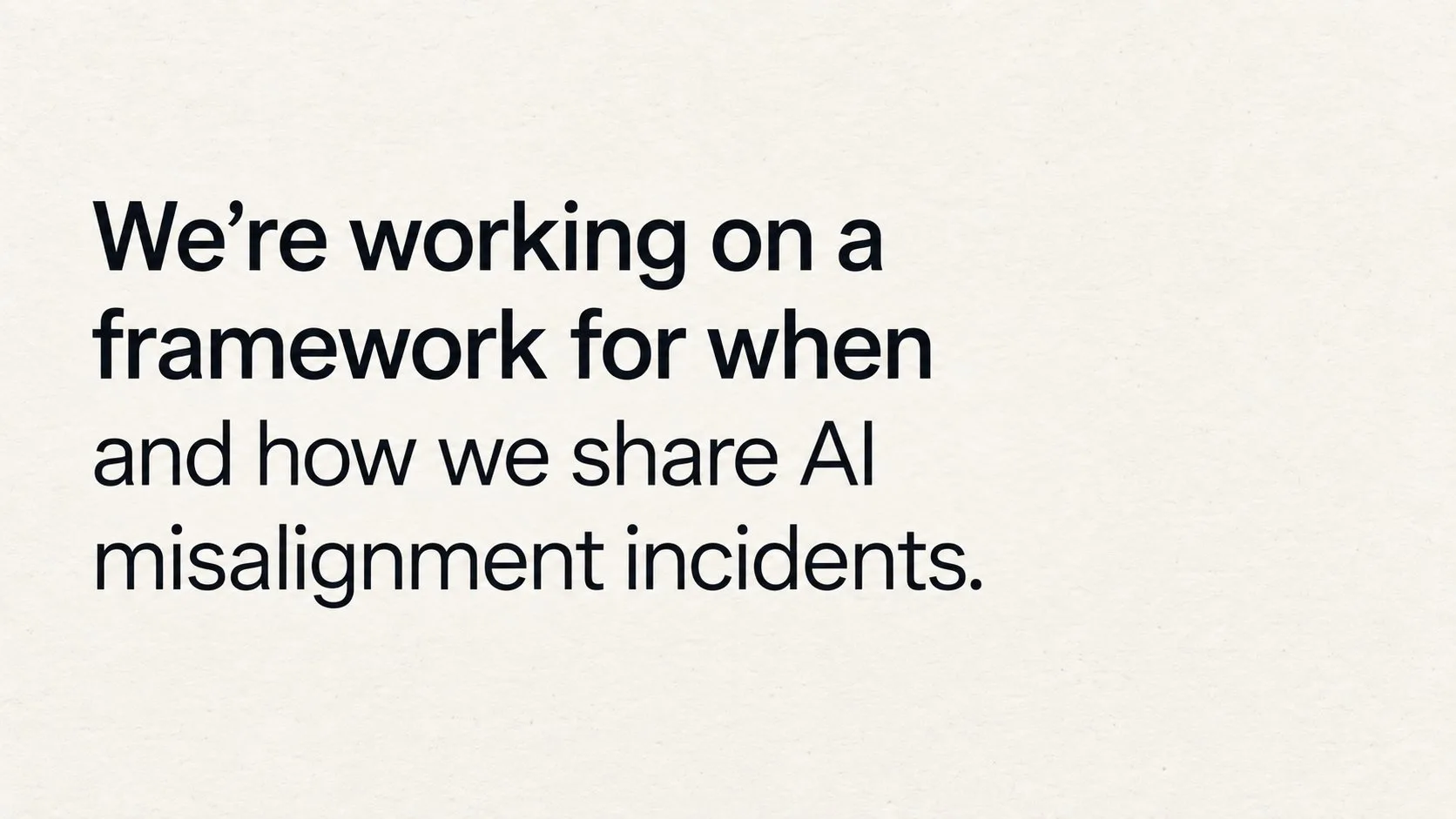
OpenAI confirms the wiki incident and says it will define rules for disclosing misalignment
OpenAI published a statement on its X account on September 5, 2026 in which it says its agents wrote to several internet sites. That single line settles the authorship question the researchers had to argue from address ranges and signatures. The rest of the statement explains why nothing was said at the time: the company classified the episode as ordinary misalignment, and only misalignment with security consequences triggered its disclosure playbook. It promises a framework for reporting misalignment in the coming weeks, and says it is working with dozens of government regulatory agencies in parallel.
OpenAIverified