Skip to content

Tags

JavaScript

5 items
Black title card reading "Upcoming Next.js August Security Release", with the Next.js mark in the corner.
Toolsmedium signal

Next.js will patch one critical vulnerability on August 26

Vercel published the date before the fix. Versions 16.3.3 and 15.5.24 arrive on August 26 with a full advisory, and the announcement exists so teams can schedule the upgrade instead of discovering it from a CVE feed.

Next.js Blogverified

FIREFOX154sibling-index() and text-box-trim
Webmedium signal

Firefox 154 brings sibling-index(), sibling-count(), and text-box-trim

The August 18 release adds three CSS features you can use right away. sibling-index() and sibling-count() give an element's position among its siblings and their total, directly in CSS and without a line of JavaScript, which ends the need to hand-write variables like --i for staggered animation delays. Alongside them come text-box-edge, text-box-trim, and the text-box shorthand, which remove the extra space above and below text so headings finally sit in the grid the way they look in the design. On the JavaScript side, includes(), join(), chunks(), and windows() were added to the iterator prototype.

MDNverified

web.dev title card reading "July 2026 Baseline monthly digest", beside the large Baseline check mark.
Webmedium signal

July Baseline digest: Intl.Locale and rect() cross the line

The edition published on August 10 moves Intl.Locale into newly available — a standard way to parse, modify, and inspect Unicode language and region tags, useful anywhere dates, numbers, and currencies are formatted without an extra library. Array.fromAsync(), which turns asynchronous data streams into an array, and the CSS rect() function, which describes rectangular shapes for clip-path and offset-path far more readably than going through polygon(), both moved to widely available. An updated MDN guide to choosing image formats shipped alongside the digest.

web.devverified

Webmedium signal

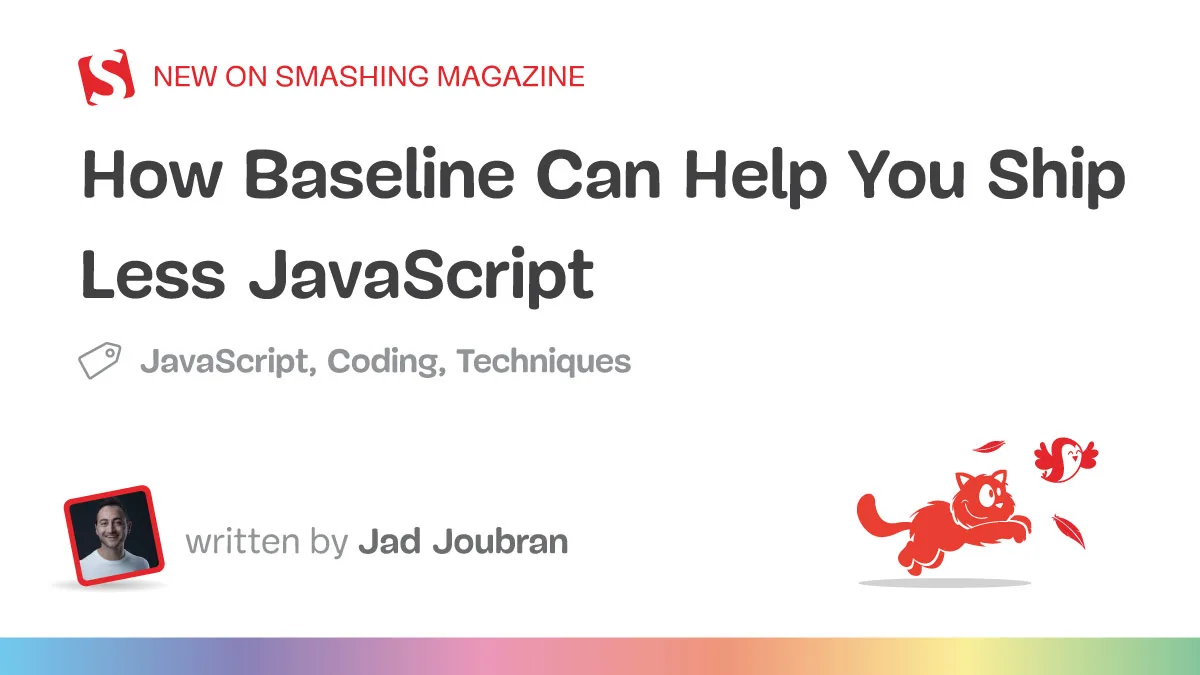
How Baseline helps you ship less JavaScript

Jad Joubran gives a practical method for auditing package.json: which libraries can be dropped today because the browser does the same job natively. The piece explains Baseline's three states — limited availability, newly available, and widely available — and shows how to use them as a measure instead of a feeling. The gap between the claim that something needs a library and the fact that the browser already does it closes faster than most projects track.

Smashing Magazineverified

Webmedium signal

NoLoJS: a catalog of patterns HTML and CSS now handle

Aaron T. Grogg assembled a survey of common JavaScript patterns that today are solved with plain HTML and CSS, with no script at all, or the smallest one possible. The collection pairs well with the Baseline piece: first check what the platform already does, then drop the dependency. The result is a lighter page and better Core Web Vitals numbers.

GitHubverified