AWS Emulator lets developers and coding agents test AWS code locally, with no account and no fee
Amazon Web Services released AWS Emulator on November 11, 2026. The free program answers AWS SDK and CLI calls on a developer's own machine or in CI, and nothing it creates reaches an AWS account. Amazon says autonomous AI agents wrote all of its code without human review.
Source
AWS Emulator is now available for building and testing AWS applications locallyAWS What's New — Machine Learning · Original published November 11, 2026
AWS Emulator, released on November 11, 2026, runs a stand-in for AWS services on a laptop or in a continuous integration (CI) pipeline, the automated system that tests code before changes are merged. Code that already uses the AWS SDKs or the AWS CLI sends its requests to the emulator instead of AWS, with no AWS account and no deployment. AWS charges no fee for it and publishes the source under the CC0 1.0 Universal public domain dedication.
How it works and where it stops
For the operations it supports, AWS says the emulator returns the same results as AWS for valid calls and the same errors for invalid ones. Operations it does not support yet return 501 Not Implemented. State is kept in memory until the emulator stops, so every run starts clean. Each copy gets its own port, keys, and in-memory state, which lets several test suites or agents run side by side without seeing each other's resources.
Services are generated from the API models AWS publishes, the same models the AWS SDKs are built from. AWS says a new service or API shows up in the emulator on its own, and its behavior is filled in and checked release by release. How closely the emulator matches AWS varies by service, and AWS publishes a fidelity report for each API.
AWS also spells out the limits. The emulator is for development and testing, not production, and it does not replace testing security settings on AWS itself. On Linux it runs as a native program without a container runtime. It collects usage telemetry by default; AWS says this can be turned off and that resources and their data stay on the device.
Why coding agents are the main audience
AWS names coding agents as a main audience. An agent can create a bucket or a DynamoDB table, run its code against the emulator, read the AWS error, and fix the code before anything is deployed. According to AWS, the agent can run the emulator in a sandbox with no network access, and CI runs need no per-branch accounts and no stored credentials.
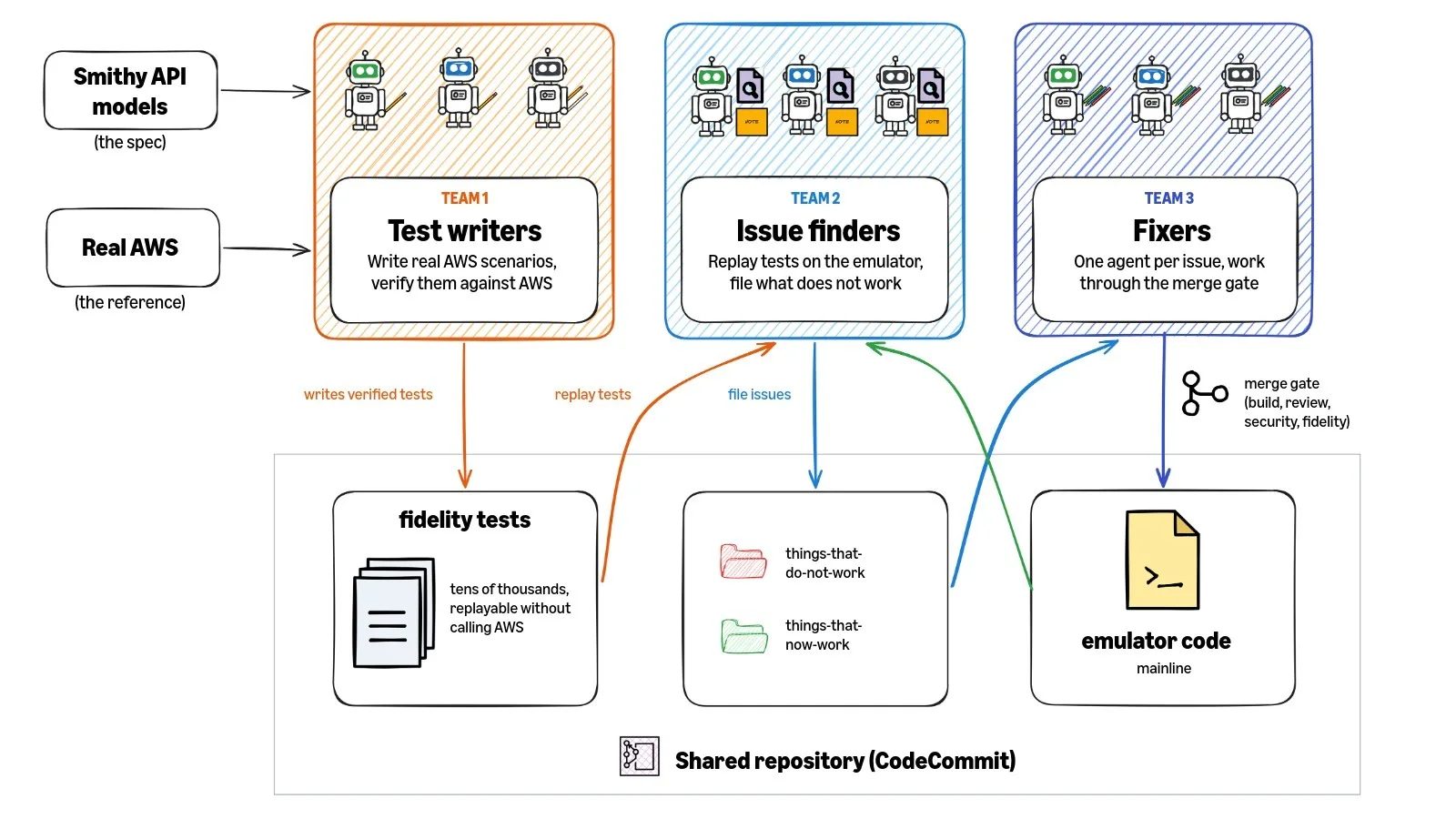
Amazon says the emulator itself was built by agents. In a post on November 11, 2026, AWS senior principal engineer Matthew Goldberg writes that autonomous agents wrote all of its code and that his team neither wrote nor reviewed any of it. The agents work in three groups: one builds tests against the real AWS cloud, one finds where the emulator diverges, and one fixes each reported issue. A change is merged only after a check in which other agents review coding standards, security, and any drop in fidelity.
When the code repository was created, Goldberg says, it held an empty web server that accepted requests for 438 AWS API models and did nothing with them. The issues the agents have fixed and those still open are both published in the repository.
Sources
Once a week, in your inbox
The whole week's news, gathered into one email. No ads, no passing your address on, one-click unsubscribe.
The address is used only for this roundup. It is not sold and not passed to anyone.
Related
GitHub will bill organizations for Copilot code review by default starting December 30
GitHub said on November 25, 2026, that Copilot code review for licensed members will be billed to the organization that owns the repository whenever no billing choice has been saved. The change applies to Copilot Business and Copilot Enterprise. Administrators who want to keep the current arrangement have to select Member before December 30, 2026.
GitHub Changelogverified
OpenClaw 2026.11.10 turns on Deep Research by default and lets users take over the agent's browser
OpenClaw's new release includes Deep Research, which looks through several sources and returns a report with quotes and gaps marked. It is on by default and uses the models the user has already set up. A second addition lets a user take over a browser tab during a sign-in, although the agent can still capture the page. The optional Knowledge plugin stores memory in local Markdown files.
OpenClawverified
AWS WAF will bill each protected resource from February 2027 and drop its fees for rules
Amazon is changing how it charges for AWS WAF, the firewall that filters traffic to web applications. Rules and rule sets become free, while every protected resource gets an hourly fee. Sites with many rules on a few resources stand to pay less, and companies that cover many resources with one rule set can pay several times more.
AWSverified