Copilot's CLI moved to a Rust runtime and kept its TypeScript terminal
GitHub's weekly Copilot roundup for August 28 carries one change that is structural rather than cosmetic: the command-line agent now runs on a native Rust runtime, while the terminal interface it draws stays in TypeScript. Around it sit smaller changes that all point the same way, toward deciding once how the agent behaves instead of deciding again every session. GitHub reports the speedup but publishes no figure for it.
Source
GitHub Copilot weekly releases — August 24GitHub Changelog: Copilot · Original published August 28, 2026
The August 28 changelog covers a week of Copilot releases across the app, the command line, JetBrains, Visual Studio, and VS Code. The item worth reading twice is in the CLI section: Copilot CLI now runs on a native Rust runtime, and its terminal interface remains built in TypeScript. GitHub calls the result significantly faster and leaves it at that, with no benchmark and no number attached.
The runtime changed, the interface did not
GitHub has not said which parts of Copilot CLI moved to Rust, and it has published no before-and-after measurements. What the changelog confirms is narrower: the CLI now runs on a native Rust runtime, and the terminal interface is still built in TypeScript. Which side of that split produces the announced speedup is therefore not something the announcement settles.
What GitHub has not published is how much faster. There is no benchmark in the changelog and no before-and-after timing, so anyone deciding whether the rewrite is worth an upgrade will have to measure it on their own project.
- Sessions that did not exit cleanly can now be restored, including sessions interrupted in the middle of a turn.
- Plugin, MCP server, and skill management got new interfaces behind the existing commands for each.
- The Customize tab in the Copilot app, which collects MCP servers, plugins, skills, and canvases in one place, is now generally available.
Permission mode became a setting instead of a habit
The CLI now takes a default execution mode and a default permission mode, and applies both to every new session. Until now the choice was made per session, which in practice meant it was made by whatever the operator typed most often.
That matters more than the naming suggests. A permission mode is the boundary between an agent that asks before it writes and one that does not, and a boundary that has to be re-established by hand each time is a boundary that eventually is not. Moving it into configuration also makes it reviewable, which is the same reason the enterprise controls below exist.
The same controls reached the editors
The rest of the week is the same idea applied in four other places. JetBrains gained enterprise controls covering plugins, MCP servers, telemetry, and agent permission modes. Visual Studio gained per-task control over reasoning effort along with model pinning, organization-wide custom agents, and a view of plan consumption before the limit is reached rather than after.
- VS Code 1.135 can pick up recent Copilot or Claude agent sessions that were started in other applications.
- It can also ask a second, complementary model for an opinion on what the first one missed.
- Chat usage is now itemized by model for every turn, which is the missing half of any conversation about premium request budgets.
- In Visual Studio, the Git agent reviews uncommitted changes or an individual commit before a pull request is opened.
„This week's updates give you more control over how Copilot runs.“
Corrections
An earlier version described the split between Rust and TypeScript as a deliberate trade, said which parts of the tool decide, schedule and stream tokens, and said the per-turn cost can be measured because of that split. Checked against GitHub's changelog, none of that is published. What is confirmed is that Copilot CLI runs on a native Rust runtime, that the terminal interface stays in TypeScript, and that GitHub calls the result faster without giving a figure. The unconfirmed claims have been removed.
Related
OpenClaw 2026.9.5 reloads plugins without stopping the Gateway and shares conversations read-only
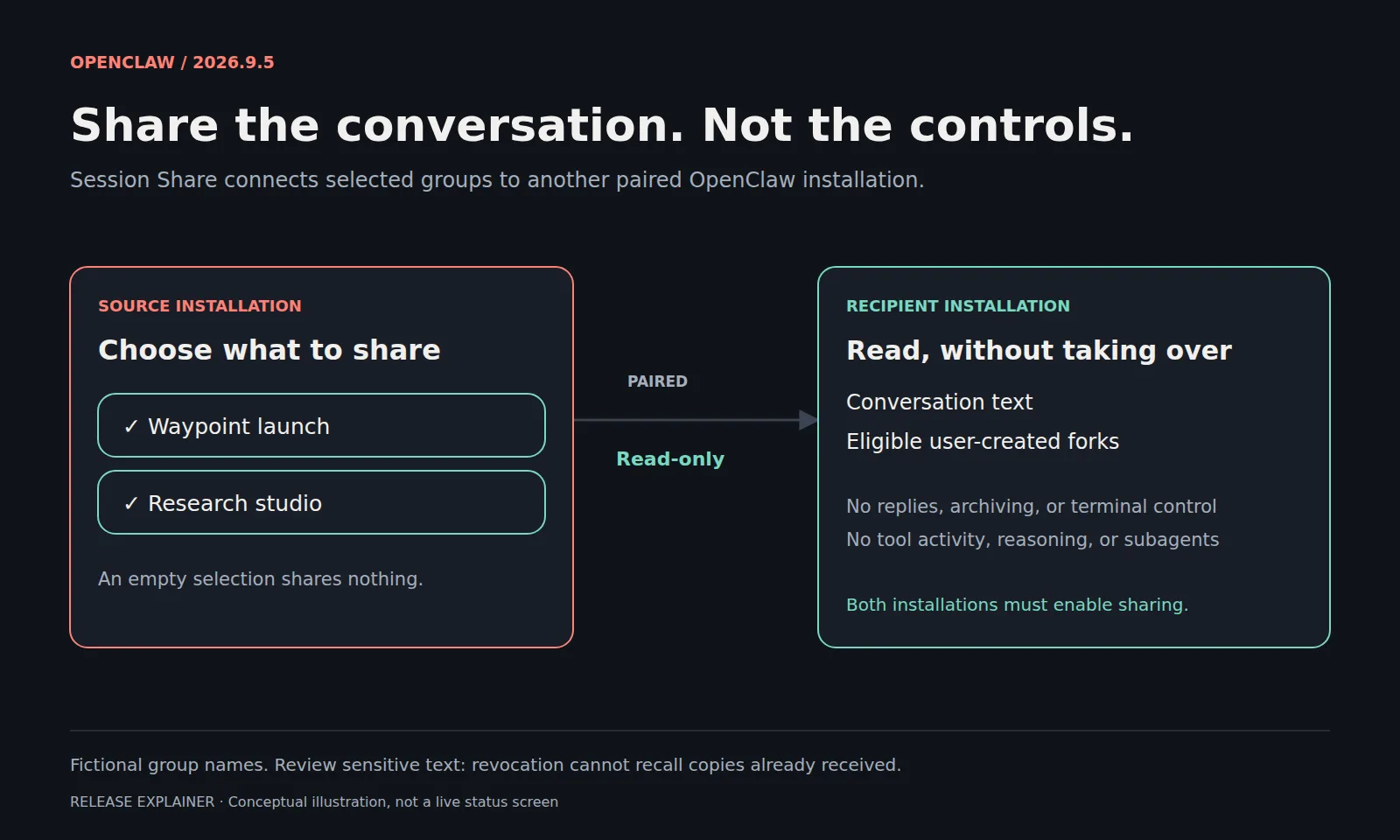
Installing, reloading, updating, or removing a plugin no longer takes the whole installation offline. Session Share hands a chosen group of conversations to a teammate on another paired installation as text they can read but not continue. Updates now validate the next version against a private copy of the setup while the current Gateway keeps running. The conversation database changes in this release even with archiving switched off, so a verified backup before upgrading is the only way back.
OpenClawverified
Claude Code 2.1.278 moved auto mode's safety checks to the server, where they are not billed
In auto mode a classifier inspects shell commands and network requests before they run, and those checks were separate model requests charged as token usage. From this version Claude Code asks the server to perform them inside the session's own requests, and does not charge for them when the server answers. The default covers Enterprise plans, Claude API accounts, and the AWS, Bedrock, Agent Platform, and Foundry paths, subject to each platform's rollout. Where the server's checks cannot reach a session, the earlier billing returns and a one-time notice says so.
Claude Codeverified
GitHub is retiring six Copilot models and has rebuilt the code review overview
Six models stop working across every Copilot surface on October 19, 2026, and each one has a named replacement. On Enterprise and Business the replacement enables itself unless an administrator has turned it off, so the remaining work sits in configuration that names a model in writing. Separately, Copilot code review reached general availability. Its overview comment now separates open findings from resolved ones and from issues it missed on an earlier pass, and every finding carries a title.
GitHub Changelogverified