GitHub Copilot now runs in JetBrains Air, and its cloud tasks use a Copilot plan instead of JetBrains credits
Copilot can now be picked as an agent in Air for local and cloud coding work, on an existing subscription. Air administrators can switch it off, but they cannot cap its spending in Air or see its usage in Air's analytics.
Source
GitHub Copilot is now available in JetBrains AirGitHub Changelog: Copilot · Original published November 3, 2026
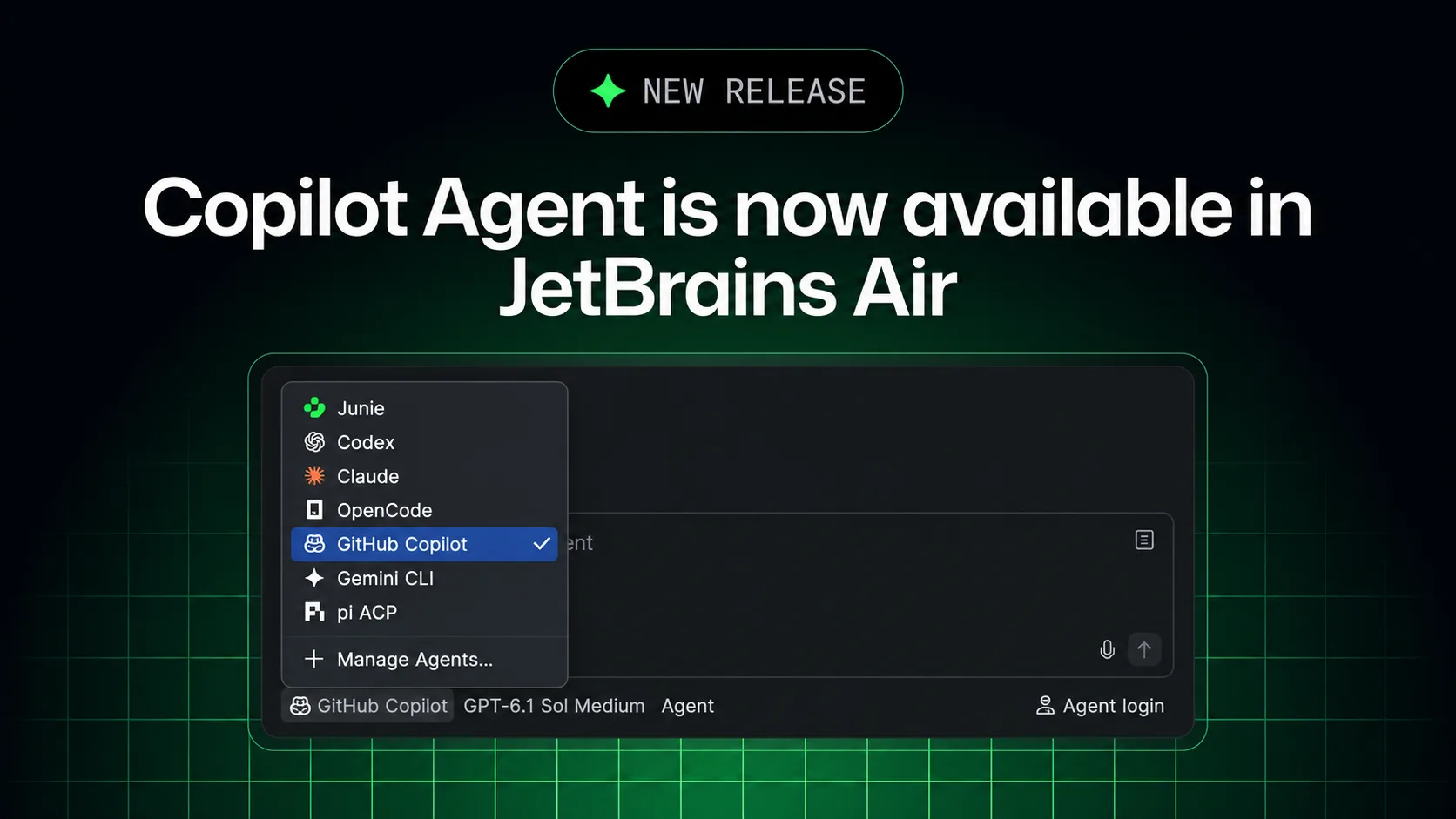
GitHub Copilot is now available as a coding agent in JetBrains Air, GitHub announced on November 3, 2026. Developers can hand it tasks in a JetBrains development environment (IDE) or in the cloud. Cloud tasks use a Copilot plan rather than JetBrains AI credits, so a team that already pays for Copilot does not spend those credits on this work.
How it works in Air
A coding agent takes a task, works through the steps, and returns changes for a person to review. In Air, a developer selects GitHub Copilot in the agent picker and connects a Copilot account. They can then follow several agent sessions at once and review the changes next to the code, with project context and IDE tools available to the agent.
The connection uses the Agent Client Protocol (ACP), which links coding agents to development tools. Air does not replace the GitHub Copilot plugin: GitHub says developers can use the two side by side and choose the workflow that suits them.
What cloud tasks require
Cloud tasks have stricter requirements than local ones. They need a JetBrains account in a business organization with Air Teams enabled, a Copilot subscription, and an Air administrator who has enabled Copilot. They start either from the browser or from the Air plugin in the IDE.
Each cloud task runs in a Docker container, an isolated software environment, on a fresh virtual machine. All traffic passes through a proxy server, and no state carries over between tasks. Copilot can build, test, and install packages there without changing the developer's own machine.
GitHub lists four limits on cloud tasks. It does not say how much of a Copilot plan a single task uses.
- Air may check a subscription or credits only when the cloud environment starts. If they are unavailable, the task fails and the session shows an error.
- A developer cannot choose whether a given task uses a personal Copilot plan or an organization's plan.
- Air's governance and analytics features do not include Copilot usage.
- Air administrators can disable Copilot through a governance policy, but they cannot set Copilot spending limits in Air.
Usage reports now separate own-key requests
GitHub also changed the Copilot usage metrics API on November 3, 2026. Enterprise and organization reports now separate bring-your-own-key (BYOK) usage, meaning requests sent to a company's or developer's own model provider or to a local model, from models hosted by Copilot. These requests used to blend into Copilot-hosted totals, because local and custom models often share names with Copilot models.
Existing totals do not change, and report days before this release do not include the new field for custom models. Local BYOK figures rely on client telemetry, so they undercount when telemetry is turned off.
„Tasks use your Copilot plan rather than JetBrains AI credits.“
Sources
Once a week, in your inbox
The whole week's news, gathered into one email. No ads, no passing your address on, one-click unsubscribe.
The address is used only for this roundup. It is not sold and not passed to anyone.
Related
Claude Code 2.1.314 added an instruction not to recreate existing games
Since version 2.1.314, Claude Code ships two sentences telling the model to build original games but not a copy of a specific existing one. Anthropic says the rule applies with Opus 5.5 and follows from its usage policy on intellectual property. Some developers report that work they hold the rights to is being refused.
Anthropicverified
Two Claude Code extension versions in Cursor's marketplace carried a backdoor
Versions 2.1.312 and 2.1.313 of Anthropic's Claude Code extension, served by Cursor's extension marketplace on October 29, plant an attacker's SSH key and try to keep a hidden tunnel open. Cursor says Anthropic did not build them. Removing the extension does not undo the damage, so Cursor has published a check and cleanup scripts.
Cursorverified
Claude Code 2.1.314 adds a setting that blocks file edits outside the working directories
A new permission setting makes the file-editing tools refuse any path outside the working directories, whatever mode the session runs in. The release also fixes a case in which a session could start without the organization's policy.
Anthropicverified