Google's WeatherNext 3 forecasts every hour at 5 kilometers, and you can query it from BigQuery
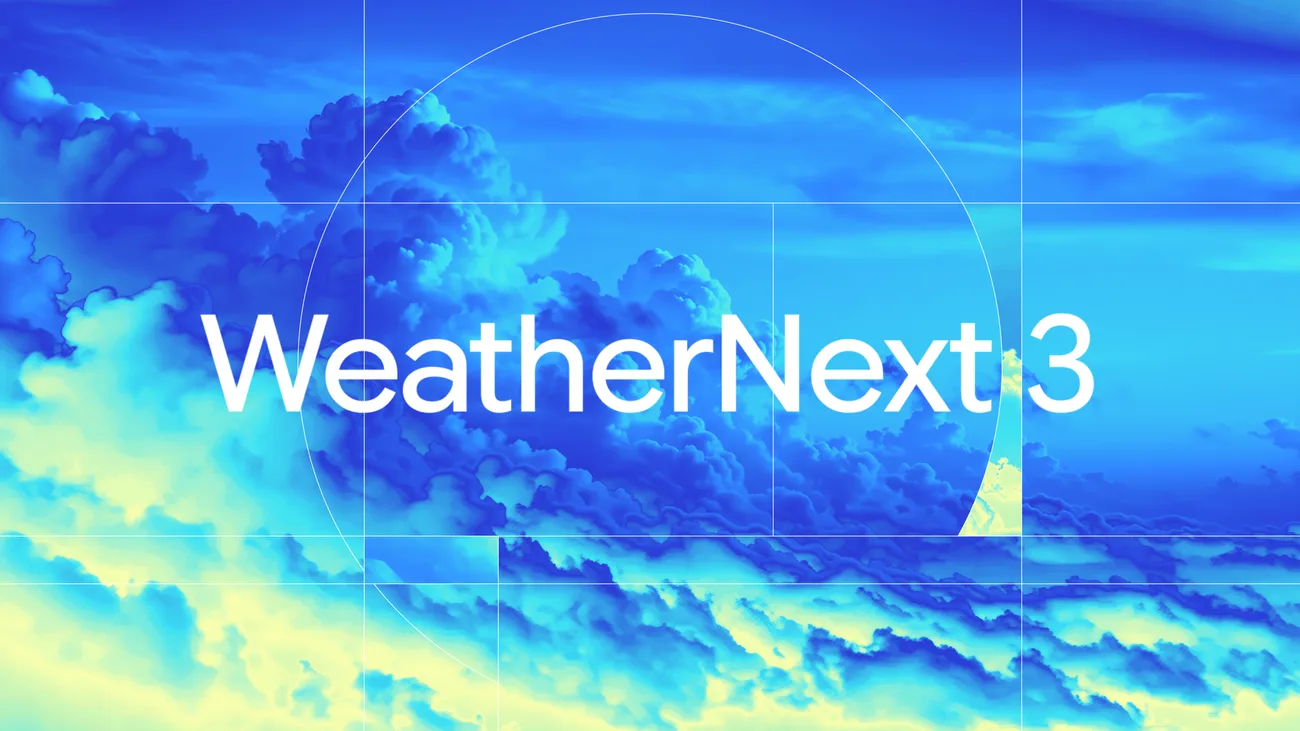
Google DeepMind and Google Research published WeatherNext 3 on September 3, 2026. It learns from live geostationary satellite mosaics rather than only from physics simulations that carry a six-hour data lag, which lets it produce a new forecast every hour instead of every six. Temperature and moisture come out on a 5-kilometer grid, where WeatherNext 2 worked on 25 kilometers. The forecast data is queryable in BigQuery and Earth Engine today, so this is a release you can build on rather than a paper you can read.
Source
Introducing WeatherNext 3, our most advanced and accurate global weather AI modelGoogle: The Keyword, AI · Original published September 3, 2026
Weather models are usually announced as research and reach developers much later. WeatherNext 3, published by Google DeepMind and Google Research on September 3, 2026, arrives the other way round: the forecast data is in BigQuery and Earth Engine on the day of the announcement, and bulk downloads sit in Google Cloud Storage.
What changed in the model
The headline change is what the model reads. Most AI weather models, including WeatherNext 2, train on output from numerical weather prediction systems, and those are physics simulations that carry a six-hour data lag. WeatherNext 3 ingests a mosaic of live global geostationary satellite data instead, so it can emit a new forecast every hour, each one grounded in the most recent observations.
The second change is grain. Key surface variables such as temperature and moisture come out at 5 kilometers, other surface variables at 10, and atmospheric variables such as wind speed at 25. Google describes the overall picture as roughly five times sharper than WeatherNext 2, which forecast on a 25-kilometer grid in six-hour increments. The model also trains directly on sparse weather station observations, which is what lets a global 5-kilometer grid account for a valley or a coastline.
- Hourly forecasts instead of six-hour increments.
- 5-kilometer grid for temperature and moisture, 10 kilometers for other surface variables, 25 kilometers for atmospheric ones.
- 100-meter wind speed, cloud cover, and solar radiation, aimed at wind and solar output estimates.
The precipitation numbers, and who measured them
Rain is where global models have always been weakest, and it is where Google puts its numbers. Against baselines, the Continuous Ranked Probability Score improves by up to 60% against NASA's IMERG, 30% against MRMS, and 10% against rain gauge measurements at early lead times. For people rather than researchers, Google states the day-ahead case separately: up to 50% more accurate precipitation forecasts when planning a day or more in advance.
Those comparisons are Google's own. The broader claim, that this is the most accurate global weather model to date, is attributed to independent live evaluations by Brightband, and that distinction is worth keeping. A vendor's evaluation of its own model and a third party's live leaderboard are two different kinds of evidence, and the post uses both.
Where you can reach it
Access is the part that makes this a tool rather than an announcement. Hourly global predictions are available with no model setup, and the same model starts powering weather in consumer surfaces on the same day.
- Query the forecast data in BigQuery and Google Earth Engine, or bulk-download it from Google Cloud Storage.
- The Google Maps Platform Weather API is served by the new model.
- Google Search, the Gemini app, and Google Maps start using it as of the announcement.
„The atmosphere will always retain a degree of unpredictability.“
Related
NeoMME's 260M encoder lands within 0.002 of a 3.75B model on ViDoRe v3
H company published NeoMME on September 3, 2026: a pair of multimodal encoders, at 260M and 800M parameters, released under Apache 2.0 and loadable through Hugging Face Transformers. On the ViDoRe v3 document retrieval benchmark the small one scores 0.523 nDCG@10, which is 0.002 behind ColQwen2.5 at roughly 14 times its parameter count. It also encodes about 51 pages per second on a single NVIDIA L40S, and the index it produces can be compressed from about 1.5 MB per page to 6 kB while keeping more than 95% of retrieval quality.
Hugging Faceverified
ChatGPT, Claude, Grok, and Gemini all had trouble inside the same two hours on September 3
On September 3, 2026, Anthropic logged elevated errors across Claude Mythos 5.1, Claude Fable 5.1, and Claude Opus 5, OpenAI logged elevated errors across ChatGPT and Codex, Grok showed users an error message, and third-party monitors recorded a likely Gemini API interruption. Four independent providers, one morning. No status page names a shared cause, and Amazon Web Services, Microsoft Azure, and Cloudflare reported nothing major. For anyone whose product calls more than one of these, this is the failure mode that a second provider does not fix.
Ars Technicaverified
OpenAI ships GPT-6 Astra at $10 per million input tokens, with enterprise access off by default
GPT-6 Astra went out on September 3, 2026, first to a limited set of organizations and then, over the following days, to ChatGPT Plus, Pro, Business, and Enterprise. In the API it answers to the name gpt-6-astra at $10 per million input tokens and $50 per million output tokens, and it is also served through Microsoft Azure and Amazon Bedrock. Enterprise workspaces do not get it automatically, because access is off by default at launch and an administrator has to turn it on. OpenAI also says the extra safety checks around this model can pause work in ChatGPT and Codex and stop it outright in the API.
OpenAIverified