Google's Gemini Decisions API scores up to 1,000 questions per request at $0.10 per million input tokens
Google released the Gemini Decisions API on November 11, 2026, powered by a new model, Gemini Decision 1. Instead of writing an answer, the model scores fixed options and returns a probability for each. Output is not billed, and one request can carry text, images, audio, video, and PDFs.
Source
Gemini Decisions API: Fast, calibrated multimodal decisionsGoogle: The Keyword, AI · Original published November 11, 2026
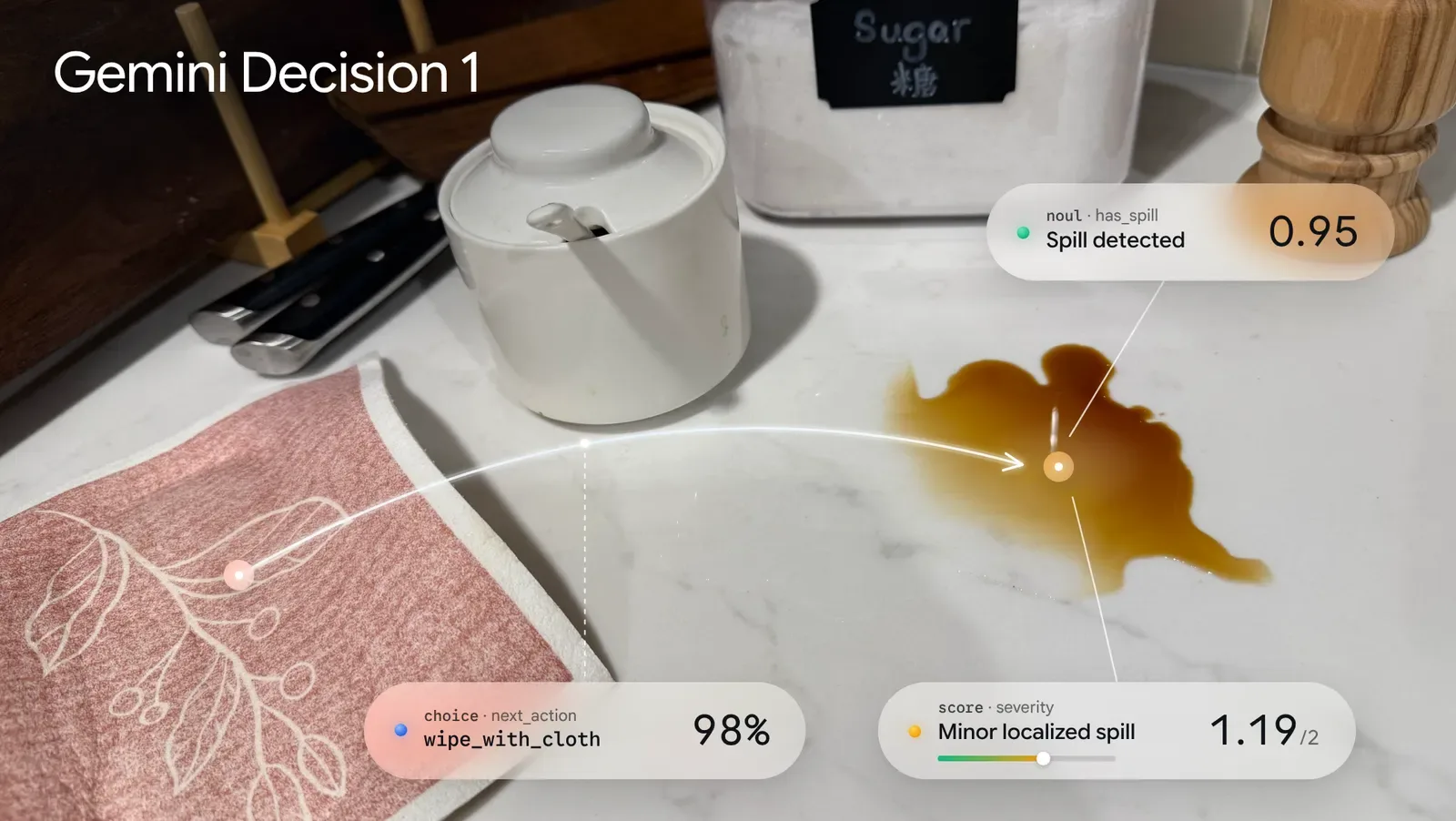
Google introduced the Gemini Decisions API on November 11, 2026. It is a new endpoint in the Gemini API and Google AI Studio for closed-set decisions: yes or no, a pick from a list, or a grade on a scale. It runs on a new model, Gemini Decision 1. A single request can carry one multimodal input of up to 256K tokens and up to 1,000 independent questions about it, at $0.10 per million input tokens with no charge for output.
What it does differently
A typical language model answers by generating text one token at a time. Gemini Decision 1 does not write an answer. It scores the candidate options in a single pass through the model and returns probabilities and a confidence score from 0 to 1 for every answer. Google says this lets code send uncertain cases to a fallback or to a human reviewer.
Questions come in three types, and one request can mix them. A yes/no question estimates the probability that a condition holds. A choice question picks from 2 to 255 options and returns the winner with a probability for each candidate. A score question grades the input on an ordered rubric and returns a weighted score with a probability for each level.
The input can combine text, images, audio, video, and PDFs, for example a call recording together with account data. For images and video, developers can set the resolution to control how much detail the model sees and how many tokens it uses.
Price and speed
Google prices Gemini Decision 1 at $0.10 per million input tokens and charges nothing for output. The shared input is billed once per request regardless of how many questions it carries, and each question adds only the tokens of its own instruction and criteria. Google says there are no charges for thinking tokens and no separate fees for audio transcription or for optical character recognition (OCR) in scanned documents. A no-cost tier in Google AI Studio is available for prototyping.
According to Google, end-to-end latency is 150 to 250 milliseconds, and for contexts up to 16K tokens it stays nearly flat whether a request carries 1 question or 100. Google also says the model is nearly five times cheaper than Gemini 3.5 Flash-Lite with the Interactions API across a shared benchmark suite. It adds that the model has the lowest calibration error, meaning the confidence it reports comes closest to how often it is actually right. These are Google's own measurements; no independent test was available for this article.
Google says its own products already use the API. Gemini Notebook routes incoming queries to a model tier and thinking level with it, which Google says cuts latency for everyday queries by up to 40%. Google Search uses it as a safety layer for tools built on the Model Context Protocol (MCP), a standard for connecting models to outside services. Integrations are rolling out in OpenRouter, LangChain, Vercel, LiteLLM, Pydantic AI, Pipecat, LiveKit, and OpenCode, and Google says Gemini in Google Cloud will follow soon.
Once a week, in your inbox
The whole week's news, gathered into one email. No ads, no passing your address on, one-click unsubscribe.
The address is used only for this roundup. It is not sold and not passed to anyone.
Related
OpenAI opens healthcare model configurations to API organizations at base-model token prices
OpenAI has added four healthcare configurations of its models to the API. They combine healthcare-specific instructions with search over a dedicated index of medical sources. Token prices match the base models, but OpenAI calls the pricing promotional and search is billed separately. Access alone does not permit processing protected health information.
OpenAIverified
llama.cpp can now quantize a model to a file size you set and choose the bit mix itself
Build b12669 adds an option to llama-quantize that takes a target file size and decides how many bits each part of the model gets. The author reports matching or beating the standard presets in 93% of tests. A second contributor found an improvement on several models and a clear loss on one.
llama.cppverified
Anthropic will retire Claude Opus 4.5 on January 22, 2027, and points developers to Opus 5.5
Requests to Claude Opus 4.5 will fail from January 22, 2027, on the platforms Anthropic runs, including when the model is set in Claude Code. Opus 5.5 is cheaper per token but needs code changes. On the same day Anthropic opened a beta that lets eligible organizations use its most capable models without Anthropic keeping their prompts.
Anthropicverified