NVIDIA releases Kumo Tabular, an open model that predicts table rows without training and tops four benchmarks
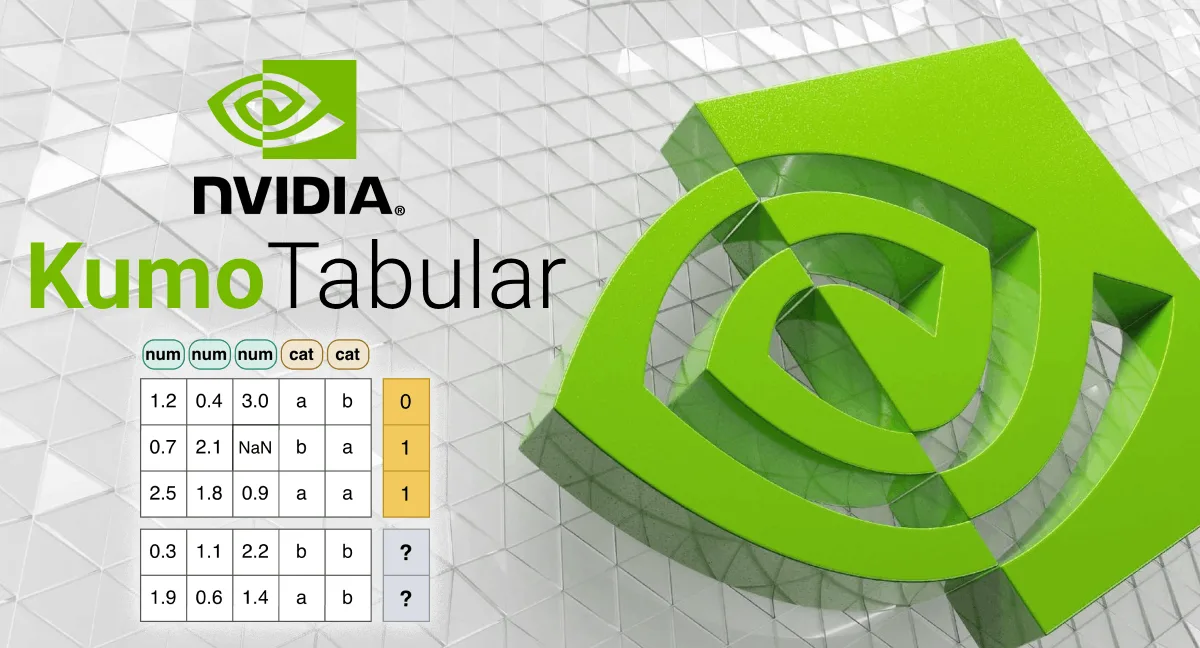
Kumo Tabular reads a table of labeled rows and returns predictions for new rows in a single forward pass, with no training, no tuning, and no feature engineering. NVIDIA published it on September 29, 2026 in three sizes from 28 million to 215 million parameters, under the OpenMDW-1.1 license that allows commercial use. By NVIDIA's own measurement it ranks first on TabArena, BeyondArena, TALENT, and ScoringBench. It handles numeric and categorical columns only, and it needs a CUDA GPU.
Source
NVIDIA Kumo Tabular Sets a New Accuracy-Efficiency Frontier for Tabular PredictionHugging Face Blog · Original published September 29, 2026
Predicting churn, default, demand, or price from a table has been the job of gradient-boosted trees for two decades, and each new question meant collecting labels, engineering features, and searching hyperparameters. NVIDIA's Kumo Tabular, released on September 29, 2026 on the Hugging Face blog, applies in-context learning to that job. You hand it labeled rows as context and unlabeled rows as queries, and it returns class probabilities or numeric predictions without updating a single weight.
What it does
The model is a Transformer built around the structure of a table. Column attention learns what a value means within its column, row attention learns how features interact, and a final stage lets query rows attend to the labeled context. Because the context never looks at the queries, its keys and values are computed once and reused for follow-up predictions. For regression the head returns 999 quantiles, which give both a point prediction and an uncertainty estimate.
Kumo Tabular was pretrained only on artificial tables sampled from structural causal models. The three sizes saw about 35, 71, and 137 million such tables, in three stages that grew the context from 1,024 rows to 60,000 rows, always with up to 100 columns. Classification and regression are separate models.
Three sizes, one license
The weights sit on Hugging Face under the OpenMDW-1.1 license, which permits commercial use. The library that runs them, structured-data-models, is under Apache 2.0 and installs with pip install structured-data-models.
- Sizes: Small, Medium, and Large, from 28 million to 215 million parameters.
- Classifier files of roughly 110, 246, and 855 megabytes, and regressor files of roughly 114, 250, and 863 megabytes, converted by us from the byte sizes listed on Hugging Face.
- Python 3.11 and PyTorch 2.7 or newer, with NVIDIA recommending cuDF to keep dataframe operations on the GPU.
- No inference provider on Hugging Face serves the model; you run it on your own CUDA GPU.
The numbers NVIDIA reports
According to NVIDIA's measurement, Kumo Tabular ranks first on TabArena with an ELO of 1950 while running 17 times faster than LimiX-2, on a single RTX 6000 Pro under a uniform evaluation setup. On BeyondArena it reaches an ELO of 1418 with an Improvability score of 7.78%, again first. On TALENT it takes the top overall ranking with average ranks of 6.67 for classification accuracy, 3.98 for classification log-loss, and 4.22 for regression RMSE. On ScoringBench, a benchmark for predictive distributions, the Large and Medium models place first and second.
These are the vendor's figures against the public leaderboards, and no independent replication existed when this was written. The comparison set includes tuned gradient-boosted trees, AutoGluon, and the recent tabular foundation models.
Limits to read first
Kumo Tabular works on numeric and categorical columns only; text, images, and timestamps have to be turned into features through the library's preprocessing recipes. A single forward pass covers up to 10 classes, and the library extends that with error-correcting output codes. NVIDIA warns that accuracy may degrade on tables far beyond the training ranges, or when the query rows come from a different distribution than the context rows, and asks you to validate on held-out data before deployment. The training recipe and the data generators are promised for later, without a date.
„With no training, no tuning, and no feature engineering.“
Sources
Related
Anthropic says GLM-5.3 builds working browser exploits and its safeguards come off for about $4,400
Anthropic's Frontier Red Team published its analysis of GLM-5.3, the open-weight model from Zhipu AI, on September 29, 2026. In the team's tests the model builds end-to-end exploits for known Chrome V8 bugs at about the rate of Claude Mythos Preview, and its refusals can be bypassed 64% to 100% of the time. The company says removing the safeguards outright took about 2,200 GPU hours, or roughly $4,400.
Anthropicverified

OpenAI ships GPT-6.1 Sol at GPT-6 Sol prices and adds a $500 Pro plan with Ultrafast
GPT-6.1 Sol costs $2 per million input tokens and $10 per million output tokens, the same as GPT-6 Sol, and its cached input drops to $0.10. OpenAI says the model comes close to GPT-6 Astra on coding and computer use at a fifth of Astra's price. The larger GPT-6.1 Astra did not ship. A new Pro 500 plan at $500 a month is the only Pro tier that includes Ultrafast, and Pro 200 returns with a smaller allowance.
OpenAIverified
Anthropic releases Claude Sonnet 5.5, with input and output tokens at half the Opus 5.5 price
Claude Sonnet 5.5 keeps Sonnet 5's prices: $2 per million input tokens and $10 per million output tokens. That is half of what Opus 5.5 charges, while Anthropic's own benchmarks put the two models within a few points of each other. Code that turns thinking off needs a change before the switch, because the old setting now returns an error.
Anthropicverified