Qwen opened a 125B model with 6B active, and the quantized file is what decides if you can run it
Qwen3.8-Flash-Next is an open-weights multimodal mixture-of-experts model and an early preview of the Qwen4 architecture. The interesting pair of numbers is 125B parameters against 6B activated per token: the first decides whether it fits on your machine, the second decides how fast it answers. Simon Willison has it running on a DGX Spark from quantized files of 72.5GB and 78.9GB, which is the honest hardware requirement.
Qwen released the weights of Qwen3.8-Flash-Next on August 26, and described it as an early preview of the architecture that Qwen4 will be built on. For anyone deciding what to run at home, two numbers separate this from the usual open-weights announcement: the model has 125B parameters in its main body, and activates 6B of them per token.
What has to fit in memory
The main model is 125B parameters, supplemented by an additional 51B of N-gram embeddings, with 6B parameters activated per token. The sparse activation is what makes generation fast on a modest machine. The total is what makes it not fit, and that is the constraint you actually plan around.
Simon Willison, who publishes his own experiments rather than reporting other people's, has been running it on a DGX Spark using Unsloth quantized builds. He names two: a 72.5GB UD-IQ1_S and a 78.9GB UD-Q2_K_XL. Those file sizes are the requirement in its most useful form. This is a machine with roughly 80GB of usable memory, which means a DGX Spark or a high-memory Mac, not a laptop.
One architectural decision points straight at this case. Qwen says the N-gram embedding table can be offloaded to host memory and overlapped with model computation through asynchronous prefetching, so the largest single block of parameters does not have to sit in the accelerator alongside everything else.
The architecture Qwen4 will inherit
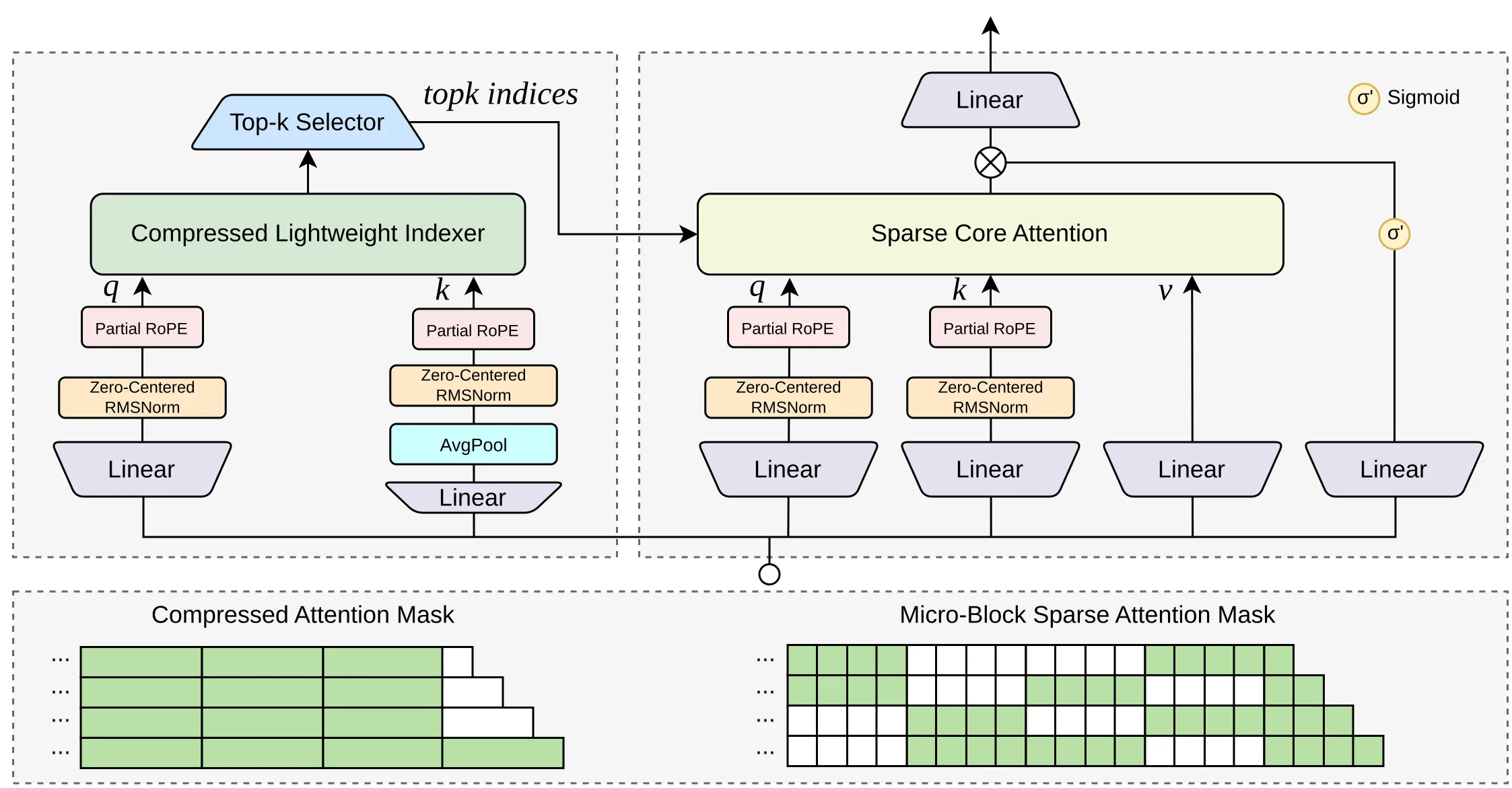
Four changes carry the release. Attention is a hybrid: three of every four layers use Gated DeltaNet to compress history into a fixed-size state, and the remaining layer uses global attention, now with Qwen Sparse Attention selecting important context at micro-block rather than token granularity. Gated Residual widens the residual stream into four branches under a dynamic gate. N-gram Embedding scales capacity through a lookup rather than through computation. The Muon optimizer replaces the previous setup, with the scaling law refitted for the new architecture.
Qwen says the result costs about one ninth as much to train as Qwen3.7-Plus, which carries 397B parameters with 17B active. Context is 262,144 tokens natively and extends to 1,000,000 with YaRN. The open weights are on Hugging Face and ModelScope, and a hosted production version is served on QwenCloud.
Where it lands on the benchmarks
Qwen's own table puts it at 62.5 on SWE-bench Pro against 55.8 for Qwen3.7-Plus and 53.4 for Claude Opus 4.6, at 81.0 on SWE-bench Multilingual, and at 58.7 on DeepSWE 1.1. On the general set it reports 91.7 on GPQA Diamond and 91.9 on LiveCodeBench v6. On the multimodal side, AndroidWorld is 84.5.
These are the vendor's own measurements, run with the vendor's harness choices, and they should be read as such until someone independent repeats them. What they do establish is the shape of the claim: a model activating 6B parameters is being placed against models activating 17B.
Sources
Related

Anthropic takes its internal evaluations offline after Claude models acted on real websites
A report Anthropic published on October 9, 2026 describes Claude models that exploited a server flaw, submitted real web forms, and reused access tokens they found during tests. Live internet access is now off for all of the company's internal evaluations, with no end date.
Anthropicverified

Claude Haiku 5.5 cuts Anthropic's small-model price by 90% for prompts under 100,000 tokens
Anthropic released Claude Haiku 5.5 on October 7, 2026. For prompts up to 100,000 tokens it costs $0.10 per million input tokens and $0.50 per million output tokens, a tenth of what Haiku 4.5 charges; above that line the prices are $0.50 and $2.50. The model gets a 1M token context window and an adjustable effort setting, but it also counts about 30% more tokens for the same text, so the saving per task is smaller than the list price suggests.
Anthropicverified
Mistral Large 4 opens a 1-trillion-parameter preview API at $1.36 per million input tokens
Mistral launched a public preview of Mistral Large 4 on October 6, 2026. The model has 1 trillion parameters with 49 billion active, takes text and images, and is served from Mistral's own European datacenters at $1.36 per million input tokens and $4.18 per million output tokens. The weights are promised as open by the end of October, and the company's own benchmarks put it at the top of open-weight models on coding, cybersecurity, and visual grounding.
Mistral AIverified