Claude Ship can approve GitHub pull requests on its own where a team's policy allows it
Anthropic's new set of agents reviews code changes on GitHub, fixes them, and can approve them without waiting for a person. A team decides how far that goes by writing a policy file. Usage is billed by tokens on top of the plan, and the documentation lists several setups in which a change merges with no human review.
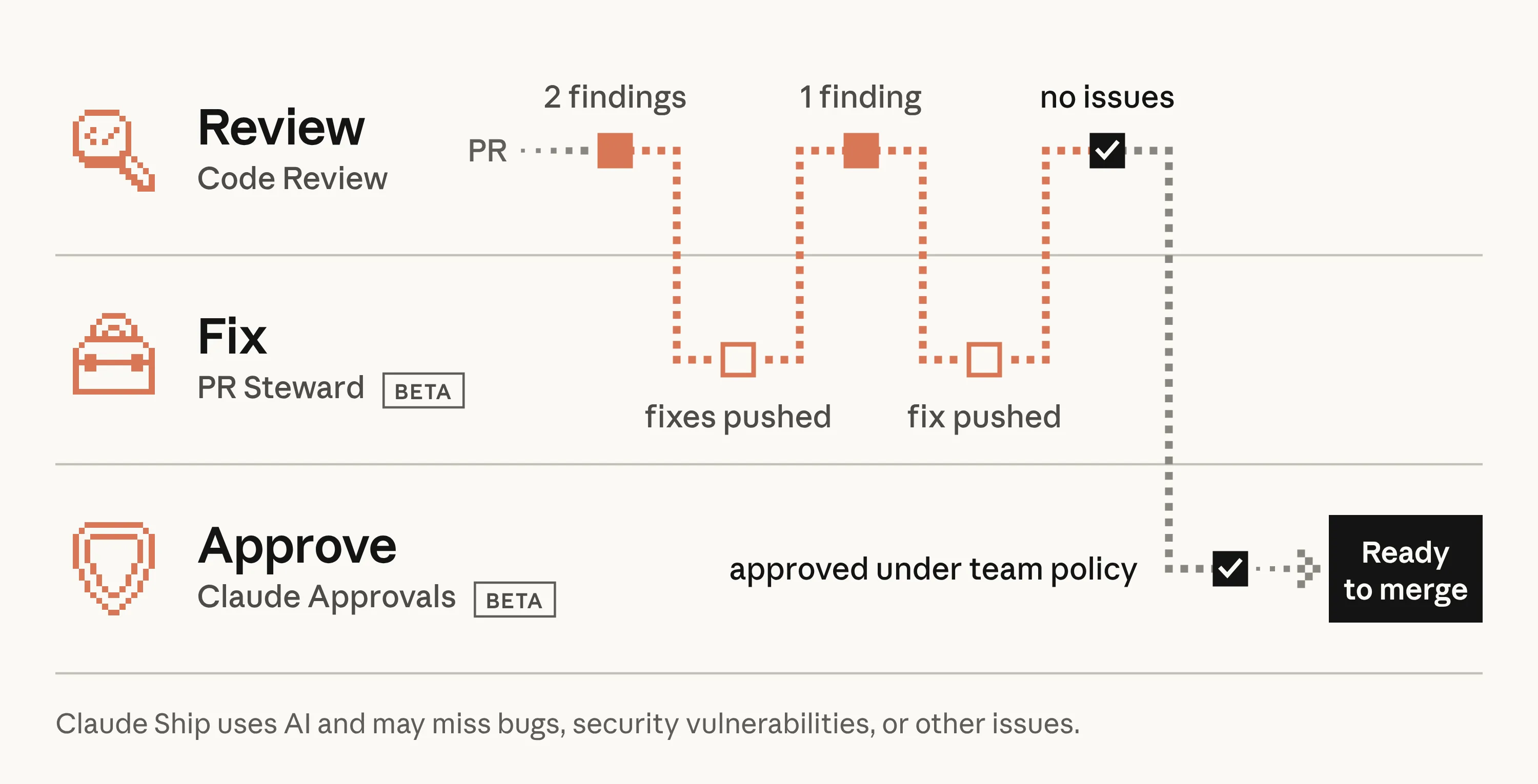
Anthropic released Claude Ship on November 23, 2026, a set of agents that take a pull request on GitHub through review, fixes, and an approval decision. A pull request is a proposed code change that is normally checked by another person before it joins the main code. With Claude Ship, Claude can give that approval itself wherever the team's written rules permit it. The service is for Claude Team and Enterprise plans, and two of its three agents are in beta.
Code Review, which was already generally available, looks for logic errors, security vulnerabilities, and corner cases that break. PR Steward works on failing checks, merge conflicts, and review comments. It pushes fixes and then says what it changed and how to undo it. Anthropic says Steward is designed not to approve or merge pull requests.
Claude Approvals makes the approval decision. It follows a policy file, .claude/approvals.yml, that sets how many people must approve a change to a given part of the code and where Claude may approve. A team could require two people for billing code and let Claude clear routine changes. Anthropic recommends that most customers begin in observe mode, in which the check shows what the policy would decide and Claude doesn't approve anything.
Individual developers also get a /ship command in Claude Code 2.1.330 or later. It can commit the work, open the pull request, review it, and handle the feedback that follows, while the merge stays with the developer. The documentation warns that the command can commit every uncommitted file and spots secrets by file name only, so the contents need a check first.
When a change merges with no human review
Anthropic's documentation describes several ways this can happen. The Claude Approvals check blocks a merge only where the team makes it a required check in GitHub. If a GitHub rule asks for one approval, Claude's can count as that approval. With auto-merge and a policy that does not require a person, a change can merge without anyone acting.
Approval also does not imply review. A rule that says claude: approves starts no Code Review by itself, so Claude can approve a change that nothing has reviewed. Once the prerequisites are met, anyone who can merge a policy file into the default branch can turn Approvals on. An owner of the Claude organization can turn it off for everyone.
What it costs
There is no flat price. Each agent is billed on tokens, separately from the usage included in the plan, and observe mode is billed as well. PR Steward has no spending limit of its own until an admin sets one. Turning off usage credits, which pay for this work, does not stop an agent that is already on. Running /ship counts as regular Claude Code usage.
Eligible Enterprise organizations have until January 15, 2027, to claim at least $10,000 in credits, which last 30 days from the claim. Claude Ship is not available to organizations that use Zero Data Retention, the HIPAA configuration, or customer-managed encryption keys.
Anthropic reports that on its Claude Code team, where Claude's review is one layer of the process, merged pull requests more than doubled from June to September while the share later reverted fell by more than 40%. The announcement includes no independent measurement.
„PR Steward has no spend limit of its own until you set one.“
Sources
Once a week, in your inbox
The whole week's news, gathered into one email. No ads, no passing your address on, one-click unsubscribe.
The address is used only for this roundup. It is not sold and not passed to anyone.
Related
GitHub will bill organizations for Copilot code review by default starting December 30
GitHub said on November 25, 2026, that Copilot code review for licensed members will be billed to the organization that owns the repository whenever no billing choice has been saved. The change applies to Copilot Business and Copilot Enterprise. Administrators who want to keep the current arrangement have to select Member before December 30, 2026.
GitHub Changelogverified
OpenClaw 2026.11.10 turns on Deep Research by default and lets users take over the agent's browser
OpenClaw's new release includes Deep Research, which looks through several sources and returns a report with quotes and gaps marked. It is on by default and uses the models the user has already set up. A second addition lets a user take over a browser tab during a sign-in, although the agent can still capture the page. The optional Knowledge plugin stores memory in local Markdown files.
OpenClawverified

AWS WAF will bill each protected resource from February 2027 and drop its fees for rules
Amazon is changing how it charges for AWS WAF, the firewall that filters traffic to web applications. Rules and rule sets become free, while every protected resource gets an hourly fee. Sites with many rules on a few resources stand to pay less, and companies that cover many resources with one rule set can pay several times more.
AWSverified